

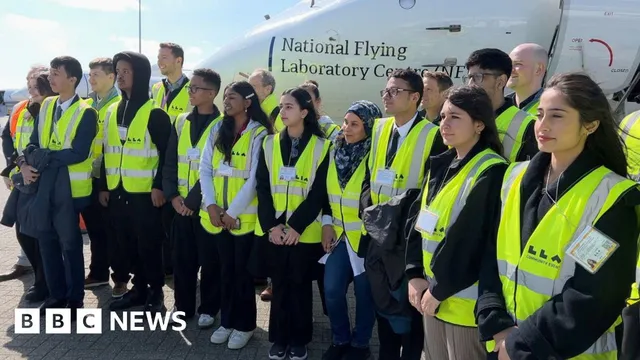
Students experience G-force aboard UK’s only flying laboratory
Students experience G-force aboard UK’s only flying laboratory
- A group of Luton A-level students participated in a unique aviation lesson aboard the UK's only flying laboratory aircraft.
- During the flight, students experienced various forces and learned about flight mechanics through real-world application.
- The program aimed to inspire young people from under-represented backgrounds to explore careers in aviation.
Story
A group of A-level students from Luton, England, recently had a unique opportunity to participate in a hands-on aviation lesson aboard the National Flying Laboratory Centre, the only flying laboratory aircraft in the UK. This event took place as part of a competition aimed at encouraging young people from under-represented backgrounds to consider careers in aviation. The flight occurred from London Luton Airport to Cranfield University in Bedfordshire, where students experienced firsthand the science behind flight mechanics and the sensation of G-force during a series of carefully controlled maneuvers. The aviation lesson involved explaining vital concepts such as lift, drag, and stability, which students could only fully understand through real-life experience. During the flight, participants felt various forces acting on their bodies; some moments included increased weight in their seats, while others experienced brief periods of near-weightlessness. This immersive approach helped the students connect theoretical knowledge to practical application, solidifying their interests in aviation careers. Eighteen-year-old Maria described the experience as unforgettable, labeling it a once-in-a-lifetime opportunity. Similarly, seventeen-year-old Leonardo expressed how this has reinforced his ambition to become a commercial pilot. He acknowledged the importance of experiencing flight dynamics firsthand, stating, “You can study it [the mechanics of flight] on a computer screen, but feeling it is definitely important.” Sixteen-year-old Mahdi also expressed excitement about being chosen for such an experience, highlighting its uniqueness compared to standard passenger flights. The day culminated with a celebratory event at Cranfield University, where the students were given a behind-the-scenes tour of aerospace facilities. Louise Hanlon, the community and social impact manager at London Luton Airport, emphasized the significance of investing in young talent from diverse backgrounds. She explained that these budding aviation professionals are crucial for the airport's future and stressed the importance of providing diverse opportunities to inspire young people to explore the variety of careers within the aviation industry. By offering hands-on learning experiences, organizations hope to bridge the gap between classroom education and real-world applications, potentially fostering a new generation of aviation experts.
Context
The report titled "educational aviation experiences in the UK" explores the diverse opportunities available for aspiring aviators, students, and enthusiasts to immerse themselves in aviation education within the United Kingdom. The UK has a rich heritage in aviation, marked by innovations and milestones that have shaped the industry globally. This report examines the various educational institutions, programs, and experiences that cater to individuals interested in pursuing careers in aviation, whether as pilots, engineers, or in air traffic control and management. From prestigious universities offering aeronautical engineering degrees to flight schools that provide commercial pilot training, the UK is home to institutions that are highly regarded in the field of aviation education. A key aspect of education in aviation revolves around practical experience, which is critical for developing the necessary skills to operate in this dynamic sector. The United Kingdom offers a multitude of flight training organizations (FTOs) and universities that provide hands-on learning through simulator training and actual flight lessons. These institutions often boast state-of-the-art facilities and equipment, ensuring that students receive valuable, real-world insights that augment their theoretical learning. Additionally, many flight schools and universities collaborate with airlines and industry partners, offering internships and work placement opportunities that further enhance the educational experience by exposing students to the operational facets of the aviation industry. Alongside traditional aviation education pathways, the UK is also known for its diverse aviation experiences available to the public, fostering a passion for aviation among non-aviators. Throughout the country, various airshows, museum exhibits, and interactive experiences are designed to inspire interest in aviation. Events such as the Farnborough International Airshow and Goodwood Festival of Speed not only showcase industry advancements but also facilitate educational outreach, enhancing the understanding of aviation technology and regulations. Furthermore, aviation museums such as the Imperial War Museum Duxford provide comprehensive exhibits that educate visitors on the historical significance and technological evolution of aircraft and aviation-related developments over the years. Finally, the UK government and various aviation organizations invest in initiatives to promote aviation education at an early age, recognizing its importance in developing the next generation of aviation professionals. Programs aimed at school children, such as flight simulations, workshops, and educational resources about aviation careers, are essential in capturing the imagination of young people and encouraging them to pursue studies in this field. Such initiatives contribute to addressing the skill shortages in the aviation sector and ensure that the UK remains a leader in global aviation education.


