

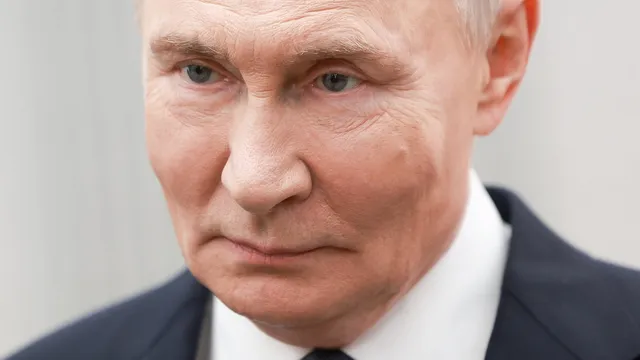
Putin threatens military action to seize full control of Donbas region
Putin threatens military action to seize full control of Donbas region
- Vladimir Putin has declared that Russia aims to take full military control of Ukraine's Donbas region unless Ukrainian troops withdraw.
- This declaration coincides with the ongoing conflict that escalated with Russia's invasion of Ukraine in February 2022.
- The Ukrainian government, led by President Volodymyr Zelensky, has firmly dismissed the demand to concede any territory to Russia.
Story
In recent developments, Russian President Vladimir Putin has openly declared his country's intention to gain complete military control over Ukraine's Donbas region, comprised of the Donetsk and Luhansk areas. This announcement comes against the backdrop of a full-scale invasion that began in February 2022, intensifying an ongoing conflict that has persisted for over eight years. Putin's remarks, which were aired on Russian state television, emphasized that Ukrainian forces must withdraw from the area, or else Russia will resort to armed conflict to reclaim the territories. Moscow's claim over the Donbas aligns with its objective to solidify control over various regions of Ukraine it has occupied. Presently, Russia holds approximately 19.2% of Ukrainian territory, including Crimea, which it annexed in 2014, all of Luhansk, and a significant portion of Donetsk. About 5,000 square kilometers of Donetsk remains under Ukrainian governance. In previous talks with the United States regarding a possible peace deal, Russia insisted on its demand for recognition of its control over all of Donbas, further complicating conflict resolution efforts in the region. The response from Kyiv has been resolute; Ukrainian President Volodymyr Zelensky has consistently maintained that his nation will not concede any territory that Russia has not officially secured through military means. Zelensky has also remarked that granting any sort of reward to Russia for its aggressive actions would undermine the principles of international law. This steadfast resistance from Ukraine underscores a broader commitment to territorial integrity amidst external pressures. As diplomatic negotiations continue, it remains unclear how the standoff will evolve. The international community largely views Russia’s actions in Ukraine, including the recent declarations about Donbas, as aggressive and illegitimate. The push for further diplomatic engagements, as indicated by recent meetings between Putin and U.S. envoys, points to an ongoing struggle to navigate the complexities of peace talks while managing the realities on the ground.
Context
The Ukraine-Russia conflict has deep historical roots that date back centuries, intertwined with national identity, cultural ties, and geopolitics. The historical context of the conflict can be traced to the complex relationship between Ukraine and Russia, influenced by the legacy of the Soviet Union, which existed from 1922 until its dissolution in 1991. Under Soviet rule, Ukraine was often seen as a crucial part of the Soviet state, contributing significantly to its economy while also facing profound cultural suppression. This historical backdrop set the stage for Ukraine's struggle for independence and national identity following the collapse of the Soviet Union, culminating in its declaration of independence in 1991. The post-Soviet period was marked by a newfound sense of nationalism in Ukraine, accompanied by an effort to establish its sovereignty and distance itself from Russian influence, which was perceived as oppressive by many Ukrainians. An important turning point in the Ukraine-Russia relationship occurred during the early 21st century, especially with the election of Viktor Yanukovych in 2010. His administration's inclination toward strengthening ties with Russia led to widespread protests in Ukraine, known as the Euromaidan movement, which sought closer integration with the European Union. The movement gained momentum and led to the ousting of Yanukovych in early 2014. In response to the political upheaval, Russia annexed Crimea in March 2014, triggering widespread condemnation from the international community. This annexation was viewed as a violation of international law, further straining relations and increasing tensions between Russia and Ukraine, and leading to the ongoing conflict in Eastern Ukraine where pro-Russian separatists declared independence in the Donetsk and Luhansk regions. The military conflict that arose from these developments has been both intense and protracted, characterized by irregular warfare, political maneuvering, and a humanitarian crisis that claims thousands of lives. Ceasefire agreements, such as the Minsk agreements, have been attempted, yet violence has persisted, illustrating the complex interplay of local, regional, and international factors. Russia's involvement has raised significant concerns about security in Europe and NATO's eastern flank. The West has responded with a series of sanctions against Russia, emphasizing the need for a collective stance on global security based on respect for national sovereignty and territorial integrity. As of December 2025, the conflict remains unresolved, with ongoing negotiations and occasional flare-ups in violence. The historical context of the Ukraine-Russia conflict reveals a narrative marked by struggles for power, identity, and autonomy that extend beyond mere territorial disputes. Moving forward, understanding the past is essential for seeking a fruitful resolution to the conflict, promoting dialogue that respects the historical aspirations of both nations while addressing the needs of the affected populations. Ultimately, any resolution will require not only political will from both sides but also a reassessment of historical grievances and contemporary realities that influence the current state of affairs in the region.


