

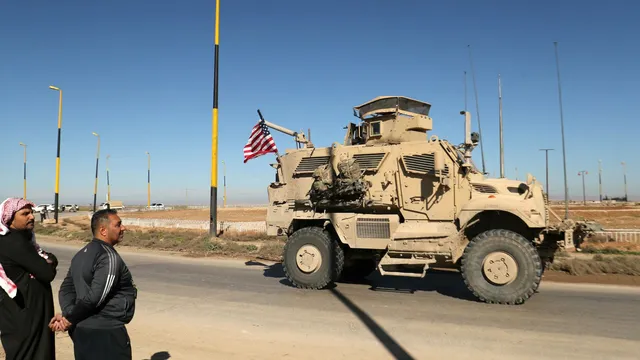
US military starts withdrawal from key base in Syria
US military starts withdrawal from key base in Syria
- U.S. forces have begun withdrawing from the Qasrak base in northeastern Syria, with equipment and personnel redeployed to Iraq.
- The pullout is part of a broader strategy to reduce U.S. military involvement in Syria amidst rising concerns about ISIS.
- The withdrawal signals a critical shift in U.S. engagements in the Middle East and its relations with regional forces.
Story
In the ongoing military operations in Syria, U.S. forces have commenced a significant withdrawal from the Qasrak base situated in northeastern Syria. This movement was confirmed by officials on February 24, 2026, when a convoy of trucks transporting military vehicles and equipment was observed moving toward the Iraqi border. This strategic pullout indicates a larger trend of reducing U.S. military presence in the region, a decision that has reportedly been under consideration since January 2026. The operations saw U.S. forces moving personnel and heavy machinery from the Qasrak base, which is the largest U.S. military installation in Syria. Local sources and Iraqi security officials indicated that this withdrawal process started on February 22, 2026. It is believed that sensitive high-tech equipment is also being transferred, a process that will require multiple weeks to complete. Both the Kurdish-led Syrian Democratic Forces (SDF) and the local Syrian army have witnessed increased territorial control in the region following this decision. This military adjustment marks a pivotal evolution in U.S. foreign policy in the Middle East, particularly involving the strained dynamics between U.S. forces and regional powers. With the Syrian government regaining control over territories previously held by U.S.-backed Kurdish forces, the primary mission for U.S. troops has shifted. Their main objective has been to counter the threats posed by the Islamic State as they try to prevent a resurgence of this extremist group, which lost its last territory in Syria in 2019. However, recent clashes between Syrian government forces and the SDF resulted in many detained ISIS affiliates escaping from detention centers, raising alarm about a potential rise in IS activities. The decision to withdraw from the Qasrak base is thus not only a logistical operation but also a reaction to evolving security concerns regarding ISIS and the stability of the region. The completion of this withdrawal signals a period of transition for U.S. military involvement in Syria, possibly aligning more with Iraqi and Syrian governmental tactics to assist in anti-terrorism efforts while contending with the political fallout of previous alliances with the SDF.
Context
The historic context of the U.S. military withdrawal from Syria is rooted in a complex interplay of geopolitical interests, domestic pressures, and evolving regional dynamics that have unfolded since the onset of the Syrian Civil War in 2011. The United States intervened in the conflict with the primary objective of eliminating the Islamic State (IS), which had gained significant territory and posed a threat not only to Syria and Iraq but also to U.S. national security interests and allies in the region. The U.S. military's engagement included airstrikes, special operations forces, and support for local partner forces, particularly the Syrian Democratic Forces (SDF), comprising Kurdish and Arab factions. This role became even more pronounced after the IS peak in the region, leading to the liberation of key territories and the degradation of IS's operational capabilities by late 2017, paving the way for a potential withdrawal of U.S. forces. However, the decision to withdraw U.S. military personnel was met with intense scrutiny and debate, both domestically and internationally. Critics argued that a hasty withdrawal could undermine the achievements against IS and destabilize the region, allowing for the resurgence of extremist groups. Furthermore, the U.S. presence in Syria also served as a counterbalance to Iranian influence, which has sought to expand its reach through its support for the Assad regime, raising concerns among U.S. allies such as Israel and Gulf states. Consequently, the withdrawal is not merely a tactical maneuver but highlights broader implications for U.S. foreign policy in the Middle East, the future of Syrian sovereignty, and the balance of power among regional actors. The implications of this withdrawal are profound and far-reaching. On one hand, the U.S. faced pressure to reduce its military footprint, reflecting a shift towards prioritizing domestic issues and recalibrating foreign policy strategies to focus on great power competition, particularly with Russia and China. On the other hand, the vacuum left by U.S. forces has heightened uncertainty and led to concerns over the potential for increased violence and instability, as various factions, including Turkish forces, Russian interests, and Iranian-backed militias, vie for control over Syria's geopolitically significant territory. The resurgence of violence in regions previously stabilized with U.S. military support poses risks to humanitarian efforts, further complicating an already dire humanitarian crisis affecting millions of Syrians. In conclusion, the U.S. military withdrawal from Syria is a significant milestone that encapsulates a shift in the U.S. approach to the Middle East, characterized by a recalibration of objectives, the negotiation of alliances, and an assessment of strategic priorities. The intertwined legacies of the Syrian conflict, the fight against IS, and U.S. foreign policy will undoubtedly influence the region's future stability, requiring ongoing attention and engagement from the international community to navigate the complex landscape that remains in the aftermath of U.S. military involvement. This context will prove critical for understanding the evolving dynamics in Syria and the broader implications for U.S. interests and regional security moving forward.


