

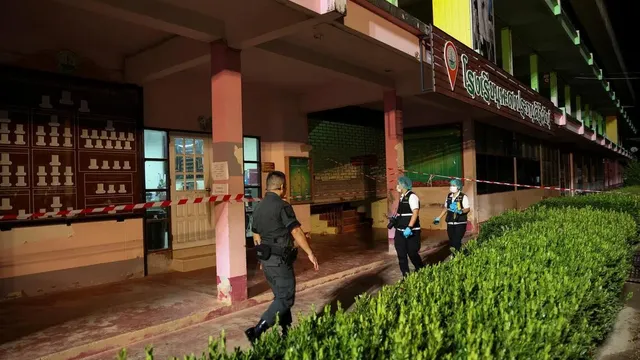
Teenager steals police gun and kills school principal in Thailand
Teenager steals police gun and kills school principal in Thailand
- An 18-year-old shooter attacked the Phatong Prathan Khiriwat School, resulting in the death of principal Sasiphat Sinsamosorn.
- Two students were injured, one seriously, and the shooter was apprehended after being grazed by a bullet.
- The incident has reignited debates over gun violence and the effectiveness of Thailand's gun laws.
Story
Thailand experienced a tragic event involving a teenage shooter at a school in southern Songkhla province on February 11, 2026. The 18-year-old assailant, who had a recent history of psychiatric treatment, entered the Phatong Prathan Khiriwat School armed with a 9mm pistol after allegedly attacking a police officer and stealing the weapon. During the incident, the school's principal, Sasiphat Sinsamosorn, was shot in the chest and later succumbed to her injuries. Additionally, two students were injured—one seriously and hospitalized, while another sustained minor injuries after jumping from the second floor to escape the chaos. Authorities swiftly responded to reports of the disturbed teenager and apprehended him at the scene. Despite being grazed by a bullet in the confrontation, he was taken into custody but has not been formally charged as investigations continue. The school community mourned the loss of their principal, honoring her bravery and contributions to education, and expressed condolences in a heartfelt social media post. The incident has once again highlighted concerns over gun violence in Thailand, a country that grapples with high rates of firearm ownership. Previous promises from officials regarding stricter gun laws have failed to prevent such tragedies, which are becoming increasingly common. The scars of the past still linger, especially from a horrific incident in 2022 when a former policeman took the lives of numerous children in a nursery massacre. This latest incident serves as a stark reminder of the urgent need for effective solutions to combat gun-related violence in Thailand.
Context
Thailand has some of the most complex and stringent gun laws in Southeast Asia, reflecting historical, cultural, and social factors that shape the nation's approach to firearms. Following a history of violence and military coups, the Thai government established strict regulations surrounding gun ownership and usage. The Firearms Act of 1947, along with subsequent amendments, lays the foundation for Thailand's gun control measures. The laws govern licensing, registration, and the carrying of firearms, which is compulsory for legal gun owners. With an estimated 10 million privately owned firearms in a country of about 70 million people, the prevalence of guns raises concerns regarding public safety and crime rates. However, gun-related homicides are relatively low compared to some neighboring countries, suggesting that gun laws, when enforced, can be effective in mitigating violence. To legally possess a firearm in Thailand, individuals must meet specific requirements, including being at least 20 years old, having a clean criminal record, demonstrating a need for a firearm, and passing a psychological evaluation. Applicants must also undergo training in firearm safety. The process can be lengthy, often taking several months. Moreover, those who are granted a license must register their firearms with the government, which helps keep track of ownership and ensure accountability. Carrying firearms in public presents additional challenges, as individuals must secure special permits, which only a limited number of licenses are issued annually. In essence, the laws favor responsible ownership and discourage the casual or reckless use of firearms. Despite these regulations, illegal firearms trafficked into Thailand contribute to a significant black market, posing challenges to law enforcement agencies. Organized crime, drug trafficking, and conflicts among rival groups often escalate violence and hinder the effectiveness of existing gun laws. Police efforts to curb illegal trafficking have seen mixed results, as corruption and inadequate funding limit their capacity to enforce regulations. Consequently, achieving a balance between personal freedoms and public safety remains a pressing issue for Thai society and governance. Public opinion varies, with some citizens advocating for increased gun rights, while others prioritize stricter controls to safeguard the community. In conclusion, while Thailand's gun laws are designed to promote safety and responsible ownership, enforcement challenges and the existence of illegal firearms complicate the overall landscape. The government continues to navigate these complexities while seeking the cooperation of community stakeholders in fostering a culture of safety. Ongoing public discourse about gun ownership is essential for future legislative reforms as Thailand examines the efficacy of its existing laws, aiming to adapt to changing social dynamics and security concerns. Therefore, continual assessment of gun laws is critical to ensure they meet the public's expectations and contribute positively to the country's stability and safety.


