

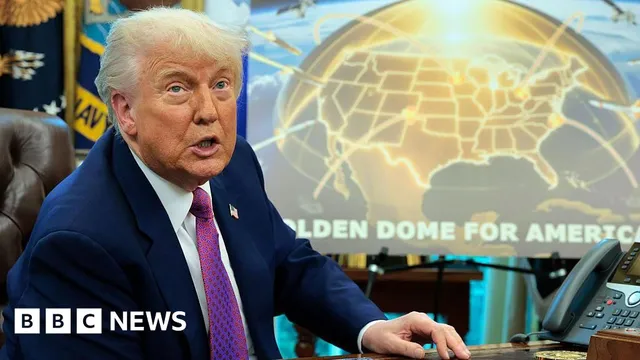
Trump's golden dome plan costs $1.2 trillion and may not provide full protection
Trump's golden dome plan costs $1.2 trillion and may not provide full protection
- The Golden Dome plan is expected to cost $1.2 trillion over 20 years, according to the Congressional Budget Office.
- Initial estimates were far lower at $175 billion, raising questions about fiscal oversight.
- Critics argue the plan is a poor investment that may not effectively protect against sophisticated missile threats.
Story
In January 2023, U.S. President Donald Trump announced a new missile defense system called the Golden Dome, intended to shield the U.S. from evolving aerial threats. According to the nonpartisan Congressional Budget Office, the projected cost for this system could reach approximately $1.2 trillion over two decades, far surpassing the initial estimate of $175 billion. The report highlighted significant acquisition costs of over $1 trillion, which includes expenses for interceptor technologies and space-based missile detection systems. As concerns grow regarding increasing missile capabilities from adversaries like Russia and China, doubts about the system's effectiveness have also surfaced. The CBO indicated that despite vast investment, the Golden Dome could still be vulnerable to a coordinated full-scale attack, underscoring an alarming potential gap in national defense. Democratic Senator Jeff Merkley criticized the plan as a misguided allocation of funds, suggesting that it primarily benefits defense contractors rather than the American public. This situation raises questions about the U.S. government's ability to develop a comprehensive defense system to protect its massive territory against advanced missile threats. In the context of shifting global security dynamics, the Golden Dome's initiative comes amid heightened tensions with countries that possess sophisticated missile technologies. Trump initially framed the program following a directive to identify and counter next-generation threats, stating the program would integrate advanced technologies across various domains, including land, sea, and space. However, experts warn that existing defense mechanisms have failed to keep pace with the rapidly evolving weaponry landscape, posing potentially grave implications for U.S. defense strategies. Plans for this ambitious initiative drew attention from both contractors and the public, given the staggering financial implications linked to the defense sector amid a broader conversation on military spending in the U.S. While Trump aims to present the Golden Dome as a forward-thinking solution against aerial threats, industry analysts and lawmakers express growing concern over its feasibility and effectiveness, prompting calls for a reevaluation of defense investments.
Context
The history of U.S. missile defense systems is a complex narrative involving technological innovation, geopolitical strategy, and kinetic defense capabilities aimed at protecting the nation from airborne threats. The evolution of these systems can be traced back to the Cold War, where the primary objective was to mitigate the risks posed by strategic nuclear missiles. The decision to develop missile defense systems was spurred by the advent of intercontinental ballistic missiles (ICBMs) and the perceived vulnerability of the United States to a surprise attack. Early initiatives, such as the Nike Zeus program in the 1950s, focused on developing a defense system capable of intercepting incoming missiles, although technical challenges limited its success and deployment. This era set a precedent for future missile defense efforts grounded in active interception of nuclear threats, which would evolve significantly in subsequent decades. By the late 1970s and early 1980s, the Strategic Defense Initiative (SDI), famously proposed by President Ronald Reagan, aimed to establish a space-based system to intercept and destroy ballistic missiles during their flight phases. Although SDI garnered considerable attention and funding, it also met with skepticism from both political leaders and scientists, primarily due to questions surrounding its feasibility and the technology required for successful implementation. The initiative, often referred to as "Star Wars," ultimately faced significant political challenges and was largely abandoned after the Cold War ended, reflecting a shift in defense priorities against a backdrop of improved international relations and disarmament treaties. The post-Cold War era saw the recalibration of U.S. missile defense strategies in response to emerging threats from regional adversaries, notably North Korea and Iran, which began developing their own missile capabilities. The 1999 National Missile Defense Act aimed to create a limited missile defense system that would protect the U.S. homeland from a small-scale ballistic missile attack. This led to the development and deployment of systems like the Ground-based Midcourse Defense (GMD), which employs ground-based interceptors designed to destroy incoming threats in space. The system's operational status has faced scrutiny regarding its reliability and effectiveness, sparking debates about the best approaches to missile defense in an evolving global threat landscape. In the 21st century, missile defense efforts expanded further with multi-layered approaches incorporating sea, land, and space-based technologies. Systems like Aegis Ballistic Missile Defense and Terminal High Altitude Area Defense (THAAD) represent advancements in intercept capabilities, integrating radar and interceptor technology to target various threats at different phases of their trajectories. The United States has also collaborated with allied nations to enhance collective defense systems, especially in the context of NATO, aiming to bolster regional security against missile threats. As of 2026, U.S. missile defense systems continue to evolve, shaped by technological advancements, changing geopolitical dynamics, and ongoing budget considerations, remaining a key component of national security policy that seeks to protect the American populace and strategic interests from the burgeoning threat of missile attacks.


