

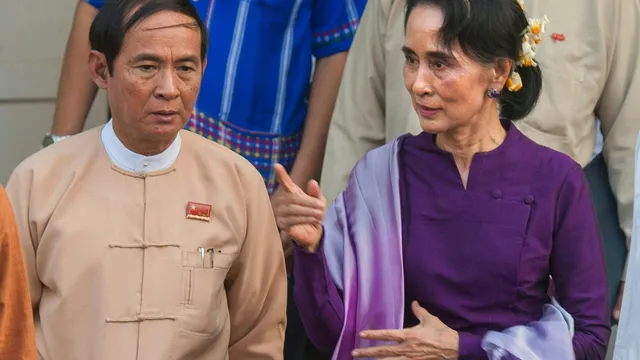
Aung San Suu Kyi may have died in isolation, says her son
Aung San Suu Kyi may have died in isolation, says her son
- Aung San Suu Kyi has not been seen or heard from in over two years under military detention.
- Her son, Kim Aris, has raised concerns about her health, stating it is alarming that the military claims she is in good health without evidence.
- Aris fears for his mother's life, questioning whether she could be dead due to extensive isolation.
Story
In Myanmar, Kim Aris, the son of imprisoned former leader Aung San Suu Kyi, has raised alarm over his mother's health condition, highlighting that she has not been seen or heard from in over two years. Aung San Suu Kyi, an 80-year-old Nobel Peace Prize laureate and a prominent figure in Myanmar's pro-democracy movement, has been subjected to solitary confinement since the military coup in February 2021, which ousted her democratically elected government. In a politically motivated trial held in 2022, she received a harsh sentence of 33 years on various charges that are widely condemned by international human rights organizations as fabricated to suppress her influence and maintain military control over the country. Kim Aris, who recently traveled to Japan to advocate for his mother, expressed extreme concern, stating that years of isolation and lack of communication have left him fearing the worst regarding her health. In his statements, he emphasized that although the military claims that Aung San Suu Kyi is in good health, they have failed to provide any independent verification or proof of her condition. This led him to question the credibility of the military's assertions and contemplate that his mother might have died without any family or legal representation having contact with her. The military's crackdown on freedom in Myanmar has prompted widespread protests against their plans to conduct elections, which are seen as a tactic to legitimize their power. Critics, including Aris, have labeled these elections as neither free nor fair, asserting that they serve only to uphold the junta's rule since it began seeking to legitimize its actions after the coup that led to widespread civil unrest in the country. Additionally, the situation regarding Aung San Suu Kyi's treatment elicited worldwide condemnation, though attention has significantly waned since past international focus on her leadership. In response to the expressions of concern from her family, Myanmar's military made rare public comments, insisting that Aung San Suu Kyi is in good health. However, the junta provided no substantial evidence to justify that claim, which has led to further distrust amongst her supporters and the international community. Kim Aris, having taken a proactive stance at international dialogues, continues to rally for support from global leaders to press the military for reforms, ensuring that Aung San Suu Kyi receives suitable medical attention, while critically assessing the junta's narrative about her health as merely a distraction from their oppressive political maneuvers.
Context
The military coup in Myanmar, which occurred on February 1, 2021, has had profound and far-reaching consequences for the country's democratic framework. The removal of the elected government led by Aung San Suu Kyi effectively dismantled the democratic institutions that had been established over the preceding decade. The military, known as the Tatmadaw, cited allegations of electoral fraud as justification for its takeover, despite the fact that independent observers had deemed the November 2020 elections largely free and fair. The coup has reversed years of progress toward democracy, stifling political pluralism and freedom of expression, and has instigated a brutal crackdown on dissent and political opposition across the nation. In the aftermath of the coup, widespread protests erupted, with citizens demanding a return to democracy. The military's violent response, which has included the use of lethal force against unarmed civilians and mass detentions, has led to significant casualties and human rights abuses, exacerbating public dissent while also instilling an atmosphere of fear. The National Unity Government (NUG), formed by ousted lawmakers and representatives of ethnic groups, has sought to galvanize resistance against the military regime, calling for international support and recognition. However, the NUG faces immense challenges, including limited resources and the complexities of uniting diverse factions under a single banner. The international community has reacted with a mix of condemnation and sanctions against the military leaders; however, the effectiveness of such measures remains debatable. Countries like the United States and members of the European Union have imposed targeted sanctions aimed at military-linked businesses and leadership figures. Nevertheless, these actions have had limited success in curbing the military's repressive tactics or restoring democracy in Myanmar. Humanitarian crises have worsened as economic collapse and the conflict have displaced millions internally, creating urgent needs for aid and relief that are increasingly difficult to fulfill amid ongoing violence and instability. The coup's impact on Myanmar's democracy can be seen not only in the immediate political suppression but also in the long-term implications for civil society and governance. The military's actions have eroded public trust in institutions, fostering cynicism among the populace regarding the potential for democratic governance. Furthermore, ethnic tensions may be exacerbated as non-Burmese groups react to the military's heavy-handed tactics. Overall, the ongoing crisis poses significant challenges for Myanmar's future, with the road to democracy looking increasingly perilous. The international community continues to grapple with how best to support the people's aspirations for democracy while navigating the realities of an entrenched military regime. The struggle for democracy in Myanmar remains a critical issue with implications for regional stability and human rights.


