

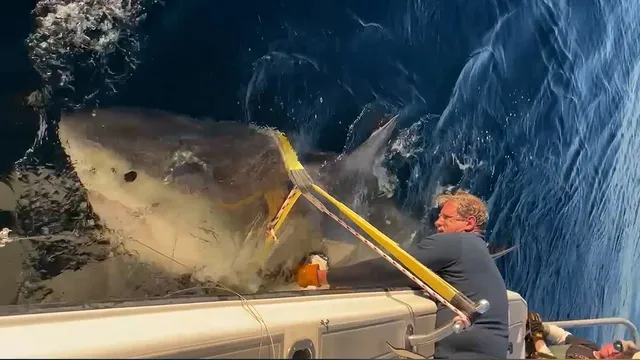
Great white shark Contender returns to Florida after epic migration
Great white shark Contender returns to Florida after epic migration
- In January 2025, a great white shark named Contender was tagged off the Florida-Georgia border.
- The shark traveled extensively, reaching as far as the Gulf of St. Lawrence before returning to Florida.
- Researchers aim to study the relationship between Contender's return and potential mating activities among great white sharks.
Story
In January 2025, a 14-foot, 1,700-pound great white shark named Contender was tagged off the Florida-Georgia border by researchers from OCEARCH, a marine research group dedicated to monitoring shark movements globally. This tagging allowed scientists to track Contender’s extensive journey, which included traveling to the Gulf of St. Lawrence and various points along the U.S. East Coast, including New Jersey and Canada. Known for being the Atlantic's largest recorded male great white, Contender resurfaced in Florida's warmer waters in January 2026, marking the completion of a remarkable year-long migration. Researchers are particularly interested in the timing of Contender’s return, as it may align with the mating activities of great white sharks, a subject that remains largely understudied. Chris Fischer, founder of OCEARCH, indicated that while there are limited clues about great white shark reproduction, the periods of late winter and early spring may be critical for observing mating behavior. The scientists hope to gather crucial information about the reproductive habits of this species, shedding light on previously unknown aspects of their life cycles. While tracking Contender, OCEARCH is utilizing a satellite tracking system that will provide real-time data for about five years. The SPOT tag used on Contender is significant as it allows researchers to follow the shark’s movements over large distances, thereby enriching their understanding of migration patterns across international waters. The extensive data gathered through this method will aid in assessing the ecological impact and behavioral trends of great whites during key periods in their life cycles. Apart from Contender, researchers are also closely monitoring interactions with other great white sharks named Breton and Goodall, particularly to see if mature males and females are present in the region simultaneously during Contender’s return. The forthcoming months will be essential for determining if Contender’s migration is related to mating behavior, prompting scientists to utilize a combination of satellite tracking, blood sampling, and hormone analysis to study great white reproduction more thoroughly. Fischer expressed hope that attention to these sharks within the next 60 to 90 days could yield valuable insights into their reproductive ecology.
Context
The great white shark (Carcharodon carcharias) is a species renowned for its size, strength, and predatory prowess. Understanding their migration patterns is critical for effective conservation efforts and ensuring the survival of this apex predator. Research has shown that great white sharks exhibit migratory behaviors closely linked to environmental cues, prey availability, and breeding cycles. They are known to migrate over vast distances, sometimes exceeding thousands of kilometers, between feeding and breeding grounds. Tagged individuals have displayed seasonal patterns, often moving towards cooler waters during warmer months and returning to warmer waters as temperatures drop. This behavior not only showcases their adaptability to varying marine environments but also highlights their role in the marine ecosystem, where they help maintain the balance of fish populations by preying on weaker and sick individuals. The migration of great white sharks is often influenced by the availability of key prey species such as seals, sea lions, and various fish. As a result, certain regions become hotspots for shark activity that coincide with the seasonal movements of these prey species. For instance, in the waters off the coast of California, great whites have been observed frequenting areas with high populations of sea lions during specific times of the year. Additionally, young sharks tend to occupy different habitats than adult sharks, utilizing shallow coastal waters that provide abundant food sources while also offering protection from larger predators. This segregation by age class further complicates the study of their migratory habits, as researchers must consider multiple factors influencing the sharks’ movements within different habitats. Recent advancements in tracking technology, such as electronic tagging, have provided researchers with invaluable data regarding the migratory routes and behaviors of great white sharks. These advanced techniques allow scientists to monitor the movements of individual sharks in real time, revealing insights into their migratory patterns, depth preferences, and feeding behavior. Findings suggest that great white sharks undertake long-distance migrations that can span several months, often moving along the coastlines and through open ocean areas. These migrations are not random; rather, they seem to follow consistent pathways influenced by ocean currents, sea surface temperatures, and the availability of prey. As researchers continue to gather more data through tagging and tracking, they will be able to better understand the intricate details of these migrations, ultimately leading to more effective conservation measures. Despite their critical role in marine ecosystems, great white sharks face various threats, including overfishing, habitat loss, and climate change. Understanding their migration patterns is essential for implementing protective measures, managing fisheries, and establishing marine protected areas. Conservation efforts must take into account the sharks’ migratory behaviors to ensure the preservation of key habitats used during their travels. By addressing the challenges that great white sharks face and promoting public awareness about their ecological importance, we can work towards safeguarding the future of this iconic species while maintaining the health of our oceans.


