

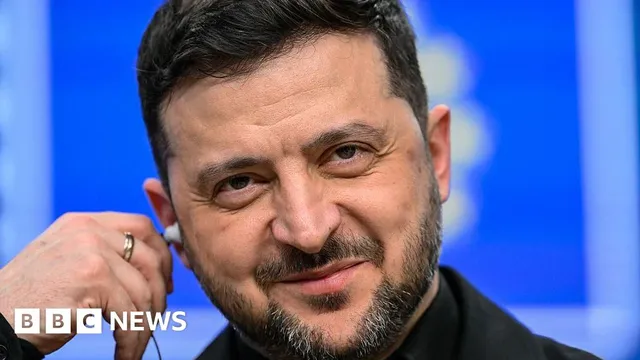
Ukraine sends drone team to bolster US military defenses in Jordan
Ukraine sends drone team to bolster US military defenses in Jordan
- Ukraine has dispatched interceptor drones and specialists to support U.S. troops in Jordan.
- This move follows a direct request from Washington amid rising Iranian threats in the region.
- The collaboration signifies both nations' commitment to confronting military challenges posed by Iran.
Story
Ukraine has recently sent a team of drone specialists and interceptor drones to assist U.S. military bases located in Jordan. This action was taken following a request made by the United States, likely due to the escalating tensions and threats from Iranian missile and drone assaults in the region, particularly targeting interests of the U.S. and allied nations. Ukrainian President Volodymyr Zelenskyy confirmed that his government acted quickly upon receiving Washington's request, dispatching the specialized team the very next day. As the situation worsens, the U.S. and allied Gulf countries are facing hundreds of Iranian drone launches, heightening their need for enhanced defense measures. This decision comes in the context of a broader military engagement, where Iranian agent networks have intensified their attacks across various Middle Eastern countries, striking locations like the United Arab Emirates, Saudi Arabia, and Bahrain. Furthermore, the conflict's ramifications have reached elastic oil markets, prompting lack of stability in global energy prices amid significant geopolitical turmoil. Zelenskyy affirmed the strong collaborative efforts between Kyiv and Washington, emphasizing the importance of rapid responses to address regional threats. Meanwhile, U.S. military strategy is under scrutiny as it attempts to balance the costs of defending against a high volume of low-cost Iranian drone attacks with sophisticated air defense systems. Analysts, including a representative from the Center for Strategic and International Studies, cautioned that traditional air defense strategies—focusing on intercepting drones individually—could prove to be financially unsustainable. With basic Iranian-made drones costing around $20,000 to $50,000 each, compared to much more expensive interception systems like the Patriot missile costing approximately $3.8 million for a single unit, it becomes clear that a strategic shift is necessary to address this asymmetric threat effectively. The dynamics of this ongoing conflict have created an environment where Iran can indefinitely project power beyond its military limitations by deploying numerous drones, challenging adversary responses and further complicating the geopolitical landscape. As these developments unfold, the United States continues to reassess its position and tactics in the Middle East, seeking to stabilize the region amid ongoing attacks and a volatile oil market. The urgent cooperation between Ukraine and the U.S. highlights the intertwining issues of international defense collaboration as both nations navigate their unique challenges in the wake of increasing Iranian hostilities, showcasing the implications of military assistance, alliance-building, and the complexities of modern warfare in the current geopolitical environment.
Context
The history of Iran-US relations has been a complex and tumultuous journey, shaped by a mix of geopolitical interests, cultural dynamics, and critical historical events. The relationship began during World War II when the U.S. and Iran were allies against Axis powers. This partnership laid the groundwork for increased American involvement in Iran's oil industry and political affairs post-war. However, the pivotal moment came in 1953 when the CIA orchestrated a coup to overthrow Iran's democratically elected Prime Minister Mohammad Mossadegh. This interference resulted in the reinstatement of the Shah, Mohammad Reza Pahlavi, who established an authoritarian regime backed by the U.S., leading to widespread discontent among Iranians and sowing the seeds of future conflict. The 1979 Iranian Revolution dramatically shifted the dynamics of Iran-US relations. The overthrow of the Shah and the establishment of an Islamic Republic under Ayatollah Khomeini led to the severing of diplomatic ties and the seizure of the U.S. embassy in Tehran, where American diplomats were held hostage for 444 days. This event solidified anti-American sentiment in Iran and shifted U.S. policy towards containment through economic sanctions and military posturing. The conflict escalated further during the Iran-Iraq War (1980-1988), with the U.S. initially supporting Iraq, which aggravated deep-seated animosities and mistrust on both sides. In the decades following the revolution, U.S.-Iran relations remained strained, with incidents such as the bombing of the U.S. Marine barracks in Beirut in 1983 and Iran's involvement in supporting militant groups in the region. The introduction of sanctions aimed at curbing Iran's nuclear program further complicated matters, as both countries navigated a new global landscape in the post-9/11 world. Iran's nuclear ambitions sparked significant concerns in the U.S. and among its allies, leading to a series of negotiations that culminated in the Joint Comprehensive Plan of Action (JCPOA) in 2015. This landmark agreement temporarily eased sanctions in exchange for Iran's commitment to limit its nuclear program, representing a fragile moment of diplomatic rapprochement between the two nations. However, the U.S.'s withdrawal from the JCPOA in 2018 under the Trump administration marked a new low in relations, leading to intensified sanctions and military confrontations, such as the assassination of Iranian General Qassem Soleimani in 2020. As of March 2026, Iran-U.S. relations continue to be defined by a cycle of confrontation and diplomacy, with both sides grappling with internal pressures and external influences. The ongoing challenges in negotiating a new agreement on nuclear proliferation, regional security, and economic sanctions underscore the precarious nature of their relationship, reigniting debates about the future trajectory of Iran-US ties in an increasingly volatile Middle East.


