

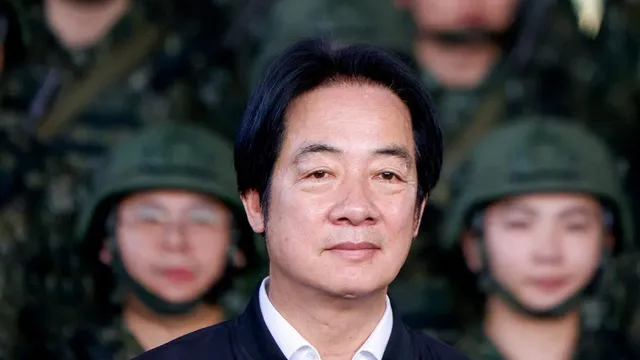
Taiwan stresses peace cannot be achieved through force
Taiwan stresses peace cannot be achieved through force
- President Lai Ching-te reaffirmed Taiwan's commitment to peaceful principles in a letter to Pope Leo XIV.
- He emphasized that military coercion from authoritarian nations does not lead to true peace.
- Taiwan aims to engage in constructive dialogue while upholding its sovereignty and democratic values.
Story
Taiwan's President Lai Ching-te recently addressed Pope Leo XIV in a letter responding to the pontiff's call for global peace, highlighting Taiwan's dedication to democratic values. The letter emphasized that any attempts by authoritarian nations to alter the status quo in Taiwan through coercion would be fruitless and would not lead to genuine peace. Lai expressed his belief that only the people of Taiwan can determine their future, reaffirming Taiwan's sovereignty amidst ongoing military pressure from China. He reiterated Taiwan's commitment to peace and stability by engaging in meaningful dialogue based on mutual respect and understanding. The backdrop of this communication encompasses heightened tensions in the Taiwan Strait, primarily due to China's continuous military presence near Taiwan, which the Taiwanese government regards as harassment. Lai's letter comes in the wake of China's military exercises around the island and their refusal to engage in dialogue with Taiwanese leaders, labeling them as separatists. By voicing concerns over military coercion, Lai sought to present Taiwan as a nation advocating for peace while countering narratives that threaten Taiwan's democratic existence. Furthermore, the letter referenced historical contexts, including World War II documents and the United Nations General Assembly Resolution 2758, which Beijing interprets as supporting its claims over Taiwan. Lai challenged these interpretations, arguing that the resolution did not mention Taiwan explicitly and asserting that the Republic of China, Taiwan's official name, has sovereignty that predates the establishment of the People’s Republic of China in 1949. He stressed the importance of differentiating Taiwan's historical narrative from the discussions around its current status. In closing, Lai underscored Taiwan's active participation in global issues, asserting its role in international security and cooperation. This includes initiatives in technology, such as the development of artificial intelligence and sustainable supply chains. By engaging with like-minded nations under values-based diplomacy, Taiwan promotes peace and human rights on a global scale, further contributing to stability in the region and showcasing its commitment to the shared values of love and justice that the Pope advocates.
Context
Taiwan's international legal status is complex and multifaceted, rooted in its unique historical, political, and social context. Following the end of the Chinese Civil War in 1949, the Republic of China (ROC) government retreated to Taiwan, maintaining that it was the legitimate government of all of China. However, the People's Republic of China (PRC), established on the mainland, asserted that it was the sole legitimate government of China, including Taiwan. This competing claim complicates Taiwan's status under international law, where the PRC's adherence to the 'One China' principle has led many countries to limit or sever official diplomatic ties with the ROC, recognizing the PRC instead. Consequently, Taiwan exists in a limited de facto sovereignty, obtaining limited recognition as an independent state while functioning autonomously in various respects. Internationally, the most significant issue regarding Taiwan’s status is its lack of formal recognition as a sovereign state by the United Nations and most member countries. The UN General Assembly Resolution 2758, passed in 1971, effectively replaced the ROC's seat with that of the PRC, reinforcing the latter's claim over Taiwan. Nevertheless, Taiwan maintains unofficial relationships with many countries and plays an important role in global trade and economic matters, highlighted by its participation in international organizations such as the World Trade Organization (WTO) and the Asia-Pacific Economic Cooperation (APEC), albeit under various designations. Taiwan advocates for participation in international organizations and treaties under the name 'Chinese Taipei' or through other channels due to the diplomatic impediments resulting from its unique situation. This limited participation does not negate its function as a self-governing entity; Taiwan has its own government, military, and constitution, characterized by democratic governance and a vibrant civil society. As such, it operates with significant autonomy from China, contributing to international dialogues concerning trade, security, climate change, and public health. The island's status invites extensive debates around sovereignty, collective security, and self-determination, with varying perspectives among international legal scholars. The geopolitical landscape surrounding Taiwan has posed significant challenges and opportunities, particularly in light of evolving relationships with major powers, including the United States and Japan. The continuous tensions across the Taiwan Strait must also be understood in the context of China's rising assertiveness on the global stage, which has implications for regional stability and international law. As Taiwan seeks to assert its identity within the international community, the question of its status remains a topic of considerable legal and diplomatic significance, demanding keen attention from policymakers, scholars, and global stakeholders.


