

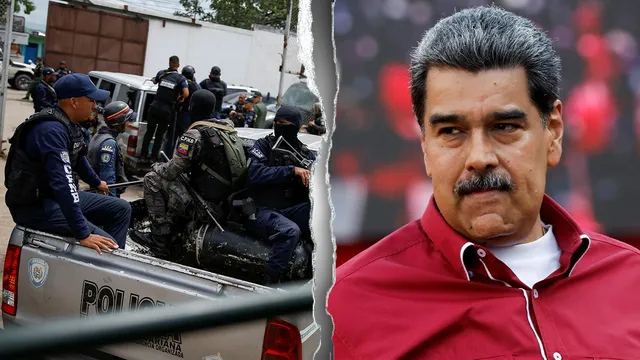
Vice President Vance blocks resolution limiting Trump’s military action in Venezuela
Vice President Vance blocks resolution limiting Trump’s military action in Venezuela
- The Senate voted to block a resolution aimed at limiting Trump's ability to use military force in Venezuela without congressional approval.
- Vance's tie-breaking vote followed a reversal by two Republican senators pressured by Trump.
- The defeat of the resolution raises concerns about presidential military powers and bipartisan checks on the executive branch.
Story
In a significant political move in the United States, the Senate voted 51-50 to block a resolution that would have limited President Donald Trump's ability to employ military force in Venezuela without congressional approval. This occurred after the Vice President JD Vance intervened to cast the deciding vote in favor of blocking the measure. Senators Josh Hawley and Todd Young had initially supported the resolution but reversed their positions after pressure from Trump. Despite bipartisan support aiming to curb Trump's military powers prompted by concerns over ongoing U.S. military action in Venezuela, the resolution’s defeat indicates strong GOP alignment with the President. The proposed resolution, led by Senator Tim Kaine, sought to invoke the War Powers Act to ensure that any military action in Venezuela would require prior congressional authorization. However, in the wake of Trump's involvement, both Hawley and Young cited assurances from Secretary of State Marco Rubio affirming there are no U.S. ground troops in Venezuela as their rationale for changing their votes. As Trump's influence over Republican members remains substantial, the overall effectiveness of congressional checks on his military power is now in question. The Senate's action reflects apprehension among lawmakers who fear political ramifications for straying from Trump's directives. The events follow a wave of escalating U.S. military activities in Venezuela, particularly after a January 3 operation that reportedly included airstrikes and an attempt to capture President Nicolas Maduro. Concerns raised by opposition lawmakers about the potential for conflict reflect a deeper divide within the Republican Party regarding executive military powers and the GOP's loyalty to Trump. While some senators have sought to restrain presidential authority through institutional measures, the GOP's response demonstrates significant internal responses to Trump’s requests and threats. Senators aligned with Trump have asserted the unnecessity of the resolution, arguing that the current military actions are not happening and thus do not require regulation by Congress. The ongoing tension between the executive branch and Congress over military interventions highlights critical questions about checks and balances within U.S. governance. As the situation evolves, it remains to be seen how this division will influence future foreign policy decisions and the Republican Party's strategy moving toward the next presidential election.
Context
The background on U.S. military involvement in Venezuela is a complex narrative shaped by historical, political, and economic factors. Over the decades, Venezuela's relationship with the United States has fluctuated significantly. For much of the 20th century, Venezuela was viewed as a key ally due to its vast oil reserves and strategic location. This relationship began to sour towards the late 1990s with the rise of Hugo Chávez, who adopted policies that were anti-American and aligned more with leftist governments in the region. His presidency marked a shift in Venezuela's political landscape, fostering anti-U.S. sentiment and leading to tensions that have persisted into the current political environment. The U.S. has often criticized Venezuelan leaders for alleged human rights abuses, corruption, and authoritarian practices, further straining diplomatic relations. Recent years have seen escalating crises in Venezuela, including widespread humanitarian issues, economic collapse, and political instability. The situation reached a critical point in early 2019 when Juan Guaidó, the opposition leader, declared himself interim president, challenging Nicolás Maduro’s rule. The U.S. quickly recognized Guaidó, which further inflamed tensions. This recognition included calls for democratic reforms and the end of Maduro's regime, leading to discussions about potential military intervention aimed at restoring order and democracy in the country. The humanitarian crisis, with millions fleeing the country and facing dire conditions, has also prompted debates about intervention, as the U.S. grapples with its responsibilities in the region. Military involvement discussions typically include the potential use of force which raises numerous concerns. Critics argue that direct military intervention could exacerbate the situation, leading to further instability in an already volatile region. Others assert that a U.S. military presence may be necessary to prevent further deterioration and to safeguard regional interests. Sanctions have been a more common approach over recent years, with imposed economic restrictions targeting key individuals and sectors in Venezuela to pressure Maduro’s government without resorting to military options. The future of U.S. military involvement in Venezuela remains uncertain and highly debated among policymakers. As the Biden administration navigates international relations, the humanitarian plight of Venezuelans continues to be a critical point of discussion. While military intervention appears to be a last resort, the ongoing situation necessitates careful consideration of diplomatic solutions, humanitarian aid, and how best to support Venezuelans in their quest for democratic governance. This background lays a foundation for understanding the various dimensions of U.S. involvement in Venezuela and the challenges faced in addressing this multifaceted crisis.


