

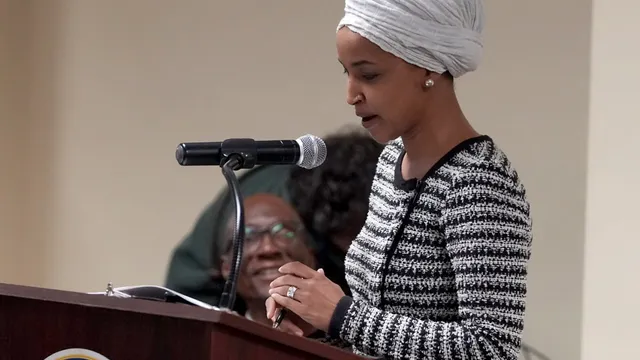
Ilhan Omar attacked with unknown substance during town hall
Ilhan Omar attacked with unknown substance during town hall
- During a town hall in Minneapolis, Congresswoman Ilhan Omar was attacked with an unknown substance by a man using a syringe.
- The assailant, Anthony Kazmierczak, was quickly apprehended and charged with third-degree assault.
- Omar stated she will not be intimidated and condemned the attack, which reflects the rising political tensions surrounding immigration policies.
Story
In the United States, Congresswoman Ilhan Omar was attacked while speaking during a town hall meeting in Minneapolis on Tuesday evening. A man charged at her with a syringe and sprayed an unknown liquid as she was addressing the crowd about abolishing ICE. The assailant, later identified as 55-year-old Anthony Kazmierczak, was quickly tackled to the ground and detained by security. The incident unfolded moments after Omar demanded the resignation of Homeland Security Secretary Kristi Noem, leading to heightened tensions due to her outspoken criticism of ICE and federal immigration policies. As Omar continued her remarks after the attack, she emphasized her resilience, stating, "I'm a survivor so this small agitator isn't going to intimidate me from doing my work." According to reports, the liquid sprayed at her had a foul smell resembling ammonia, prompting concern among witnesses, though no one suffered severe physical reactions. Omar confirmed she was unharmed but condemned the attack as unacceptable. The authorities promptly arrested Kazmierczak on charges of third-degree assault. President Donald Trump responded to the incident and made controversial comments, suggesting that Omar "probably had herself sprayed," despite not having seen the video footage of the attack. His remarks reflected the ongoing political animosity between him and the congresswoman, who has frequently been the target of his criticism regarding her Somali background and views on immigration. Trump labeled Omar a fraud and repeated negative remarks about her home country of Somalia, further escalating the already polarized political discourse surrounding immigration issues in the U.S. The attack on Omar highlights the increasing political tensions and violence associated with immigration debates, particularly in Minneapolis, a focal point for federal immigration enforcement activities. Local and national officials have since condemned the assault, calling for unity against violence. It underscores the broader implications of political rhetoric in the current climate, where acts of aggression against public figures occur amidst a backdrop of contentious immigration policies and civil rights debates. As the story continues to develop, lawmakers and community leaders are urging for a serious examination of the rise in political violence and its roots in divisive political narratives.
Context
The impact of political rhetoric on violence is a significant concern in contemporary society. Political rhetoric, which includes the language and communication strategies employed by politicians and public figures, has the potential to influence public perception and behavior. When political leaders use inflammatory language or rhetoric that portrays certain groups as enemies, it can incite fear, division, and ultimately violence. This phenomenon is not new; throughout history, there have been numerous instances where words have led to heightened tensions and violent outcomes. The language used in political discourse can create an environment where violence is seen as an acceptable response to perceived threats, whether those threats come from political opponents, marginalized communities, or foreign entities. Modern examples illustrate the direct correlation between political rhetoric and acts of violence. In many instances, hostile language has been followed by hate crimes, protests that escalate into violence, or targeted attacks against specific groups. Research indicates that when leaders resort to demonizing rhetoric, it legitimizes aggression among their supporters and can contribute to a culture where violence is more readily accepted as a solution to conflicts. The dynamics of social media amplify this issue, as messages can spread rapidly, often reaching individuals who may be predisposed to react violently to political messages. The polarized nature of today's political landscape exacerbates these risks, as individuals feel increasingly justified in taking extreme actions against those they perceive as adversaries. Moreover, the psychological effects of political rhetoric cannot be overlooked. Political messages that evoke strong emotions can lead individuals to dehumanize others, making it easier to perpetrate acts of violence. Theories of social psychology provide insight into how exposure to aggressive rhetoric can shift individual and group behaviors, leading to an increase in collective aggression. Individuals who feel disenfranchised, threatened, or angry are particularly susceptible to the influence of such rhetoric, as they are more likely to respond with hostility and violence when motivated by strong emotions. This highlights the responsibility of political leaders to choose their words carefully, as their language can have far-reaching consequences. To mitigate the impact of harmful political rhetoric, it is essential to foster a political discourse that emphasizes empathy, understanding, and constructive dialogue. Engaging in civil discourse can help create an environment where differing opinions can be expressed without escalating into violence. Education plays a critical role in promoting media literacy, enabling individuals to critically assess political messages and recognize the potential for rhetoric to incite violence. By promoting a more responsible approach to political communication, society can work towards reducing the prevalence of violence as a response to political differences, ultimately leading to a more peaceful coexistence.


