

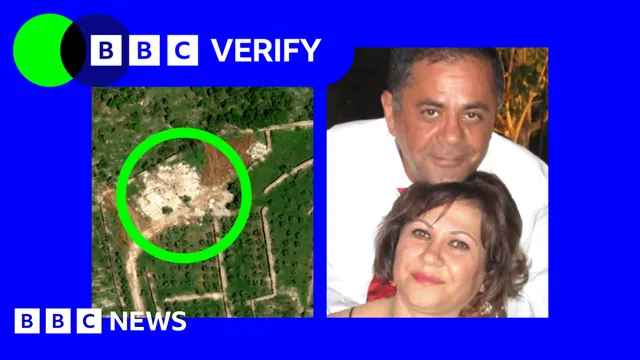
Couple's dreams shattered as home destroyed in Israeli strikes
Couple's dreams shattered as home destroyed in Israeli strikes
- Joe Elias and his wife Diana are unable to return to their home in Qouzah due to its destruction amid renewed fighting between Hezbollah and Israel.
- Satellite imagery indicates that approximately one-third of Qouzah's residential buildings were destroyed during the conflict.
- The ongoing violence has left many Lebanese citizens living in fear and anxiety, questioning their safety in daily life.
Story
In early March 2023, intense fighting resumed between Hezbollah and Israel, causing widespread destruction in southern Lebanon, particularly in the village of Qouzah. Joe Elias, a Lebanese-American engineer, reported that he and his wife, Diana, were unable to return to their home as it had suffered significant damage amidst the Israeli military's ongoing campaign against Hezbollah. According to satellite imagery analyzed by BBC Verify, nearly a third of the residential buildings in Qouzah were destroyed in just over a month during the conflict, which has raised concerns among international law experts about potential war crimes due to the targeting of civilian areas. As tensions escalated, Joe Elias, who had spent 26 years in the U.S. before returning to Lebanon to provide his six children with a connection to their heritage, expressed deep sorrow over the loss of not only physical structures but also the memories tied to his family home. He vividly recalled planting olive, fig, and pomegranate trees in their garden, as well as importing furniture from the Amish community in Pennsylvania—a personal touch to their home now lost. His loss mirrored the experiences of many Lebanese civilians who are living with anxiety and fear owing to the unpredictable violence, which has forced them to flee their homes amid an ongoing conflict not solely limited to territorial disputes but also rooted in deeper historical grievances. Amid the chaos, the broader Lebanese population remains affected by the conflict's psychological toll. Reports indicate a pervasive atmosphere of fear, as evidenced by citizens like Amir, a university student who witnessed destruction from a distance, and Layla, a resident living near targeted neighborhoods. They expressed the deep anxiety that now permeates daily life, where simple trips to the market become fraught with danger. The violence has not only claimed the lives of combatants but has also resulted in civilian casualties, with the United Nations reporting significant losses, including children. In light of these events, a tenuous ceasefire was announced on April 16, 2023, after six weeks of conflict. Despite this, Israel continues to occupy regions of southern Lebanon and there is no formal diplomatic relationship between the two nations, leaving many to ponder whether peace is achievable in an area long plagued by strife. As residents like Joe and Diana attempt to reclaim some semblance of normalcy amidst the ruins, the question remains: will the people of Lebanon ever feel safe and secure in their own homeland as the cycle of violence persists?
Context
The historical context of the conflict between Hezbollah and Israel is rooted in the complex dynamics of Lebanon and the broader Middle East. Hezbollah, a Shiite militant group and political party, emerged in the early 1980s in response to the Israeli invasion of Lebanon in 1982. The group's formation was influenced by the Iranian Revolution and the desire to resist Israeli presence and control in Lebanon. The Lebanese Civil War (1975-1990) provided an environment for Hezbollah to grow, as it capitalized on grievances against Israel and the central government in Beirut, positioning itself as a defender of Lebanese sovereignty and Shiite interests. Over the years, Hezbollah received significant support from Iran and Syria, further embedding its role in the regional power struggle. The roots of the conflict can be traced back to unresolved territorial disputes, particularly regarding the Shebaa Farms area, which is claimed by Lebanon but is considered part of the Golan Heights occupied by Israel. The ongoing tensions were punctuated by several conflicts, including the 2006 Lebanon War, where Hezbollah's military capabilities were showcased during its conflict with Israel. The war stemmed from the abduction of two Israeli soldiers by Hezbollah, leading to a heavy military response from Israel. The conflict resulted in widespread destruction in Lebanon and significant loss of life, but also bolstered Hezbollah's standing within Lebanon and the region due to its perceived resistance against Israeli military action. Additionally, the conflict is perpetuated by broader regional and international dynamics, including the Israeli-Palestinian conflict and the geopolitical interests of external players such as the United States, Iran, and various Arab states. The cyclical nature of violence, exacerbated by political developments, including tensions related to Iran's nuclear program and its support for groups like Hezbollah, continues to complicate peace efforts. Moreover, the Syrian Civil War has added another layer to the conflict, as Hezbollah has been involved in supporting the Assad regime, further entrenching its ties with Iran and impacting regional relationships. In contemporary times, despite the 2006 conflict, sporadic violence continues along the Lebanese-Israeli border. Hezbollah maintains a significant military infrastructure and continues to pose a strategic challenge to Israel. The ongoing lack of a comprehensive peace agreement, coupled with mutual distrust, means that the potential for further conflict remains high. Both sides engage in psychological warfare and rhetoric, maintaining the narrative of resistance against aggression. The deep societal divisions within Lebanon, shaped by sectarian tensions, also perpetuate Hezbollah's role as both a political and military entity within the Lebanese political landscape. Understanding the intricacies of this conflict requires acknowledging the historical grievances, the sectarian dimensions, and the impact of regional geopolitics that continue to shape the relations between Hezbollah and Israel.


