

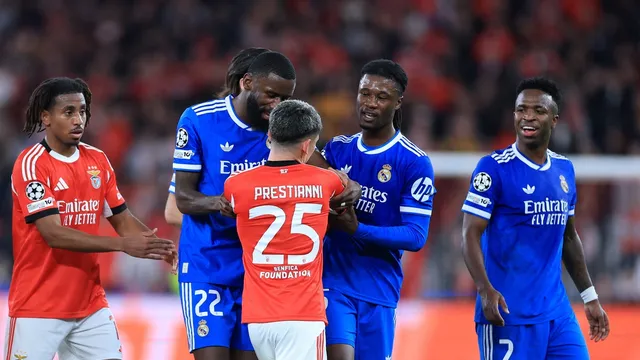
Gianluca Prestianni rejects claims of racially abusing Vinicius Junior
Gianluca Prestianni rejects claims of racially abusing Vinicius Junior
- Benfica and Prestianni vigorously deny claims of racial abuse made by Vinicius Junior.
- Wesley Fofana and other players have been subjected to online racist abuse recently.
- The conversation around football racism is intensifying, prompting calls for systemic changes.
Story
In Portugal, allegations arose during a Champions League match between Real Madrid and Benfica, in which Real Madrid's Vinicius Junior claimed to have been racially abused by Benfica's Gianluca Prestianni. Following the match, which took place on February 17, 2026, Prestianni was provisionally suspended, leading to significant backlash from various parties. Benfica's management vigorously defended Prestianni, stating he never admitted guilt and that he has always claimed not to be racist. The incident sparked a wider conversation about racism in football, with authorities and anti-discrimination organizations calling for stronger actions against online abuse, emphasizing that racism must be eradicated from the sport entirely. Additionally, Wesley Fofana and players including Romaine Mundle have also faced online racist abuse in recent incidents, showcasing a troubling trend in football. Organizations, clubs, and authorities continue to push for robust measures to combat this pervasive issue and ensure a safe environment for athletes.
Context
The history of racism in football serves as a reflection of broader societal issues related to discrimination and prejudice. From its inception, the sport has been a microcosm of the challenges faced by marginalized communities. Racism in football can be traced back to the late 19th and early 20th centuries, where African and Caribbean players faced overt racism from crowds and clubs, often being denied opportunities based on their race. Early instances of racially charged abuse set a precedent that has echoed through the decades, influencing the experiences of players from various racial and ethnic backgrounds. The impact of the colonial era is evident, with many players arriving from colonies facing not only physical challenges on the pitch but also psychological barriers stemming from deeply ingrained racist attitudes in society at large. The situation began to gain international attention during the 1960s and 1970s as civil rights movements emerged, and anti-racism sentiments began to take root in football culture. Prominent players, such as Pelé and later on, figures like John Barnes and Rio Ferdinand, began to publicly address the issue of racism in the sport, advocating for change both on and off the pitch. This shift was instrumental in raising awareness, and various organizations started working to tackle racism more robustly. The Football Association in England, along with UEFA and FIFA on an international level, began to implement policies aimed at combating racism, although enforcement has often been a challenge. The late 20th and early 21st centuries witnessed a notable evolution in both the occurrence of racism within stadiums and the response to it. High-profile incidents, such as those involving players like Thierry Henry and Dani Alves, further highlighted the ongoing problem. In response, player-led campaigns, such as 'Kick It Out' and 'Black Lives Matter,' have gained traction, promoting inclusivity and respect while actively opposing racist behaviors. Campaigns aimed at educating young fans, along with a zero-tolerance policy towards racism from officials, have become increasingly common, but many argue these measures, while necessary, are often insufficient. Social media has also played a dual role, allowing for the spread of both racist commentary and a platform for raising awareness and mobilizing support against these acts of hate. Despite significant progress, racism continues to be a pervasive issue in football, presenting ongoing challenges for players, clubs, and governing bodies alike. Incidents of racial abuse persist, indicating that while policies and awareness have improved, the deep-seated nature of racism requires a continual effort towards cultural change within the sport. The fight against racism in football is now being recognized as a collective responsibility, involving players, clubs, associations, and fans uniting to create a more inclusive environment. The evolution of the conversation surrounding racism in football mirrors broader societal movements towards equality and respect, illustrating how the beautiful game can not only reflect but also shape cultural attitudes towards race and diversity.


