

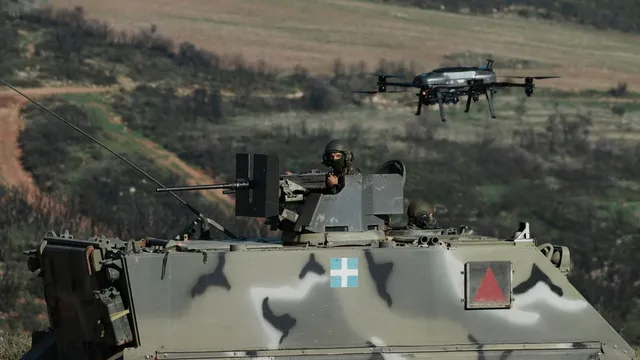
Greece demonstrates domestic drone capabilities during NATO exercise
Greece demonstrates domestic drone capabilities during NATO exercise
- Greece conducted a military exercise showcasing a broad range of domestically developed drones and counter-drone tools.
- The exercise demonstrated drones assisting in tactical operations, including delivering supplies and obstructing enemy movements.
- The event emphasized NATO's push for faster military innovation and adaptation to modern warfare.
Story
On November 14, 2025, Greece hosted a military exercise showcasing an array of domestically developed drones and counter-drone tools, responding to NATO’s emphasis on modernizing armed forces with innovations driven by startups. This exercise marked a significant shift towards utilizing drones in warfare, highlighting their operational possibilities in a full tactical scenario. Various types of drones were deployed, such as quadcopters and fixed-wings, playing pivotal roles in coordinating the mock battle on the hillside under a low November sun. The demonstrations included the use of small quadcopters for dropping mines, delivering medical supplies, and even projecting demoralizing audio messages to simulate psychological warfare against adversaries. The use of an experimental two-wheeled drone capable of operating from confined spaces adds to the unique capabilities displayed during this military initiative.
Context
The impact of drones on modern warfare has been profound, reshaping military strategies and the nature of conflict itself. Drones, or unmanned aerial vehicles (UAVs), have become pivotal in intelligence gathering, surveillance, and strikes, allowing military forces to execute operations with greater precision and fewer risks to personnel. The ability to remotely operate these vehicles provides significant tactical advantages such as real-time data transmission and targeted strikes against high-value targets without the immediate presence of ground troops. This technological advancement has led to a shift away from traditional warfare towards an approach where stealth, asymmetry, and precision are emphasized. As a result, military planners increasingly incorporate drones into their operational frameworks, enhancing their capabilities in both offensive and defensive roles. Moreover, drones are transforming the dynamics of battlefield engagement by allowing for prolonged monitoring of target areas and rapid response to emerging threats. The integration of advanced sensors and artificial intelligence has improved the operational effectiveness of drones, enabling them to conduct complex missions that were previously impossible or too risky for manned aircraft. These developments not only provide enhanced situational awareness for commanders but also facilitate decisions based on real-time intelligence. The strategic calculations involved in combat scenarios have evolved, as even smaller units can access capabilities that once required large-scale deployments. Consequently, this has resulted in a more decentralized approach to combat operations, where smaller, agile teams leverage drone technology to execute operations effectively. However, the rise of drones in warfare also raises significant ethical and legal concerns. The use of drones in military operations, particularly for targeted killings, has sparked debates over issues such as sovereignty, accountability, and civilian casualties. The remote nature of drone strikes often distances operators from the consequences of their actions, leading to questions about the moral implications of killing without direct engagement. Additionally, the proliferation of drone technology poses risks beyond traditional military powers, as non-state actors and terrorist groups increasingly gain access to UAVs. This democratization of drone warfare challenges existing frameworks of international law and complicates global security, as states must grapple with the implications of drones in asymmetric conflicts. In conclusion, the impact of drones on modern warfare is multifaceted, presenting both opportunities and challenges. While they enhance military capabilities and redefine traditional combat strategies, the ethical and legal ramifications demand careful consideration. Policymakers and military leaders must navigate this rapidly evolving landscape, balancing the benefits of drone technology with the responsibility to minimize harm and uphold international norms. As drone technology continues to develop, its influence on the future of warfare will remain a critical area for research and debate, necessitating ongoing dialogue around regulation, accountability, and the ethical use of force.


