

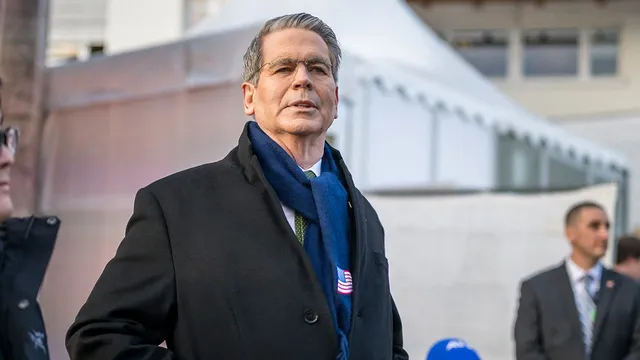
Trump declares Greenland crucial for national security
Trump declares Greenland crucial for national security
- Donald Trump emphasized Greenland's strategic importance during a phone call with NATO Secretary General Mark Rutte.
- The U.S. plans to discuss potential control over Greenland at the World Economic Forum in Davos.
- European leaders assert that Greenland's sovereignty under Denmark is not negotiable.
Story
On January 20, 2026, U.S. President Donald Trump communicated the importance of Greenland in a telephonic discussion with NATO Secretary General Mark Rutte. The conversation reportedly emphasized the strategic value of the territory for both national and global security, echoing Trump's previous assertion that Denmark cannot adequately safeguard Greenland. In the same context, Trump indicated plans for a meeting involving multiple parties at the World Economic Forum in Davos, Switzerland, although he refrained from disclosing the identities of those parties. He stated on Truth Social that there is 'no going back' regarding considerations about acquiring Greenland, as it holds substantial significance for the U.S. and its allies. Concurrently, Trump’s comments prompted military exercises in Greenland conducted by European NATO allies, aimed at consolidating unity in the face of Trump's aggressive territorial assertions. European leaders have voiced strong opposition to Trump's claims, emphasizing that Greenland’s sovereignty remains non-negotiable. In recent months, relations between the U.S. and its NATO allies, including Denmark, have become increasingly strained as Trump's push for Greenland's control intensifies. This came after Trump expressed discontent over not receiving the Nobel Peace Prize last year, linking that to his determination to assert control over Greenland, which he regards as an essential strategic asset amidst rising tensions with China and Russia. The situation has further escalated trade disputes, with Trump threatening to impose tariffs on European nations resisting his claims on Greenland, a move described by EU leaders as a mistake that could provoke retaliatory actions. Ursula von der Leyen, European Commission President, highlighted that such tariffs could only benefit adversaries and reiterated the EU's determination to respond firmly to any threats against Greenland's sovereignty. The overall geopolitical climate surrounding this discourse reflects a broader contest for influence in the Arctic region, as nations jockey for strategic positioning in an area of increasing importance due to its resources and military significance.
Context
The Arctic region has emerged as a focal point of geopolitical tensions, significantly influencing global security dynamics. As climate change diminishes ice cover, it exposes new shipping routes and untapped natural resources, prompting a scramble for territorial claims among Arctic nations. Countries such as Russia, the United States, Canada, and others have intensified their military presence and strategic initiatives in the Arctic, raising concerns about potential conflicts over sovereignty and access to resources. This geopolitical contest is not merely regional; it has global implications, affecting international trade, environmental policy, and the balance of power among nations. Russia's expansive military buildup, including the establishment of new bases and increased naval operations, exemplifies the heightened stakes in the Arctic. Simultaneously, the U.S. has been modernizing its Arctic capabilities and strengthening alliances with other Arctic states and NATO, framing its presence as essential to maintaining a rule-based order in the region. These actions exemplify the complexity of Arctic geopolitics, where environmental and strategic considerations intertwine, leading to a heightened risk of miscalculations or confrontations between major powers. The race for resources, alongside the quest for control over shipping lanes, further exacerbates these tensions, as nations weigh the potential economic benefits against the backdrop of security risks. Moreover, the Arctic's unique geopolitical landscape complicates existing security frameworks. The absence of a robust governance structure to manage disputes and resource allocation creates an environment ripe for potential conflicts, particularly as non-Arctic nations, interested in resource access or transit, seek to assert influence in the region. Initiatives like the Arctic Council, while valuable for cooperation, often lack the enforcement mechanisms necessary to address violations or aggressive posturing effectively. This deficiency underscores the need for a concerted international effort to establish clearer agreements and protocols that encompass both environmental protection and security concerns, fostering a cooperative atmosphere rather than allowing competition to dictate interactions in this delicate region. In conclusion, the geopolitical tensions in the Arctic are reflective of broader global security trends wherein geopolitics, environmental factors, and economic incentives converge. As Arctic nations and non-Arctic players pursue their interests, the potential for conflict heightens, placing a spotlight on international diplomacy and the necessity of collaborative frameworks. The future of Arctic security hinges on the ability of nations to navigate these complexities constructively, prioritizing dialogue over discord and fostering a sustainable Arctic strategy that acknowledges the interconnectedness of global stability. Only through concerted international effort and engagement can the geostrategic race for Arctic dominance be managed, ensuring that the region remains a zone of peace and cooperation rather than a flashpoint for conflict.


