

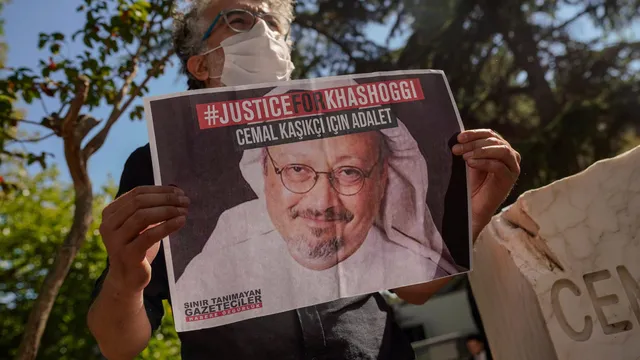
Hanan Khashoggi demands accountability for her husband's murder
Hanan Khashoggi demands accountability for her husband's murder
- Jamal Khashoggi was killed by Saudi agents in 2018 during an operation in Istanbul.
- His widow, Hanan El-Atr Khashoggi, has been outspoken about the lack of justice and accountability.
- Amidst her grief, she continues to seek compensation and the return of her husband's belongings.
Story
In 2018, Jamal Khashoggi, a prominent Saudi Arabian journalist, was murdered by Saudi agents in Istanbul. Khashoggi, a vocal critic of the Saudi government, was known for his writings for The Washington Post. During a visit to the Saudi consulate, he was killed in an operation that involved dismemberment, with his body never recovered. His wife, Hanan El-Atr Khashoggi, has continued to seek justice, claiming that no accountability has been achieved since his murder. The situation was further complicated in 2021 when she learned that her devices were targeted with spyware, suggesting a breach of privacy regarding her communications and discussions about the future with Jamal. Recently, with the arrival of Saudi Crown Prince Mohammed bin Salman in Washington, Hanan expressed her disappointment with the lack of recognition and denouncement of her husband's murder, especially in light of President Trump's dismissive remarks about Khashoggi. She holds hopes for receiving justice and compensation, along with the return of her husband's belongings, and wishes for a proper burial—emphasizing the emotional and personal toll the tragedy has taken on her life. Throughout these developments, she has called for greater accountability from the Saudi government regarding not only her husband's death but also the treatment of political prisoners in Saudi Arabia. This ongoing quest for justice illustrates both a personal struggle and a broader commentary on human rights in the kingdom.
Context
The situation regarding human rights in Saudi Arabia has drawn international attention and condemnation in recent years, particularly in light of the country's recent actions and policies. As of November 2025, human rights violations remain a critical concern, with ongoing issues related to freedom of expression, assembly, and the treatment of dissidents. The government has been known to suppress opposition, with reports of arbitrary detention and harsh sentences imposed on activists, journalists, and critics of the regime. The Saudi authorities routinely employ counter-terrorism laws to silence dissent under the guise of national security, leading to trials that often lack due process and result in prison sentences for individuals merely expressing their opinions. Overall, the sense of fear permeates civil society, stifling the voices of those who advocate for reform and human rights protections. Women’s rights in Saudi Arabia have been a particular focus of global scrutiny. While there have been some improvements, such as the lifting of the driving ban and increased participation of women in the workforce, significant inequalities remain. Women still face numerous restrictions tied to their personal autonomy and legal status, particularly in matters related to marriage, divorce, and child custody. Moreover, the male guardianship system continues to hinder women's ability to make independent decisions and limit their freedoms. Instances of domestic violence and harassment also remain inadequately addressed by the authorities, reflecting broader societal attitudes that often perpetuate gender discrimination. In terms of the treatment of migrant workers, the Saudi government has faced criticism for the exploitation and abuse that many foreign workers experience. The Kafala system, which ties workers' residency to their employers, often leads to situations of forced labor, lack of legal recourse, and deplorable living conditions. Reports indicate that many migrant workers endure wage theft, excessive working hours, and unsafe working environments, with complaints frequently going unaddressed by authorities. The COVID-19 pandemic has exacerbated existing vulnerabilities, leading to job losses and heightened risks of deportation for many migrant laborers who have little legal protection. Finally, while there have been diplomatic efforts and initiatives to portray a more progressive image of Saudi Arabia on the international stage, these actions often fail to translate into meaningful change within the country. Reports from various human rights organizations detail how the government's public relations efforts, such as hosting mega-events and promoting Vision 2030, stand in stark contrast to the ongoing violations faced by the population. As Saudi Arabia continues to navigate its portrayal as a modernizing state, the persistent violations of human rights cast a shadow over its credibility and commitment to reform. The international community remains watchful, urging for accountability and adherence to basic human rights standards as the kingdom grapples with its identity and future.


