

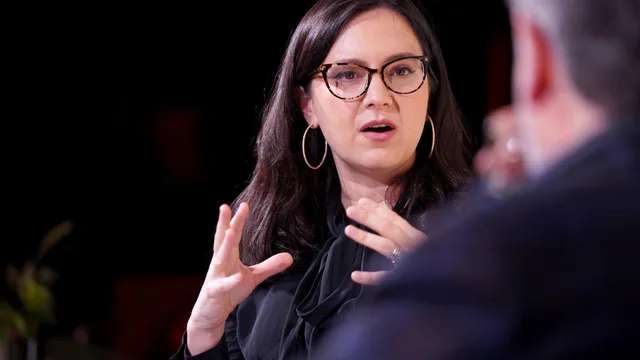
Bari Weiss faces backlash for CBS News Iran war coverage
Bari Weiss faces backlash for CBS News Iran war coverage
- Critics at CBS News have expressed concerns over Weiss's editorial approach regarding the Iran war.
- Key incidents include Weiss's controversial social media posts and omitted historical context from news coverage.
- The backlash reflects rising tensions about media representation and responsibility during international conflicts.
Story
In 2023, CBS News faced criticism for its reporting on the Iran war, with allegations directed at its editor-in-chief, Bari Weiss, for promoting a pro-Trump narrative. Following the onset of military actions by the U.S. and Israel against Iran, newsroom insiders expressed alarm over Weiss's editorial decisions, claiming that she was leading a 'propaganda-palooza' favoring Trump’s military strategy. Key examples of concern included Weiss's social media activity, such as tweeting a fire emoji during a segment where a guest criticized leftist opinions on the war. Insiders noted that a summary provided by CBS anchor Tony Dokoupil excluded critical historical context, notably the 1953 U.S.-backed coup in Iran, which many staffers considered alarming. This coverage has raised questions about Weiss’s influence and her past statements supporting Israeli military strikes in the Middle East. Furthermore, Weiss has taken a notable role in overseeing Iran-related news, engaging more than in previous topics, which some view as a strong test of her right-leaning inclinations. The cumulation of these aspects illustrates not only the internal discontent within CBS News but also highlights the broader concerns over media integrity and representation amid ongoing geopolitical strife. As public opinion around U.S. military engagements continues to be polarized, CBS’s approach under Weiss's helmsmanship has ignited debates over journalistic standards and responsibilities in times of war, particularly in reporting on complex narratives tied to significant historical precedents.
Context
The historical context of US-Iran relations is complex and rooted in a series of key events that have shaped the interactions between the two nations over decades. The relationship traces back to the early 20th century when the United States established diplomatic ties with Iran, initially involving cooperation in economic and military matters. However, this bond began to fray significantly after World War II, particularly during the 1950s, following the nationalization of the Iranian oil industry. The U.S. viewed this move as a threat to its interests, leading to the CIA-backed coup in 1953 that reinstated the Shah, Mohammad Reza Pahlavi. This intervention set a precedent for American involvement in Iranian affairs and led to widespread resentment among the Iranian populace against foreign interference, particularly that of the United States. The situation escalated in the 1970s with the Iranian Revolution, which resulted in the overthrow of the Shah and the establishment of the Islamic Republic under Ayatollah Khomeini in 1979. This marked a dramatic shift in US-Iran relations, as the new government was vehemently anti-American and perceived the U.S. as a symbol of Western imperialism. The hostage crisis, in which 52 American diplomats and citizens were held hostage for 444 days, further deteriorated relationships and led to sanctions imposed by the United States. The fallout from this event not only suspended diplomatic relations but also resulted in a long-standing adversarial stance from both sides that would shape policy and rhetoric for decades. In the years that followed, tensions continued to rise, particularly during the Iran-Iraq War (1980-1988), where the U.S. provided support to Iraq while maintaining an adversarial posture towards Iran. The conflict influenced U.S. perceptions of Iran as a destabilizing force in the region. Fast forward to the early 2000s, the U.S. renewed its focus on Iran amid concerns over its nuclear program and allegations of supporting terrorism. The 2003 invasion of Iraq and the subsequent destabilization of the country only intensified fears regarding Iranian influence across the region. This backdrop gave rise to the controversial 2015 Joint Comprehensive Plan of Action (JCPOA), an agreement designed to limit Iran's nuclear capabilities in exchange for sanction relief. The re-entry of tensions post-2018, when the U.S. unilaterally withdrew from the JCPOA under the Trump administration, marked a significant downturn in relations. The ensuing 'maximum pressure' campaign included severe sanctions targeting the Iranian economy and its oil exports, leading to a series of confrontations in the Persian Gulf and altered Iranian behavior on the nuclear front. As of 2026, the relationship remains fraught, with ongoing debates in the U.S. regarding how best to balance diplomatic engagement with the need for security in the region. The ever-changing dynamics, including domestic political factors on both sides, coupled with broader geopolitical concerns, continue to define the complex and often tumultuous history of U.S.-Iran relations.


