

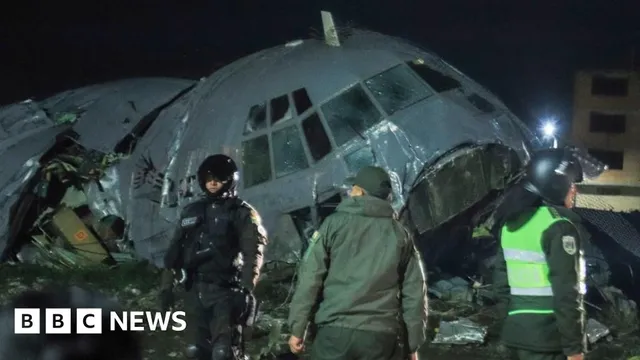
Tragedy strikes Bolivia as military plane crashes, claiming lives and scattering cash
Tragedy strikes Bolivia as military plane crashes, claiming lives and scattering cash
- A military cargo plane crashed in El Alto, Bolivia, resulting in at least 20 deaths and numerous injuries.
- The plane was transporting newly printed currency from Santa Cruz to La Paz when it skidded off the runway and collided with vehicles.
- Authorities are investigating the cause of the crash, amidst chaos as people attempted to claim the scattered money.
Story
In Bolivia, a tragic incident occurred on Friday when a cargo plane belonging to the Bolivian air force crashed in El Alto, a city near the capital, La Paz. The disaster took place around 18:15 local time as the Hercules C-130 plane was arriving from Santa Cruz, carrying newly printed banknotes for the Central Bank. Reports indicate that the plane skidded off the runway, crashed into vehicles on a highway, and ultimately ended up in a nearby field, leading to significant casualties. Initial reports provided by authorities suggested at least 15 fatalities, but subsequent updates indicated that the death toll had risen to at least 20, with many others injured. Eyewitnesses described a chaotic scene as the aircraft broke apart, scattering bundles of money on the ground. Videos circulated on social media showed people rushing to collect the banknotes despite the presence of police, who used tear gas to disperse the growing crowd around the crash site. The Police were forced to intervene as reports emerged of individuals attacking journalists covering the scene, defending their predicament from those trying to profit from the unsecured currency. The Minister of Defence, Marcelo Salinas, emphasized that the currency was not yet legal tender, lacking serial numbers, and warned that possessing the money would be a crime. The Central Bank echoed his sentiments, clarifying that the banknotes were in transit to La Paz and not yet issued for circulation. Emergency services reported at least 31 injuries related to this incident, while firefighters worked diligently to control the ensuing fire from the damaged plane. Furthermore, witnesses recounted precarious weather conditions, including a severe hailstorm and lightning, at the time of the crash, which may have played a role in the tragedy. El Alto International Airport was temporarily closed following the event, as officials launched an investigation into the cause of the crash. The Bolivian air force indicated that two of the six crew members aboard had not been found by the end of the evening, contributing to the prolonged chaos surrounding the incident and the community's grief over this catastrophic event for the nation.
Context
Bolivia's air safety regulations are critical in ensuring the safe operation of aviation in one of the world's most challenging environments. The country’s unique topography, with its high-altitude airports and diverse climate, necessitates stringent safety measures. The Bolivian Civil Aviation Authority (AASANA) is tasked with overseeing air safety, operating under regulations established by the International Civil Aviation Organization (ICAO). These regulations cover various areas, including aircraft maintenance, pilot training, and operational procedures, which are essential for managing the risks associated with flying in this distinct geography. In recent years, Bolivia has made significant strides in improving air safety standards. The government has invested in upgrading airport infrastructures and enhancing air traffic control systems to accommodate increasing air traffic while prioritizing safety. This includes the introduction of advanced navigational aids and communication technologies, which are vital for flight operations in the country's mountainous regions. Moreover, training and certification programs for personnel involved in aviation operations have been strengthened, ensuring that both pilots and ground crew are well-equipped to handle the complexities of the dramatic Bolivian terrain. Despite these advancements, challenges remain in the realm of aviation safety. Incidents involving small aircraft, often used for transportation to remote areas, highlight the ongoing risks associated with inadequate oversight and the need for rigorous adherence to safety protocols. A push for compliance with international safety standards is crucial, as it not only enhances the operational integrity of airlines but also fosters public confidence in air travel. Continuous assessment and improvement of safety regulations in light of operational data and incident reports will be essential for the future. In conclusion, Bolivia’s commitment to air safety is reflected in its regulatory framework, which aligns with international norms and aims to address local challenges. The dedication of the AASANA and the Bolivian government to improving safety standards showcases a proactive approach to mitigating risks in aviation. As the country continues to modernize its aviation infrastructure and practices, ongoing vigilance and adaptation to emerging challenges will be key to ensuring that air travel remains safe and reliable for all.


