

Trump weighs military options amid Venezuela crisis
Trump weighs military options amid Venezuela crisis
- Top Pentagon officials briefed President Trump on military options for potential operations in Venezuela.
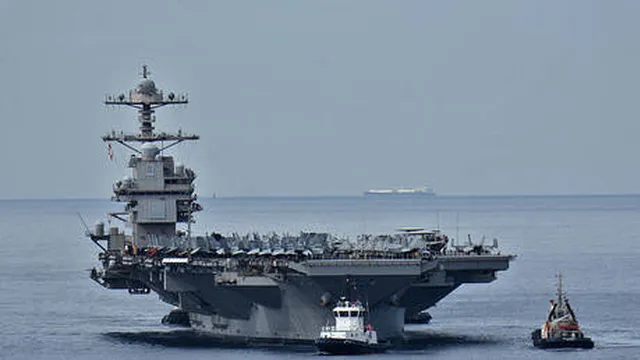
- The U.S. military has increased its presence in the region, including deploying the USS Gerald Ford aircraft carrier.
- Concerns over potential military action include the risk of political instability in Venezuela.
Story
In recent days, discussions at the Pentagon surrounding military options for Venezuela have intensified, with updated briefings provided to President Donald Trump. During a meeting, top officials, including Defense Secretary Pete Hegseth and Chairman of the Joint Chiefs of Staff General Dan Caine, laid out new potential military operations, including both air strikes and land strikes against Venezuela, although no definitive action has been authorized yet. This development follows significant U.S. military movements in the region, including the deployment of the USS Gerald Ford, which arrived recently in the Southern Command area of operations. The U.S. has expressed concerns over the Venezuelan government, accusing President Nicolas Maduro of involvement in drug trafficking, which has further strained relations and increased tensions. As a precaution, Venezuela has mobilized its military in response to the perceived threats from the U.S., conducting drills to showcase readiness to defend the homeland. While officials have stated the options range from non-action to air strikes targeting various Venezuelan infrastructures, there remains a significant risk associated with any direct military intervention. Analysts suggest that military action could exacerbate the political instability within Venezuela, creating a power vacuum that may lead to further chaos instead of resolution of the ongoing crisis. Lawmakers in the U.S. have indicated the need for legal justifications regarding the potential military action, as a previous secret list of targets had circulated but was tied mainly to maritime operations rather than direct strikes against legitimate state targets in Venezuela.
Context
The history of U.S.-Venezuela relations is marked by a complex interplay of political, economic, and social factors that have shaped the bilateral ties between the two nations. Historically, the relationship has its roots in the early 20th century when Venezuela emerged as a significant oil producer. As the U.S. became increasingly dependent on foreign oil, particularly during the post-World War II era, its interest in Venezuelan oil wealth grew. This led to a cooperative period wherein the U.S. supported the Venezuelan government through investments and military aid, viewing Venezuela as a strategic partner in the Western Hemisphere during the Cold War. However, the relations began to sour in the late 20th century as Venezuelan politics became increasingly polarized. The rise of Hugo Chávez in the late 1990s marked a turning point in U.S.-Venezuela relations. Chávez embraced a socialist agenda, diversifying Venezuela's economy away from oil dependency while strengthening ties with Cuba and other leftist governments in Latin America. His confrontational rhetoric towards the U.S. turned public sentiment against Washington, and the U.S. government frequently criticized Chávez's authoritarian tendencies. The U.S. responded to these developments with a mix of diplomatic isolation and economic sanctions, exacerbating tensions between the two nations. Following Chávez’s death in 2013, his successor Nicolás Maduro faced escalating challenges, both domestically and internationally. Under Maduro, Venezuela experienced a deteriorating economic situation characterized by hyperinflation, food shortages, and mass emigration. The U.S. policy towards Venezuela hardened under the Trump administration, which recognized opposition leader Juan Guaidó as the interim president in 2019, aiming to leverage international support against Maduro’s regime. Sanctions targeting Venezuela’s oil sector and key government officials were intensified, worsening the humanitarian crisis in the country, while the U.S. portrayed itself as a champion of democracy and human rights. The complex dynamics of U.S.-Venezuela relations continue to evolve, particularly in light of global geopolitical shifts. By 2025, the ongoing humanitarian situation in Venezuela, along with the broader implications of U.S.-Latin American relations, remain critical factors influencing policy decisions. The approach taken by the Biden administration indicates a potential shift towards a more diplomatic engagement, assessing the role of dialogue and multilateral negotiations in addressing the ongoing crisis. Nonetheless, the historical context of antagonism and mistrust underscores the difficulty of achieving a constructive relationship between the two nations.


