

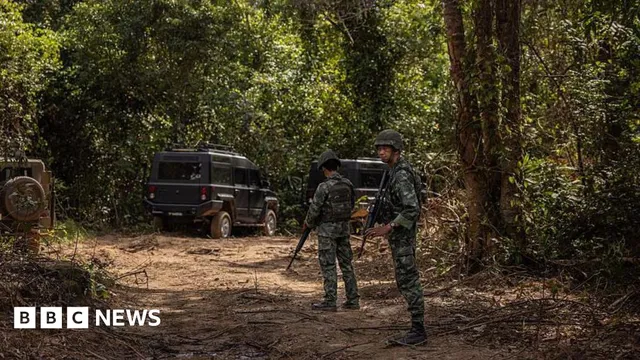
Escalating violence as Thai troops clash with Cambodian forces at the border
Escalating violence as Thai troops clash with Cambodian forces at the border
- The Thai army claimed that Cambodian soldiers opened fire on Thai troops during a border engineering project.
- Cambodia accused Thailand of initiating the attacks on its territory, while escalating military actions have led to evacuations in border provinces.
- The recent fighting has jeopardized diplomatic progress between Thailand and Cambodia, urging leaders to call for a return to talks.
Story
Recently, tensions escalated along the Thai-Cambodian border, with reports of renewed clashes following a ceasefire earlier in July 2025. The Thai army claimed that Cambodian forces initiated gunfire towards Thai troops stationed to secure a road improvement project in Si Sa Ket Province, while Cambodia countered that it was Thai forces that attacked first. This exchange has led to significant military actions on both sides, with Cambodia allegedly utilizing tanks and drones, while Thailand accused Cambodia of launching volleys of rockets into civilian areas within Thailand's territory. Amidst the chaos, Malaysia has proposed to mediate discussions amid calls for a return to diplomatic efforts, with leaders expressing concern over the long-standing disputes potentially devolving into prolonged confrontations. Videos surfaced on social media depicting distress among families in Cambodia's border provinces as evacuations were ordered due to the intensifying military actions, showcasing the deeply felt impact of the conflict on innocent civilians. The vaccination drive in the affected regions has been interrupted, revealing the broader implications of the border clashes on community safety and health in these areas.
Context
The history of tensions along the Thailand-Cambodia border has been characterized by a complex interplay of historical, territorial, and nationalistic factors. The roots of these tensions can be traced back to the colonial era when the borders of Southeast Asia were largely drawn by European powers. The modern borders did not reflect the ethnic and cultural demographics of the region, which has contributed to ongoing disputes. One of the key historical touchpoints is the ancient Khmer Empire, which extended into parts of present-day Thailand. This historical connection has been both a source of pride and contention as each nation lays claim to cultural heritage linked to this shared past. One of the most significant triggers for contemporary disputes is the area surrounding the Preah Vihear Temple, a UNESCO World Heritage site, which has been at the center of a prolonged conflict between Thailand and Cambodia. In 1962, the International Court of Justice ruled that the temple belonged to Cambodia, a decision that was not fully accepted by Thailand, leading to nationalistic fervor in both countries. Clashes over the temple grounds intermittently erupted, particularly during the late 2000s and early 2010s, bringing soldiers to the border and resulting in loss of life and displacement of communities. These confrontations were fueled by national pride, political maneuvering, and sometimes inflammatory rhetoric from leadership on both sides. The political landscape in both countries has further complicated the situation. In Thailand, the political turmoil and changing governments have often seen border issues used to rally public support or distract from domestic problems. Similarly, Cambodia's government has leveraged the border tensions to consolidate power and appeal to nationalism among its populace. Moreover, the lack of effective communication and dialogue between the two nations has exacerbated misunderstandings, increasing the risks of armed confrontations. Over the years, numerous attempts at diplomacy and peace negotiations have been initiated, with varying degrees of success, but a lasting resolution remains elusive. In recent times, economic interests, such as trade and tourism, have also played roles in shaping the border dynamics. Both countries share a desire for peaceful co-existence to promote regional stability and economic growth. Initiatives aimed at joint development of border areas and cultural exchanges could foster a more cooperative relationship, moving away from historical grievances. Nevertheless, the underlying issues of national sovereignty, identity, and territorial integrity continue to pose challenges. As both nations evolve, it is imperative for Thailand and Cambodia to engage in constructive dialogue rooted in mutual respect to pave the way for a more peaceful and collaborative future.


