

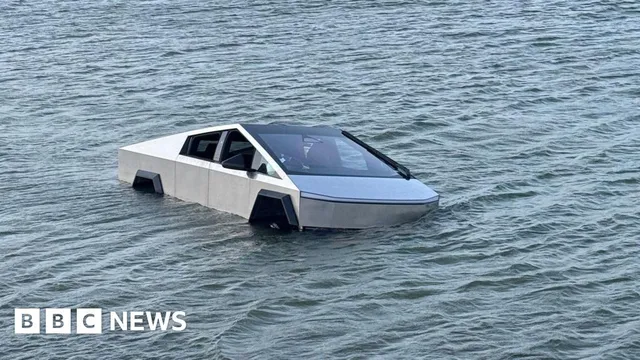
Man arrested for driving Tesla Cybertruck into lake to test wade mode
Man arrested for driving Tesla Cybertruck into lake to test wade mode
- A man was arrested after driving his Tesla Cybertruck into Grapevine Lake.
- The vehicle was abandoned by the driver after taking on water and becoming disabled.
- Authorities warn about the legal and safety concerns associated with driving into water bodies.
Story
In north Texas, an incident occurred where a man reportedly drove his Tesla Cybertruck into Grapevine Lake to utilize the vehicle’s wade mode feature. The incident took place on a Monday, leading to the involvement of the Grapevine Police Department and the Grapevine Fire Department Water Rescue Team. After the driver abandoned the vehicle and it took on water, the authorities were called to recover the partially submerged truck. The wade mode feature allows the Cybertruck to navigate through shallow bodies of water, up to a maximum depth of 81.5 cm (32 inches), according to Tesla's owners manual. The driver of the Cybertruck was charged by police for operating a vehicle in a closed section of the lake and for violations regarding water safety equipment. It was disclosed by the authorities that the driver intentionally drove into the lake after stating his intent to experience the wade mode feature. However, the vehicle quickly became disabled and took on water. The incident raises significant legal and safety concerns, as noted by a police spokesperson, Katharina Gamboa, cautioning against driving vehicles into water bodies. Tesla provides clear guidelines on the operation of its vehicles and explicitly states that it is the driver’s responsibility to assess the water depth before entering. Furthermore, the company notes that if any damage or water ingress occurs as a result of driving in water, it won't be covered by the vehicle's warranty. They recommend steering clear of deep or rapidly flowing waters which can be hazardous. Despite the Cybertruck's physical capabilities in shallow waters, the decision to drive into such conditions can lead to legal repercussions, as well as safety risks not only for the driver but for any potential rescuers who may have to intervene. Following the recovery of the vehicle, the police have echoed sentiments on the legal implications of knowingly driving a vehicle into restricted areas of water, encouraging citizens to be aware of and respect safety regulations enforcing such actions. Law enforcement reinforces that such reckless behavior could result in dire consequences, emphasizing the need for responsible vehicle operation and adherence to local laws governing water activities.


