

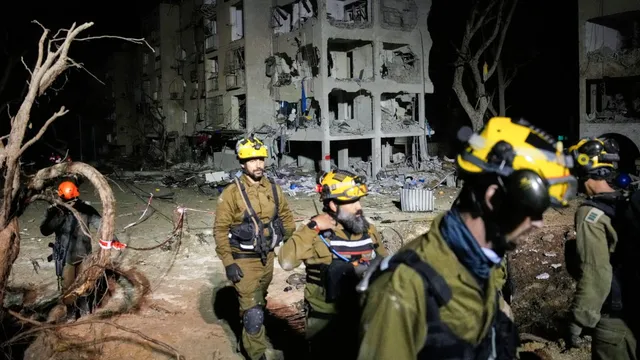
Iranian missiles injure over 180 people in Israel amid ongoing conflict
Iranian missiles injure over 180 people in Israel amid ongoing conflict
- Iran launched missile attacks on southern Israel, targeting towns near critical infrastructure.
- The strikes resulted in significant casualties and damage, alarming Israeli authorities and the public.
- Prime Minister Netanyahu vowed to retaliate, emphasizing the need to defend civilians and national security.
Story
In the context of escalating tensions, Iran launched missile attacks on southern Israel on March 21, 2026, wounding more than 180 individuals in the towns of Arad and Dimona. The strikes coincided with three weeks of conflict initiated by US-Israeli strikes on Iran, raising concerns about safety in areas near critical infrastructure. The missile that hit Dimona is particularly alarming due to its proximity to Israel's main nuclear facility, although officials noted there was no immediate threat to nuclear operations. Within just days of these missile strikes, there was heightened vigilance among Israeli security forces, especially considering Iran's claim that these attacks were retaliation for targeted strikes on its nuclear plants. Reports indicated that Iranian projectiles had reached Israel's territory, with stats pointing to Israel intercepting around 92% of such attacks. The attacks resulted in significant damage to residential buildings, leading to stricken civilians being evacuated and treated for their injuries. Prime Minister Benjamin Netanyahu and other officials condemned the attacks, stating that they signify a blatant assault against civilian infrastructure. In response to the missiles, Israeli forces are expected to intensify their operations, both against Iran and Hezbollah, Iran's Lebanese ally. This situation underscores a broader geopolitical struggle, as Iran's response is viewed as a direct message amidst ongoing international scrutiny regarding its nuclear ambitions. Governors and military leaders across different nations have voiced their concerns over the fragility of stability in the region and the potential risk of escalating violence as both sides prepare for further confrontations. As the conflict intensifies, the humanitarian aspect remains a significant concern, with many civilians caught in the crossfire. The damages from the missile strikes have led to local authorities being overwhelmed by the aftermath, while emergency services have been on high alert to address injuries and provide psychological support. Continued tensions and missile exchanges hint at a drawn-out conflict, where the balance of power is precariously shifting, and the international community is left grappling with the implications for security in the Middle East.
Context
The Iran-Israel conflict is a complex and multifaceted geopolitical issue that has roots in historical, ideological, and strategic disagreements. The tension can be traced back to the Islamic Revolution in 1979 when Iran transformed from a Western-aligned monarchy under Shah Mohammad Reza Pahlavi into the Islamic Republic under Ayatollah Khomeini. This revolution drastically shifted Iran's foreign policy, leading it to oppose Israel, which it viewed as a heretic state supported by the United States. Key events, such as the establishment of revolutionary guards and Israel's support for Iraq during the Iran-Iraq War, further deepened animosity. Iran's steadfast backing of Palestinian groups, such as Hamas and Hezbollah, has also perpetuated the conflict, as these organizations are committed to opposing Israel's existence. Iran's prominence in the Axis of Resistance against Israel reflects its ideological commitment to combating Zionism and U.S. influence in the region. Throughout the years, various incidents have intensified hostilities, particularly in the context of nuclear negotiations and military engagement. Israel has repeatedly expressed concerns about Iran's nuclear ambitions, fearing that the development of nuclear weapons could lead to an existential threat. In response, it has engaged in covert operations and military strikes against Iranian nuclear facilities, as well as targeting Iranian military personnel in Syria. Additionally, both nations have employed cyber warfare tactics to undermine each other's capabilities. Iran, for its part, has threatened to retaliate against Israel for any attacks, indicating that the conflict could spill over into a broader regional confrontation. The recent developments, including Iran's advancements in missile technology and its proxy's capabilities, have made the prospect of direct confrontation increasingly likely. Diplomatic approaches to mitigate the Iran-Israel conflict have faced numerous challenges. International efforts, including the 2015 Joint Comprehensive Plan of Action (JCPOA), aimed at curbing Iran's nuclear program in exchange for the lifting of sanctions, were undermined when the United States unilaterally withdrew from the agreement in 2018. This action not only escalated tensions between Iran and the U.S. but also strained Israel's relationships with various allies who saw the negotiations' potential benefits. As Iran's nuclear advancements continued, Israel intensified its campaign to globally rally support against Iran, presenting it as a destabilizing force in the Middle East. The geopolitical landscape has shifted significantly, with regional powers reassessing their positions in light of the conflict, leading to new alliances and enmities. In summary, the Iran-Israel conflict continues to evolve, shaped by historical grievances, ideological clashes, and strategic interests. Each party has a vested interest in countering the other's influence, leading to escalating military actions and heightened rhetoric. The complexities of the situation underscore the need for effective diplomacy, though prospects for resolution remain uncertain as both nations remain entrenched in their positions. As regional dynamics continue to shift, understanding the nuances of the Iran-Israel conflict is critical for any future efforts aimed at resolving tensions in the Middle East.


