

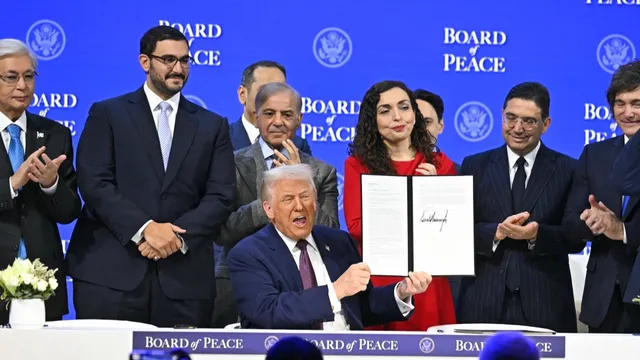
Netanyahu joins Trump's controversial Board of Peace amid war crimes warrant
Netanyahu joins Trump's controversial Board of Peace amid war crimes warrant
- Benjamin Netanyahu confirmed his participation in Donald Trump's Board of Peace for Gaza, despite earlier objections.
- The Board of Peace aims to oversee the implementation of a Gaza peace plan involving various countries.
- Netanyahu's involvement may hinder relationships with Arab nations and further complicate the peace process.
Story
In January 2026, Israeli Prime Minister Benjamin Netanyahu announced his decision to join Donald Trump's newly established Board of Peace, aimed at overseeing the next phase of the Gaza peace plan. Initially, Netanyahu had criticized the board's makeup due to the inclusion of Turkey’s Foreign Minister Hakan Fidan and Qatari diplomat Ali Al-Thawadi, who were appointed to a separate Gaza Executive Board without Israel's coordination. This led to tensions surrounding Israel’s role in the peace process, especially given the outstanding arrest warrant against Netanyahu from the International Criminal Court for alleged war crimes during the ongoing conflict. Trump's Board of Peace represents a shift in diplomacy focused on the Gaza region, inviting multiple countries, including traditional US allies and adversaries, to participate in a peace-building effort. The board's charter suggests a more nimble and effective alternative to the United Nations, attracting approximately 35 nations thus far, as diplomatic figures and businesses are also invited to join. Critics have pointed out concerns regarding the board supplanting the UN's role and the concentration of decision-making power in Trump's hands, which raises questions about its credibility as a neutral mediator in the peace process. Several Muslim-majority countries, including Saudi Arabia, Turkey, Egypt, Jordan, Indonesia, Pakistan, and Qatar, have publicly accepted Trump’s invitation, while other nations have expressed hesitation due to potential repercussions from the US administration. The board aims to consolidate a permanent ceasefire in Gaza, supporting reconstruction efforts and fostering a long-lasting peace in the region. However, challenges persist, especially with Hamas and Israel not fully agreeing on terms regarding demilitarization and the release of hostages. Meanwhile, Netanyahu's acceptance of the invitation may create further backlash among Arab nations that view his involvement as an obstacle to peace negotiations. For at least the past few months, the Gaza region has seen heightened violence and casualties, raising concerns about the effectiveness of a new peace initiative led by controversial leaders. As the project unfolds, various nations will have to navigate their national interests while balancing pressures from both the Trump administration and their domestic constituencies, which may lead to a complicated diplomatic landscape in 2026.
Context
The Gaza peace plan proposed during Donald Trump's administration sought to address the long-standing Israeli-Palestinian conflict through a set of frameworks aimed at establishing peace and stability in the region. Central to this plan was the recognition of Israel's sovereignty while also proposing a future Palestinian state, a point of contention that has historically divided negotiations. The plan outlined key territorial adjustments, with Israel retaining control over major settlement areas, while offering Palestinians alternate territories and economic incentives to promote regional development and connectivity. This approach intended to create a two-state solution but faced criticism for failing to adequately address the rights and aspirations of Palestinians, particularly in terms of land rights and sovereignty over East Jerusalem, a critical point of dispute between both sides. The economic aspect of Trump's Gaza peace plan was highlighted as potentially transformative, proposing significant investment in Palestinian territories to develop infrastructure and create jobs. The plan aimed to allocate substantial funds, potentially exceeding 50 billion dollars, to support these initiatives, seeking to enhance the quality of life for Palestinians, thereby fostering a more conducive environment for peace discussions. Although ambitious in its economic proposals, critics argued that without a firm commitment to political issues, especially regarding borders and security arrangements, economic growth alone would be insufficient to resolve deep-rooted tensions and grievances. The diplomatic approach of the plan involved building alliances with Arab nations, reframing the Palestinian issue within a broader regional context. Support from key regional players was viewed as crucial to its potential success, attempting to align shared interests against Iran's influence and establishing a unified stance towards Israel. However, the lack of direct involvement or endorsement from Palestinian leadership led to widespread skepticism about the plan's viability and its effectiveness in genuinely addressing the core concerns of the Palestinian populace. The plan's reliance on regional cooperation was seen as a double-edged sword, as Arab nations' support would be contingent on significant concessions from both sides. Ultimately, while the Trump administration's peace plan reflected a paradigm shift in U.S. foreign policy towards the Israeli-Palestinian conflict, its execution and reception highlighted the complexities of achieving lasting peace in the region. The framework proposed an ambitious vision but fell short of garnering acceptance from either side, emphasizing the challenges inherent in negotiating conflicting national narratives and aspirations. The ongoing tension since the plan's introduction showcases the intricate dynamics that continue to define the Israeli-Palestinian relationship, affirming that any future agreements will require not only bold ideas but also trust-building between the parties involved.


