

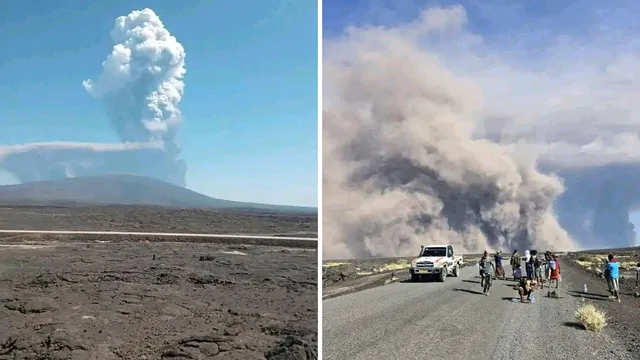
Ethiopia's Hayli Gubbi volcano erupts for the first time in 12,000 years
Ethiopia's Hayli Gubbi volcano erupts for the first time in 12,000 years
- On November 23, 2025, Hayli Gubbi volcano erupted for the first time in nearly 12,000 years.
- The eruption sent ash clouds drifting across the Red Sea toward Yemen, Oman, and parts of India, disrupting air travel.
- The event highlights the risks posed by dormant volcanoes and the need for ongoing monitoring and awareness.
Story
Ethiopia, specifically in the Afar region, witnessed an unprecedented volcanic event when Hayli Gubbi erupted for the first time in nearly 12,000 years on November 23, 2025. The eruption began around 8:30 a.m. UTC and sent ash and sulfur dioxide plumes soaring up to 45,000 feet (13.7 kilometers) into the atmosphere. The initial reports indicated that thick clouds of ash drifted across the Red Sea and were forecast to impact Yemen, Oman, and parts of India as the situation developed. As a result, local villages such as Afedera were blanketed in ash, causing concerns for livestock herders whose grazing fields became smothered. Local officials reported no casualties from the eruption, despite loud explosions and shock waves being felt by nearby residents, described by one as sounding like a sudden bomb detonating. The Hayli Gubbi volcano, located about 500 miles from Addis Ababa, stands out as a rare site within the geologically active Danakil Depression. This area typically experiences low seismic activity, making the eruption of Hayli Gubbi significant. The Toulouse Volcanic Ash Advisory Center confirmed the confirmation of the eruption shortly after it started. Monitoring by various research institutions, including Michigan Technological University, played an essential role in tracking the destructive potential of the ash clouds. Furthermore, the eruption has significant implications for aviation. The ash clouds disrupted air traffic in the Red Sea region, leading to numerous flight cancellations and diversions across airlines in India and the Middle East. This disruption raised concerns about flight safety due to ash affecting aircraft engines and visibility. Major airlines like Air India and IndiGo reported flights either cancelled or diverted due to the ash plume's impact. As the ash was forecast to drift eastward towards China, it raised further concerns regarding air quality and public health, amidst ongoing protests against air pollution in Indian cities. In broader terms, the eruption serves as a powerful reminder of the potential hazards posed by long-dormant volcanoes that can unexpectedly awaken. Scientists continue to monitor Hayli Gubbi and its surrounding geological landscape closely, given the essential insights into volcanic behavior that such events can yield. With the eruption occurring in an already vulnerable ecological region, the long-term socio-economic impacts on local communities, especially livestock herders, may evolve as the situation develops in the coming weeks and months, necessitating ongoing observation and research. Authorities emphasize the importance of continued vigilance in tracking potential volcanic activity and monitoring the ash's movement to mitigate risks associated with air travel and local public safety.
Context
The geological studies of the Afar region in Ethiopia present a unique opportunity to understand the dynamics of tectonic processes as this area is located at the meeting point of three tectonic plates: the African Plate, the Arabian Plate, and the Somali Plate. This convergence leads to a variety of geological phenomena, including rift formation, volcanic activity, and extensive land deformation. The Afar Triangle, which is part of this region, is known for its active rifting, where the tectonic forces are pulling the land apart, resulting in the formation of new crust and the emergence of rift valleys. The region's geology is characterized by extensive basalt formations and volcanic plugs, which provide critical insights into both the present-day tectonic activity and the geological history of the Earth’s crust in areas undergoing rifting and extension. Geologically, the Afar region is famed for its numerous active volcanoes, including Erta Ale and Dabbahu, which are integral to understanding explosive volcanic behavior in rift zones. Continuous monitoring of these volcanoes has revealed insights into their eruptive patterns and the magma supply systems beneath them, providing valuable data for assessing volcanic hazards. Additionally, the presence of geothermal resources in the Afar region highlights the potential for sustainable energy exploitation, aligning with global interests in renewable energy sources. The geology of the region also contains rich deposits, including salt, potash, and other minerals, which have significant economic implications locally and for broader regional trade. The interplay between geological forces has profound implications for both natural ecosystems and human settlement in and around the Afar region. The unusual geological formations resulting from rifting create diverse habitats supporting unique flora and fauna. However, tectonic activity also poses significant risks to the local populations, especially in terms of volcanic eruptions and earthquakes. The studies undertaken in this region aim to develop effective management strategies to mitigate these risks, as understanding of the local geology is critical for designing resilient infrastructure and safeguarding communities from natural disasters. Furthermore, researchers continue to explore the region's past climate changes recorded in the geological stratigraphy, which may hold keys to understanding historical human migration patterns and adaptations. In conclusion, the ongoing geological studies in the Afar region of Ethiopia exemplify the complex interplay between tectonics, volcanology, and climate change, providing a rich tapestry of knowledge that can inform both scientific understanding and practical applications. The need for comprehensive interdisciplinary research is paramount; it not only enhances our understanding of Earth's processes but also aids in the development of strategies to harness the region’s natural resources while minimizing hazards to human population and infrastructure. The geological insights garnered from the Afar region are invaluable, serving as a model for studying similar geological features worldwide.


