

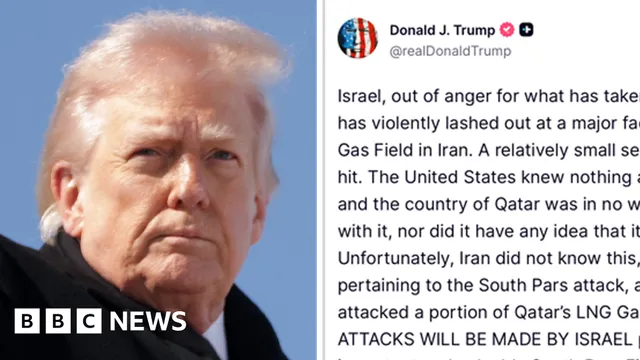
Trump threatens to blow up Iran's South Pars gas field amid escalating conflict
Trump threatens to blow up Iran's South Pars gas field amid escalating conflict
- Iran retaliated against Israel's strike on the South Pars gas field by attacking energy facilities across the Gulf.
- Donald Trump issued a warning that further Iranian attacks on Qatar would lead to massive military retaliation against Iran.
- The escalation in conflict poses significant risks to regional stability and the global economy.
Story
In recent days, tensions have escalated significantly between Israel, Iran, and Qatar following an Israeli strike on Iran's South Pars gas field, a crucial energy site. This attack led to a heavy response from Tehran, which targeted multiple energy facilities across the Gulf, including Qatar's Ras Laffan Industrial City. President Donald Trump, reacting to the retaliatory strikes, condemned Iran's actions and emphasized that Israel would refrain from further attacks on the South Pars field unless provoked by Iran. He further threatened that in the event of an Iranian attack on Qatar, the United States would respond by completely destroying the South Pars gas field. Experts suggest that this shift in Israeli military strategy from targeting officials to energy infrastructure may have long-term consequences for both Iranian civilians and the global economy, affecting oil and gas supply chains. The attack on the gas field is part of a broader conflict that has already seen casualties among high-ranking Iranian military leaders, and it's raising concerns about the future stability of the region. As Iran retaliated by targeting vital energy facilities in Qatar, it also signaled a potential shift in the geopolitical landscape, with the possibility of prolonged conflict and heightened economic repercussions for Iran, Qatar, and ultimately the global market, especially in energy sectors.
Context
The Middle East has long been a region marked by geopolitical tensions and complex alliances, influenced by a mixture of historical grievances, religious divides, and external interventions. In recent years, particularly leading up to 2026, there have been notable developments that have reshaped the geopolitical landscape. The emergence of new alliances, such as those formed during the Abraham Accords, has shifted the dynamics between Israel and several Arab nations, providing a framework for enhanced cooperation in areas such as trade, security, and technology. This new cooperation has not only fostered economic opportunities but has also posed challenges for longstanding rivalries, particularly with Iran, which views the rapprochement as a threat to its influence in the region. Iran remains a pivotal player in Middle Eastern geopolitics, especially as it continues to assert its dominance through proxies and regional alliances. The country has engaged in a campaign to solidify its position, especially by leveraging its relationships with non-state actors in Iraq, Syria, Lebanon, and Yemen. Recent escalations in its nuclear program and missile capabilities have raised concerns among neighboring states and global powers, prompting discussions around renewed diplomatic engagements and potential sanctions. The ongoing tensions between Iran and Saudi Arabia further complicate the situation, as both seek to expand their influence and control over the region, often resulting in proxy conflicts that draw in additional players, including the United States and Russia. Turkey’s role in the Middle East has also evolved, particularly as it seeks to assert itself as a regional leader. Its military engagements in Syria and involvement in Libya highlight a shift from being a NATO member state to a more independent foreign policy actor willing to engage directly in regional conflicts. Turkey's aspirations to lead a coalition of Sunni Muslim-majority nations against perceived threats from Shiite Iran have further solidified its position, but it also risks alienating potential allies within the broader international community. The impact of Turkey's actions has sparked discussions about the balancing act required for regional stability, as it navigates complex relationships with both Western and Eastern powers. The geopolitical landscape is further complicated by the role of global powers such as the United States, Russia, and China. The U.S. continues to exert influence in the region through military presence and diplomatic efforts, yet faces growing competition from Russia and China, who are expanding their economic and military ties. Russia's involvement in Syria and its partnerships with Iran and Turkey serve to challenge U.S. hegemony in the region. On the economic front, China's Belt and Road Initiative presents an opportunity for investment and development in Middle Eastern infrastructure, further entrenching its influence. As the region navigates these complex dynamics, the interplay between local factors and international interests will remain critical in understanding the future of Middle East geopolitics.


