

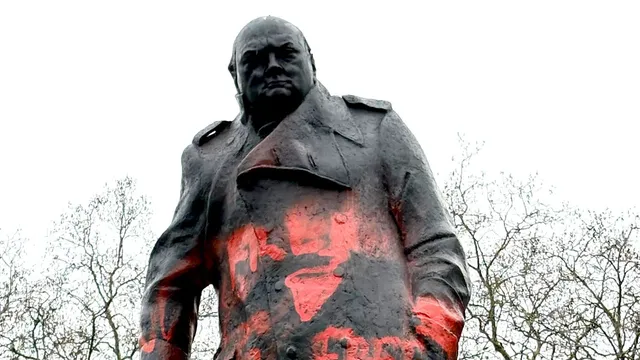
Man arrested for defacing Churchill statue with pro-Palestinian slogans
Man arrested for defacing Churchill statue with pro-Palestinian slogans
- A man was apprehended after defacing a monument in London with slogans critical of Zionism.
- The vandalism was part of ongoing tensions related to the Israel-Palestine conflict and was claimed by an activist group.
- Authorities condemned the act as an attack on British culture and history, stressing the importance of protecting national symbols.
Story
In the United Kingdom, particularly in London, the statue of former Prime Minister Winston Churchill was vandalized recently. A 38-year-old suspect was arrested on the morning of February 27, 2026, after being caught defacing the statue with pro-Palestinian slogans painted in red. The slogans included messages such as 'Zionist war criminal' and 'Stop the Genocide.' This act of vandalism reflects ongoing tensions related to the Israel-Palestine conflict, with various activist groups advocating for the rights of Palestinians. The vandalism occurred around 4 AM, and Metropolitan Police were alerted moments after it began. Officers arrived on the scene within two minutes and detained the suspect, who was subsequently charged with racially aggravated criminal damage. Authorities have refused to disclose the suspect's identity, as he has yet to be formally charged. Following the incident, the statue was cordoned off for cleaning, drawing further attention to the vandalism. Activist groups have claimed responsibility for the act, expressing their views against perceived human rights violations occurring in Palestine. This incident follows a history of vandalism at this particular statue, which also became a target during the Black Lives Matter protests in 2020, when it was sprayed with accusations of racism against Churchill. Many public figures condemned the recent act of vandalism, calling it a disgrace and an attack on British culture and history. The government responded strongly to the vandalism, considering Churchill an important figure in British history. Officials emphasized the need to protect national landmarks, asserting that attacking these symbols is an attack on democracy. The backlash against the act of vandalism raises questions regarding freedom of expression versus respect for national symbols. This incident not only reflects the current political climate concerning the Palestine issue but also highlights growing frustration and tensions within society regarding historical figures and their legacies. The statue of Churchill, a prominent icon, has stood since 1973 and should remain a symbol of the nation's history rather than a canvas for political statements.
Context
The Free Palestine movement has garnered significant attention globally as advocacy for Palestinian rights has intensified over the years. Central to this movement is the call for an end to the Israeli occupation of Palestinian territories and the recognition of Palestinians' right to self-determination. The movement encompasses a variety of actions, from grassroots organizing to formal protests, which aim to raise awareness of the ongoing conflict, human rights violations, and the impact of policies on Palestinian communities. This multifaceted approach reflects a deep-rooted historical context filled with complex socio-political dynamics that continue to influence the region and international relations. Protests often occur in various forms and locations, mobilizing support from local communities as well as international solidarity groups. Demonstrations against Israeli military actions, blockade policies, and settlement expansions are common, drawing participants from diverse backgrounds who share a commitment to justice for Palestine. These protests serve not only as a platform for expressing dissent but also as a means to educate and engage the public about the struggles faced by Palestinians. Additionally, the movement utilizes social media and digital platforms to amplify its message, making it accessible to a wider audience and fostering a global dialogue about the issues at stake. The significance of the Free Palestine movement lies in its ability to unify voices around a cause that transcends geographical boundaries, galvanizing support from activists, organizations, and citizens worldwide. Many protestors see their engagement as not only an expression of solidarity with Palestinians but also as part of a broader struggle against oppression and inequality. By advocating for policies that reflect humanitarian principles and international law, the movement seeks to challenge prevailing narratives that often marginalize Palestinian perspectives. Furthermore, this activism is crucial in promoting accountability and pushing for changes that could lead to a peaceful resolution of the Israeli-Palestinian conflict. As the Free Palestine movement continues to evolve, it will undoubtedly face challenges, including pushback from opposing views and the complexities of political negotiations. Nonetheless, the persistence of protests highlights an enduring commitment to advocating for justice, equality, and human rights. The historical significance and the contemporary urgency of the movement ensure that it remains a focal point for discourse around peace in the Middle East. With ongoing international support and local grassroots initiatives, the dual goals of ending the occupation and ensuring Palestinian statehood remain integral to the movement, navigating a path towards a more just future.


