

U.S. military plane injures five after hitting barrier in Philippine training
U.S. military plane injures five after hitting barrier in Philippine training
- A United States military plane engaged in training hit a concrete barrier while taking off in the Philippines.
- The incident resulted in injuries to all five personnel aboard, with three requiring hospital treatment.
- The training aims to prepare military forces for contingencies during natural disasters, emphasizing the importance of safety and readiness.
Story
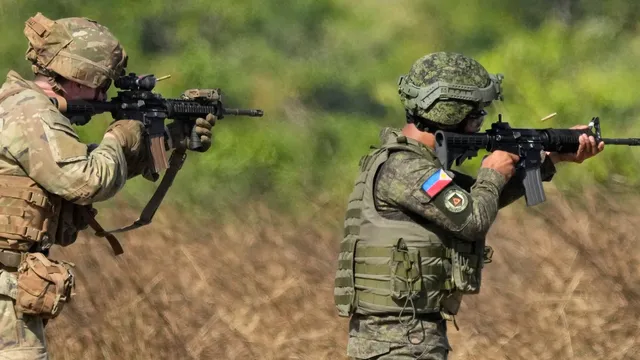
On February 24, 2026, a United States military plane encountered an accident during a training exercise in the Philippines, specifically in the town of Laoac within Pangasinan province. The incident occurred while the aircraft was attempting to take off from a designated alternate landing zone, an area specially chosen for such exercises. Philippine officials have reported that all five American personnel aboard the aircraft were injured in the accident when it hit a concrete barrier during takeoff. Emergency medical responses were carried out immediately following the incident. The pilot and two other military personnel sustained more serious injuries and were subsequently transported to a local hospital for treatment, while two other injured individuals received on-site medical assistance. The training, which involved the U.S. Air Force, was coordinated with Philippine authorities, ensuring that proper safety protocols were observed prior to the exercise. Despite the unfortunate accident, officials stated that the training was essential for preparing military forces to handle contingencies in scenarios where traditional airfields may be rendered unusable due to natural disasters such as typhoons and earthquakes. This particular training exercise forms part of a broader agreement under the Visiting Forces Agreement established in 1999, which allows U.S. military personnel to engage in joint training exercises with their Filipino counterparts. In recent years, these exercises have increasingly focused on improving the Philippines' defense capabilities, particularly in light of escalating tensions owing to territorial disputes in the South China Sea. Both Chinese and Philippine naval forces have seen increased confrontations as they contest their respective territorial claims in this highly disputed area. As authorities begin to investigate the cause of the accident, the incident raises questions regarding the safety measures in place during military operations aimed at strengthening alliances and defense readiness in the region. It highlights the importance of ongoing training and preparation for U.S. and Philippine forces as they navigate complex geopolitical landscapes while responding to potential threats to sovereignty and security.
Context
The history of U.S. military presence in the Philippines is a complex narrative that traces back to the end of the Spanish-American War in 1898, when the United States acquired the Philippines as a territory. This marked the beginning of a significant military relationship between the two nations. The U.S. aimed to establish a strategic foothold in Asia and viewed the Philippines as a vital location for military and commercial purposes. Following the war, the Philippines transitioned from Spanish rule to American governance, which was met with resistance from Filipino nationalists. The subsequent Philippine-American War (1899-1902) resulted in a heavy U.S. military presence as the United States quelled the insurgency. This period set the stage for extensive military infrastructure and bases in the archipelago, with significant upgrades to ports and airfields, which facilitated the U.S. military's operations in the region and served as a staging ground during World War II. During World War II, the Philippines became a critical battleground, particularly after the Japanese invasion in 1942. U.S. forces, along with Filipino troops, fought to reclaim the islands during campaigns such as the Battle of Bataan and the Battle of Leyte Gulf. Following the American liberation of the Philippines in 1944-1945, U.S. military presence continued to grow, solidifying the strategic importance of the Philippines in American military strategy. After the war, the U.S. and Philippine governments signed the Bell Trade Act and the Military Bases Agreement, allowing the U.S. to maintain military bases like Clark Air Base and Subic Bay Naval Base, which became essential during the Cold War, particularly for containment strategies against communist movements in Asia. The Philippine-American relationship continued to evolve throughout the latter half of the 20th century, particularly during the Cold War and in response to regional conflicts. The bases allowed the U.S. to project power in Southeast Asia and conduct military operations in places such as Vietnam. However, the presence of foreign troops also stirred nationalistic sentiments among Filipinos, leading to protests and calls for the removal of U.S. military bases. In 1991, after the fall of the Berlin Wall and shifting geopolitical dynamics, the Philippine Senate voted not to renew the Military Bases Agreement, which culminated in the closure of the major U.S. military bases in the Philippines by 1992. Despite the end of formal bases, U.S.-Philippine military relations persisted through various agreements, including the Visiting Forces Agreement (VFA) signed in 1998, which facilitated joint military exercises and training efforts. After the events of September 11, 2001, the U.S. ramped up its military presence to help combat terrorism in the region, primarily in Mindanao, where it worked with Philippine forces against groups like Abu Sayyaf. The military relationship between the two nations remains critical as they navigate contemporary security threats in Southeast Asia, focusing on issues such as territorial disputes in the South China Sea and regional stability. Concurrently, the richer history of U.S. military presence in the Philippines reflects the evolution of both nations' defense strategies and their commitment to maintaining a partnership resilient to the changing global landscape.


