

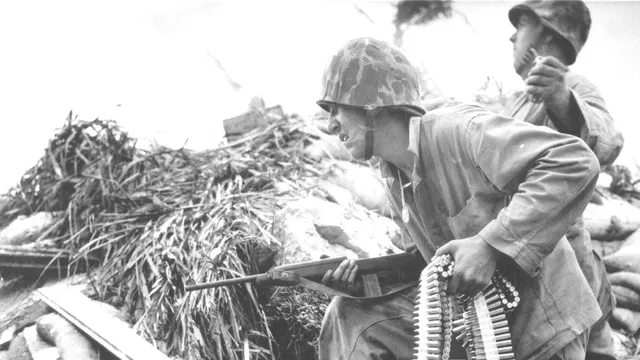
Over 1,000 Americans die in brutal Battle of Tarawa
Over 1,000 Americans die in brutal Battle of Tarawa
- In November 1943, the Battle of Tarawa resulted in over 1,000 American deaths and nearly 2,300 wounded during a three-day assault.
- The battle began the U.S. campaign across the central Pacific, facing fierce Japanese resistance and logistical challenges.
- The legacy of Tarawa has shaped future military operations and is a profound reminder of the sacrifices made by American forces.
Story
In November 1943, during World War II, the Battle of Tarawa took place in the central Pacific, particularly at Betio Island in the Tarawa Atoll, situated approximately 2,500 miles southwest of Hawaii. This critical engagement marked the beginning of the U.S. drive across the central Pacific, which ultimately aimed to secure communication lines with Australia and New Zealand. The battle was characterized by a brutal three-day assault, wherein American forces faced fierce resistance from the Japanese, resulting in heavy casualties—over 1,000 Americans killed and nearly 2,300 wounded in just three days of combat. As American naval forces prepared for this assault, they faced the challenge of executing a large-scale amphibious assault against a heavily fortified position with limited experience. Despite the Marine Corps’ storied combat history, the conditions on Tarawa were particularly challenging. Notably, the task force included three battleships and several cruisers and destroyers, all coordinated under Admiral Harry Hill. However, the effectiveness of this naval support was compromised by the sandy terrain, which absorbed high explosives and allowed many Japanese bunkers to survive initial bombardments; moreover, the Marines’ initial landings were complicated by mistakes in tide calculations. The first waves of Marines landed using LVTs or amphtracs, but as many of these vehicles were lost, subsequent waves faced the daunting task of landing in Higgins boats, which were often stranded on the coral reef due to the miscalculated tide. The Marines found themselves pinned down on the beach due to intense Japanese resistance and the presence of a seawall that the amphtracs could not overcome. On the second day of the battle, two Navy lieutenants undertook a courageous mission to rescue 150 stranded and wounded Marines, further showcasing the camaraderie and heroism displayed during this campaign. The climax of the battle led to significant lessons for future military operations. Four Medals of Honor were awarded for acts of valor, including one to Colonel David Shoup, who led his men despite sustaining severe injuries. The battle’s outcomes influenced subsequent operations during the Pacific Campaign, providing vital knowledge that would safeguard many American lives in future island assaults, ultimately contributing to Japan's surrender in 1945. In this context, as Thanksgiving approaches, it is essential to reflect upon and honor the sacrifices made by Marines and sailors during this significant and costly chapter in U.S. history.
Context
The Battle of Tarawa, fought from November 20 to November 23, 1943, was a pivotal engagement during World War II, specifically within the Pacific Theater. Tarawa Atoll, part of the Gilbert Islands, was strategically significant for both the United States and Japan. The battle represented the first major assault in the central Pacific, illustrating the fierce and determined resistance posed by Japanese forces. It highlighted the importance of amphibious assaults in the war and set a precedent for further operations in the Pacific. The overwhelming American naval and air power contrasted sharply with the entrenched Japanese defenders, emphasizing how technological superiority could shift the tide of battle, albeit at a heavy cost in human life. The American forces, primarily composed of the 2nd Marine Division, faced severe challenges during the initial landings. The tide and coral reefs hindered their approach, causing delays and leading to significant casualties. The ferocity of Japanese resistance, primarily organized by General Yoshitake Kawaguchi, showcased the defensive strategies employed by Japan throughout the war. Tarawa, with its fortified positions and entrenched troops, necessitated an infantry assault supported by heavy naval bombardment, which aimed to provide cover for the advancing Marines. This battle was marked by fierce close-quarter combat, resulting in heavy losses on both sides and underscoring the brutal nature of World War II combat. The result of the battle was a decisive victory for the United States, with heavy casualties suffered by the Japanese, nearly wiping out their garrison. The fight for Tarawa resulted in approximately 1,200 American deaths and over 4,500 Japanese casualties. The American victory at Tarawa provided a crucial morale boost for Allied forces and demonstrated the United States' commitment to reclaiming territory from Japanese control. Moreover, it served as a learning ground, revealing essential lessons about amphibious warfare, logistics, and the need for better coordination among naval and ground forces, which were applied in subsequent campaigns across the Pacific. In a broader context, the Battle of Tarawa had significant implications for the overall strategy of the Allied powers in the Pacific. It marked a shift toward an aggressive island-hopping campaign, allowing the U.S. military to bypass heavily fortified islands and strike directly at weaker targets. This strategy proved effective in leading to victories in subsequent battles such as Saipan and Guadalcanal. The harsh realities of Tarawa also pushed the U.S. military to adopt improved tactics, enhancing troop training, and fostering a more comprehensive understanding of the Pacific Theater's unique operational challenges. Ultimately, Tarawa is remembered not only for its immediate tactical impacts but also for its long-lasting effects on the conduct of the war in the Pacific.


