

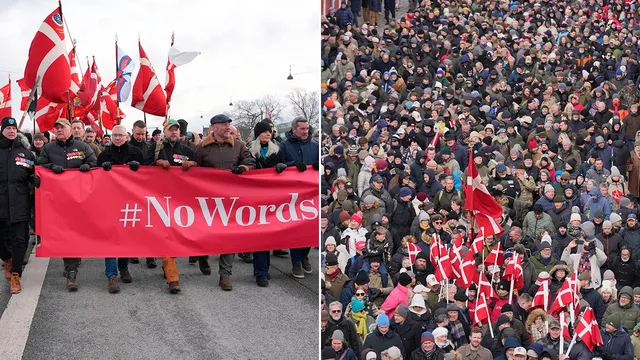
Danish veterans protest against Trump’s remarks and Greenland threats
Danish veterans protest against Trump’s remarks and Greenland threats
- Hundreds of Danish veterans protested outside the U.S. Embassy in Copenhagen in response to Trump’s comments and actions regarding Greenland.
- The protest included ceremonies honoring fallen Danish servicemen, with attendees voicing their feelings of betrayal and disrespect by the U.S. administration.
- Danish veterans expressed their anger and disappointment at how their contributions to global military efforts have been overlooked, stressing the importance of acknowledgment.
Story
In Copenhagen, Denmark, a significant protest was organized by hundreds of Danish veterans on Saturday in response to comments made by U.S. President Donald Trump regarding Greenland. The protest involved many veterans who had fought alongside American troops in various missions, including Afghanistan and Iraq, and stemmed from sentiments of being belittled by the Trump administration. The veterans felt disrespected not only because of Trump's claims that NATO troops often stayed out of combat but also due to the administration's threats to acquire Greenland, which is a territory of Denmark. The gathering commenced at Kastellet, a historical fortress, from where they marched to the U.S. Embassy, proudly displaying large Danish flags. The protest’s organizers, Danish Veterans & Veteran Support, expressed their distress over being overlooked for their sacrifices and contributions to global peace and democracy. They articulated a sense of betrayal felt by Danish veterans, given that many of them had fought alongside U.S. forces and lost friends in battle, as indicated by the 52 flags planted at the embassy representing fallen Danish servicemen. Tensions were heightened due to statements made by Trump regarding the capabilities of Denmark and its military forces. He labeled non-U.S. troops as often avoiding frontline action, which struck a nerve with veterans who faced significant challenges during their service. In addition, 44 Danish soldiers lost their lives in Afghanistan, making their death toll notably high among coalition forces. This led to a feeling of wound-up anger within the veteran community, who were already frustrated by the apparent disregard for the right of Greenland to self-determine its future. The protest was intensified by a series of events leading up to it, including the removal of flags honoring fallen soldiers from outside the embassy. This action was interpreted as disrespectful by the veterans, who believed their sacrifices should be acknowledged. In response, the State Department clarified that the removal of the flags was standard procedure following protests, which only aggravated feelings of betrayal among participants. Overall, the event highlights the strained relations between the veteran community in Denmark and the current U.S. administration, fueled by mixed sentiments regarding their sacrifices and the administration’s rhetoric toward military contributions and geopolitical matters.
Context
The history of US-Denmark relations is marked by mutual respect, cooperation, and increasingly close ties since the 19th century. The two nations established diplomatic relations in 1846, leading to a shared value system grounded in democracy, human rights, and social welfare. Throughout the years, they have cooperated on various issues ranging from trade to cultural exchanges. Post World War II, Denmark became an active participant in NATO, aligning itself with the US and other Western powers against the backdrop of the Cold War, which further solidified their alliance. The US recognized Denmark's strategic importance in the North Atlantic, influencing military and economic policies that fostered bilateral trade and investments. One of the key milestones in US-Denmark relations occurred during the 20th century with Denmark's significant contribution to NATO operations and the UN, emphasizing a commitment to collective defense and international cooperation. The US and Denmark collaborated on various initiatives, including counter-terrorism efforts and joint military exercises that enhanced their capabilities and readiness. The bilateral relationship has also been characterized by shared interests in environmental sustainability and climate change action, with Denmark being a global leader in renewable energy technologies. This collaboration is evident in their joint efforts to premiere initiatives that promote environmental policies aimed at sustainable development. In the 21st century, the relationship has evolved to encompass a broader range of issues, including trade partnerships, climate policy, and cooperation on global challenges such as the pandemic response and cyber security. Denmark has become an important ally for the US in addressing global security threats, particularly in the Arctic region, where both nations have engaged in discussions about security sovereignty, environmental protection, and sustainable resource management. The two countries also enjoy a robust economic partnership, with significant US investments in Denmark and vice versa, contributing to job creation and innovation in both economies. As of 2026, the relationship between the US and Denmark continues to flourish, marked by mutual respect and shared values that strengthen their alliance on the global stage. The ongoing dialogue between the two nations is reflective of a strong commitment to democracy, human rights, and collaborative problem-solving. Looking forward, the US and Denmark are expected to deepen their cooperation in addressing 21st-century challenges, continuing a legacy of partnership that benefits both nations and promotes stability and prosperity in the international community.


