

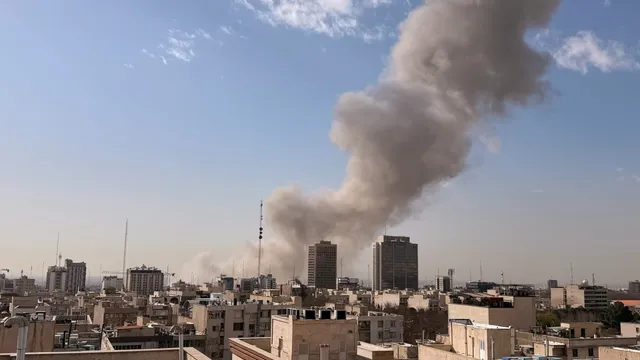
U.S. and Israel escalate conflict with airstrikes in Iran
U.S. and Israel escalate conflict with airstrikes in Iran
- The United States and Israel conducted extensive airstrikes against Iranian military and political leaders.
- Iran vowed to retaliate and asserted its focus was on U.S. military bases.
- The situation has intensified geopolitical tensions and highlighted the potential for further conflict.
Story
On Saturday morning, a significant escalation in tensions between the United States, Israel, and Iran was realized as the U.S. and Israel initiated airstrikes targeting Iran’s military and political leadership. This operation, dubbed 'Operation Epic Fury,' followed a period of heightened rhetoric from U.S. officials, including President Donald Trump, who had made continuous threats of military intervention in Iran while increasing U.S. troop presence in the Gulf region. Trump's administration indicated its attempts to negotiate and come to an agreement with Tehran, yet these efforts did not come to fruition. Iran, under the leadership of its Supreme National Security Council, responded by promising a devastating retaliatory response to the attacks. Iran's Foreign Minister Abbas Araghchi noted that their military focus was on U.S. military facilities rather than civilians, asserting that their primary interest lay in de-escalation should the strikes halt. Concurrently, reports emerged of an Israeli strike resulting in casualties at a school in Minab, Iran, indicating the conflict's dire human consequences. The strikes led to multiple alerts from regional U.S. allies, with missile interceptions taking place at U.S. bases in their territories. Trump, during this tumultuous time, vowed to take every measure to protect U.S. personnel, cautioning that American casualties could occur as is typical in warfare. As the U.S. Embassy in Jerusalem issued shelter-in-place directives for its employees and their families, the White House confirmed Trump was closely monitoring developments from Mar-a-Lago. An emergency meeting of the United Nations Security Council was convened shortly after the strikes, signaling international concern over the escalating conflict. The broader implications of these actions underscore the increasing complexity of geopolitical relations in the Middle East, with Iran maintaining its insistence on its non-pursuit of nuclear weapons and rejecting U.S. demands regarding nuclear negotiations and regional influence. This military confrontation marks a pivotal moment in U.S.-Iran relations and raises questions about future diplomacy and regional stability.
Context
The U.S.-Iran conflict has deep historical roots that date back to the early 20th century, but it intensified notably after World War II. The nationalization of the Iranian oil industry in 1951, led by Prime Minister Mohammad Mossadegh, triggered a crisis as Western powers, particularly the United States and the United Kingdom, feared losing control over Iranian oil supplies. This culminated in a covert operation, known as Operation Ajax in 1953, orchestrated by the CIA and MI6, resulting in the overthrow of Mossadegh and the reinstatement of the Shah, Mohammad Reza Pahlavi. This intervention sowed deep seeds of resentment among Iranians towards the U.S., which became more pronounced during the Islamic Revolution of 1979, when the Shah was overthrown and the theocratic regime led by Ayatollah Khomeini came to power, casting the U.S. as a principal adversary and rallying the masses against foreign intervention in Iran's affairs. The ramifications of the 1979 revolution significantly altered Iranian foreign policy and its relations with the United States. In the aftermath, the U.S. Embassy in Tehran was seized, and American diplomats were held hostage for 444 days, which further deteriorated relations. The U.S. imposed economic sanctions aimed at curbing Iran's nuclear program and limiting its influence in the Middle East. These sanctions, particularly after the enactment of the Iran Sanctions Act in the 1990s and later the severe measures following President Trump's withdrawal from the 2015 Joint Comprehensive Plan of Action (JCPOA) in 2018, have deeply affected Iran's economy and exacerbated regional tensions. In addition to sanctions, military confrontations have also characterized this conflict. The prolonged Iran-Iraq War in the 1980s, which saw significant U.S. involvement on the side of Iraq, highlighted the complexities of U.S.-Iran relations during the Cold War era. The later emergence of proxy conflicts, where Iran supports groups such as Hezbollah in Lebanon and various militias in Iraq and Syria, has led to the U.S. viewing Iran as a destabilizing force in the region. The assassination of Iranian General Qassem Soleimani in January 2020 by a U.S. drone strike was a significant escalation in hostilities, leading to retaliatory attacks and further military posturing in the region. Efforts to resolve the conflict diplomatically have had limited success despite ongoing discussions about Iran's nuclear program. The failure of negotiations, the cyclical nature of sanctions, and mutual distrust continue to hinder reconciliation efforts. Recently, initiatives to return to the JCPOA framework have gained some traction among European nations and involved parties, but a comprehensive agreement remains elusive as both nations maintain significant political and ideological divides. The U.S.-Iran conflict thus reflects a complex interplay of historical grievances, geopolitical strategy, and regional security, and its resolution may require significant changes in either nation's approach to diplomacy and conflict resolution.


