

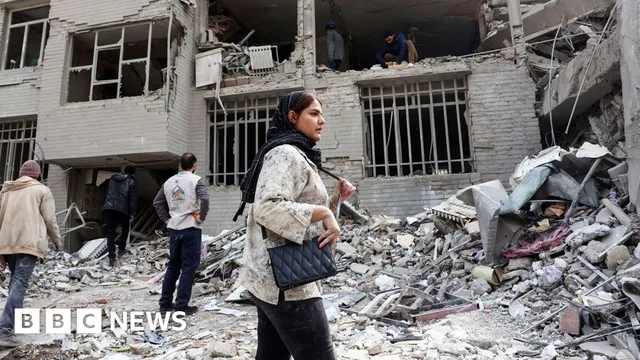
Iran rejects US talks amid deep mistrust and skepticism
Iran rejects US talks amid deep mistrust and skepticism
- Iran's officials have outright denied that any diplomatic talks with the US occurred, interpreting US claims as unrealistic.
- The longstanding tensions and military actions from the US have contributed to an environment of deep mistrust regarding negotiations.
- This mistrust emphasizes Iran's strategic approach, suggesting their tough public stance may be about establishing negotiation conditions rather than a complete rejection of diplomacy.
Story
Iran has actively denied claims from the US regarding productive conversations about ending military hostilities, particularly after remarks made by former President Donald Trump. This denial comes amidst a backdrop of escalating tensions between the two countries, especially following recent military actions against Iran by the US and its allies. Officials in Iran characterize these talks as mere US rhetoric rather than genuine dialogue. The historical context adds depth to Iran's position, as ongoing military pressures have fostered a narrative of mistrust, suggesting that negotiations may serve more as a tactical game rather than a sincere diplomatic effort. The Islamic Republic projects an image of a civilization with deep historical roots, emphasizing their endurance against external aggression. However, internally they struggle with legitimacy, often clinging to narratives that present an image of resolute strength while grappling with immediate crises. Their recent rhetoric invokes a long-standing cultural positioning around their historic civilization, but this is complicated by the reality of their governance, which often favors short-sightedness. Iran's leadership faces substantial internal and external pressure, complicating their ability to engage meaningfully in discussions with the US. As a result, the gap between US assertions of progress and Iran's outright rejection appears insurmountable at the moment, although the harsh rhetoric may also be employed to set conditions for any potential future dialogue. The interaction between ideology and realism in Iran’s political stance suggests a state caught between its historical narrative and contemporary geopolitical realities.
Context
The history of negotiations between Iran and the United States has been marked by a series of complex interactions, driven by geopolitical interests, security concerns, and differing ideologies. This relationship has evolved significantly since the establishment of diplomatic ties in 1950, through to the critical periods of the Iranian Revolution in 1979, whereby relations deteriorated rapidly. The seizure of the U.S. Embassy in Tehran and the subsequent hostage crisis defined a generation of U.S.-Iran relations, resulting in a comprehensive break in diplomatic communications and the imposition of economic sanctions that continue to this day. Since then, diplomatic engagement has been sporadic and often met with skepticism due to mutual mistrust rooted in historical grievances and competing regional ambitions. In the 21st century, efforts to stabilize this fraught relationship have taken various forms, notably through nuclear negotiations. The Bush administration adopted a strategy of isolating Iran, particularly in response to its nuclear ambitions. However, it was the Obama administration that embarked on a multi-year diplomatic effort, leading to the landmark Joint Comprehensive Plan of Action (JCPOA) in 2015. This agreement aimed to curb Iran's nuclear program in exchange for the lifting of economic sanctions. The negotiations were characterized by high-stakes diplomacy, involving not only the U.S. and Iran but also world powers, such as the UK, France, Germany, Russia, and China. The successful implementation of the JCPOA marked a breakthrough, as it halted Iran's potential development of nuclear weapons for a decade, while simultaneously re-engaging Iran into the international community. However, the progress made under the Obama administration faced a significant setback with the arrival of the Trump administration in 2017, as the U.S. unilaterally withdrew from the JCPOA, reinstituting severe sanctions on Iran. This withdrawal fostered increased tensions, as Iran responded by breaching several terms of the agreement. The resulting escalation not only heightened hostilities but also fuelled a series of maritime confrontations, proxy conflicts in the Middle East, and an urgent international dialogue over escalating military posturing. The Trump administration's maximum pressure campaign aimed to compel Iran to negotiate a broader agreement that included not only its nuclear program but also its missile program and regional activities; however, this strategy largely failed to elicit the desired outcome. As of March 2026, U.S.-Iran negotiations remain tense, with indirect dialogues ongoing amidst changing global dynamics. The Biden administration has expressed an interest in returning to negotiations to revive the JCPOA, albeit under a more comprehensive framework that addresses regional security concerns and Iran’s ballistic missile program. The international community watches closely as both nations navigate their respective domestic pressures and international expectations. The continued stalemate in negotiations has deep ramifications not only for U.S.-Iran relations but also for regional stability in the Middle East. The evolving discourse around these negotiations illustrates the complexities and challenges inherent in dealing with a country like Iran, whose strategic importance cannot be understated in the context of global security.


