

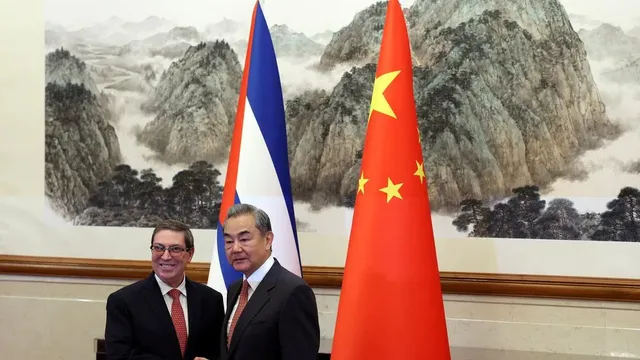
China firmly supports Cuba against US threats
China firmly supports Cuba against US threats
- China expressed its firm support for Cuba's sovereignty during a recent meeting in Beijing.
- The meeting occurred against the backdrop of increased U.S. sanctions and threats towards Cuba.
- This indicates a strengthening alliance between China and Cuba in response to external pressures.
Story
On February 5, 2026, in Beijing, Chinese Foreign Minister Wang Yi met with Cuban Foreign Minister Bruno Rodriguez Parrilla, asserting China's strong commitment to support Cuba amid escalating tensions with the United States. The U.S. government, under President Donald Trump, has intensified its actions against Cuba, labeling its socialist government as a security threat and moving to block oil supplies to the nation. China's support is particularly significant as it highlights the deepening alliance between the two socialist countries, which face similar challenges from external pressures. The geopolitical context surrounding this meeting is complex, given the historical ties between Cuba and China, both of which are governed by communist parties. China views the U.S. measures as unwarranted interference in Cuba's internal affairs. Wang Yi emphasized the importance of national sovereignty in the discussions, reinforcing Beijing's stance against any forms of external intervention. Furthermore, Liu Haixing, a senior Chinese communist party minister, reiterated China's commitment to assist Cuba amid what he described as ‘complex and profound changes’ in Latin America, distinguishing China’s support from the controversies surrounding U.S. interactions with Latin American countries. The Cuban government, led by President Miguel Díaz-Canel, has rejected U.S. claims of terrorism and threats to its national security, declaring Cuba’s intent for dialogue based on mutual respect and equality. This duality of the situation underscores the increasingly fractious nature of international relations involving Latin America, the U.S., and major powers like China. While Cuba seeks to maintain sovereignty and secure its rights to development, the U.S. continues to express its unwavering stance against the Cuban regime and its alliances with countries deemed hostile. Amidst this backdrop, China not only offers diplomatic support but also solidarity rooted in shared ideological goals, positioning itself as a reliable ally for Cuba in a time of heightened diplomatic tensions. The potential ramifications of this support could influence regional dynamics, especially those involving U.S. interests in Latin America. The convergence of these geopolitical currents will likely shape the future of Cuba-China relations and their collective responses to external pressures, particularly from Washington.


