

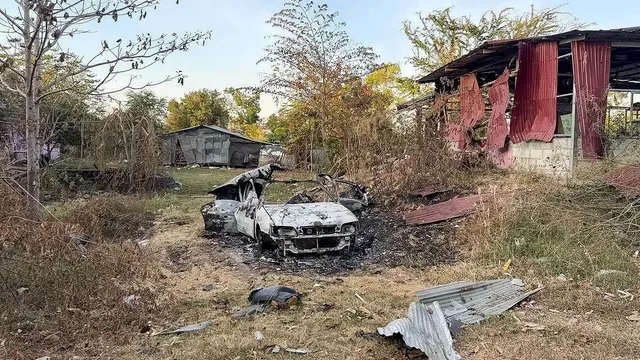
Thai military responds with warning shots after laser targeting incident
Thai military responds with warning shots after laser targeting incident
- On January 30, 2026, a border incident occurred between Thai and Cambodian forces in Si Sa Ket Province.
- Thai forces fired warning shots after detecting a laser pointer aimed at their base, following an explosion near their location.
- Both sides coordinated after the incident to prevent further tensions and improve communication.
Story
On January 30, 2026, a border incident occurred in the Kantharalak District, Si Sa Ket Province, Thailand, involving exchanges between Thai and Cambodian forces. At 8:10 PM, a trip flare at the Tamorchat base lit the area, triggering suspicions of Cambodian troop movements towards Thai positions. This escalated when, at approximately 9 PM, the sound of a 40mm grenade launcher was heard, and it was later confirmed that an explosion had landed near the Phu Pha Lek operational base, amplifying tensions at the border. In response to the burgeoning situation, Thai forces reported detecting a searchlight-like beam and a laser pointer directed at their base, interpreted as a provocative act by the Cambodian forces. Reacting swiftly, the Thai military discharged warning shots to ensure the safety of their personnel and to deter any further aggressive actions from the opposite side. The display of military readiness was intended to signal that such targeting would not be tolerated. Following the firing of warning shots, both Thai and Cambodian military commanders engaged in coordination efforts to de-escalate the situation. The incident is characterized as sudden and apparently unplanned. Preliminary assessments suggest that it may have been triggered by disciplinary lapses among Cambodian soldiers, highlighting potential weaknesses in communication and protocol during border exercises. As a result of this incident, military leaders from both sides were brought to the table to discuss protocols that would prevent future occurrences. Emphasizing cooperation at the border, the hope is that these discussions will result in strengthened ties and a clearer understanding of operational limitations to prevent misunderstandings that could lead to conflict.
Context
The historical context of the incidents at the Thailand-Cambodia border is complex and deeply rooted in the long-standing territorial disputes and national identities of both countries. The border, a product of colonial demarcations, has seen various conflicts, particularly around significant cultural sites such as the Preah Vihear Temple, which has been a flashpoint for national pride and historical claims. Tensions have frequently escalated into military confrontations, particularly in the late 2000s when both nations laid claim to the temple and surrounding areas, leading to armed skirmishes that resulted in casualties on both sides. Such incidents underscore the fragile nature of relations and the importance of historical grievances in shaping contemporary interactions between Thailand and Cambodia. In addition to the Preah Vihear Temple conflict, the broader territorial disputes have been compounded by varying nationalistic sentiments and the influence of local political dynamics. The Thai and Cambodian governments have, at times, used the border disputes to bolster domestic political support, framing the issues within a context of national integrity and sovereignty. This has often led to heightened rhetoric and public mobilization against the perceived threat from the neighboring country, creating cycles of tension that have been difficult to resolve. Various diplomatic efforts and interventions by ASEAN and other international entities have aimed to mediate these disputes, but inconsistencies in political will and commitment from both governments continue to pose challenges. The socioeconomic aspects of the border incidents cannot be overlooked, as both nations share critical economic interests in trade, tourism, and shared natural resources. While the border has been a site of conflict, it is also a point of potential cooperation. Historical trade routes that cross the border and the movement of people for work and tourism illustrate how intertwined the economies of Thailand and Cambodia are. This duality creates a complex landscape where both nations must navigate aggressive nationalism alongside the necessity for economic collaboration, often leading to conflicting policies and practices. Understanding this dynamic is crucial for contextualizing the incidents that arise at the border. Ultimately, the historical context of the Thailand-Cambodia border incidents demonstrates the need for a nuanced approach to conflict resolution that considers not only territorial claims but also the cultural, economic, and political factors that shape bilateral relations. Historical grievances, national identity, and socioeconomic ties are all integral to addressing the root causes of disputes. As both nations move forward, fostering dialogue and mutual respect, while acknowledging and addressing historical issues, will be key in preventing future conflicts and promoting stability in the region.


