

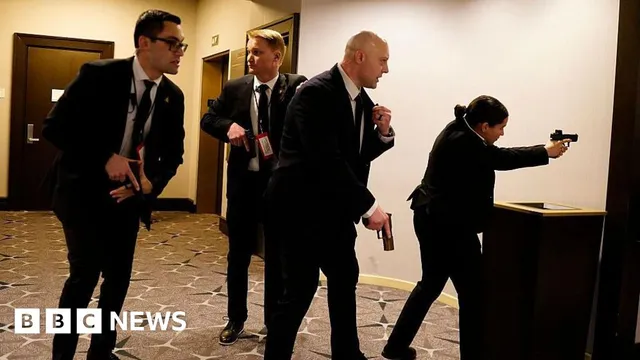
Trump attends White House Correspondents' Dinner amid Epstein spotlight
Trump attends White House Correspondents' Dinner amid Epstein spotlight
- A video projected at the White House Correspondents' Association dinner highlighted Donald Trump's associations with Jeffrey Epstein.
- This event marks Trump’s first attendance at the dinner during his presidency, generating increased media focus and scrutiny.
- The dinner serves to celebrate the press, but also reflects existing tensions between Trump and the media.
Story
In the United States, the White House Correspondents’ Association dinner took place on April 25, 2026. This event marks Donald Trump’s first appearance at the dinner during his presidency, after having previously avoided it for over a decade. The dinner, known for bringing together journalists, political leaders, and other public figures, gained heightened attention due to Trump's controversial relationship with the press and the planned projection of a video showcasing his ties to the late Jeffrey Epstein. This commemorative annual event serves as a celebration of the First Amendment and aims to support journalism scholarships. Ahead of the dinner, a two-minute video was projected onto the Washington Hilton, where the event was held, highlighting Trump's connections to Epstein. Aaron Parnas, who posted the video clip online, indicated that it sought to draw focus back onto Trump's association with Epstein, particularly as discussions around the Epstein case have since dwindled. The video included both clips and images of Trump with Epstein, as well as redacted documents from the Epstein investigation, which has involved significant scrutiny given Epstein's background as a convicted sex offender and infamous figure in sex trafficking controversies. Interestingly, this incident occurred following comments made by Melania Trump, in which she denied any personal links to Epstein and condemned allegations against her as unfounded. She emphasized the necessity to end such untrue narratives and clarified that while she and her husband attended events where Epstein was present, they were never friends. This complex interplay of remarks preceding the correspondence dinner illustrates the ongoing tensions that affect the Trump family's reputation amid the overshadowing history involving Epstein. The evening at the dinner was constructed to be traditional yet highly anticipated due to Trump's attendance, drawing both excitement and skepticism from various attendees who typically are critical of him. Many journalists and attendees grappled with whether it was appropriate to share a space with a president who has exhibited significant animosity towards the media. Nevertheless, Trump’s presence stirred speculation on how he would handle the event's customary comedic elements, as past dinners have included performances by comedians. Notably, Trump’s daughter-in-law, Lara Trump, hinted that he would be delivering an entertaining and humorous address, pushing back against the notion that he would find the proceedings hostile. As the event unfolds, it serves as a pivotal moment reflecting both the divide between Trump and the media as well as the continued scrutiny surrounding his past affiliations.
Context
The White House Correspondents' Dinner (WHCD) is an annual event that brings together journalists, politicians, and celebrities, traditionally spotlighting the role of the press in shaping democratic discourse. Its impact on journalism can be viewed from multiple dimensions, including the promotion of press freedom, the relationship between the media and political figures, and the public's perception of both entities. Held since 1920, this event serves as an important reminder of the Fourth Estate's essential role in a healthy democracy, fostering discussions on issues of transparency, accountability, and the need for a robust media that can challenge authority without fear of retribution. Over the years, the WHCD has evolved into a significant cultural event in Washington, D.C., bringing national attention to the importance of journalism. The ceremony prominently features comedic performances, typically roasting politicians and the media themselves, which has the effect of diffusing tensions between the press and political figures while simultaneously reinforcing the necessary scrutiny that journalists must exert on public officials. This aspect of the dinner has a dual purpose: it entertains while also reminding attendees and audiences alike of the accountability expected from both reporters and government representatives. Moreover, the WHCD has become a platform for advocating press freedom, particularly in times of increasing government hostility towards the media. By showcasing journalists and honoring their work, the dinner highlights the challenges faced by the press—such as censorship, the proliferation of misinformation, and physical threats. Prominent journalists often use the occasion to deliver poignant, politically charged speeches that resonate well beyond the banquet hall. These speeches serve as rallying cries, imploring attendees and viewers to recognize the critical importance of serious journalism in preserving democratic values and promoting informed public discourse. In recent years, the WHCD has faced criticism for becoming too Hollywood-centric and straying from its journalistic roots. Critics argue that the event inadvertently glamorizes the media rather than reinforcing its crucial watchdog function. Yet, the dinner continues to be a focal point for discussions surrounding the media’s role in society and the preservation of journalistic integrity. As news consumption habits shift and the landscape grows ever more complicated with digital misinformation and polarization, the influence of the White House Correspondents' Dinner on journalism remains significant, necessitating a reevaluation of its objectives and impact in fostering a culture that prioritizes truth-telling and accountability.


