

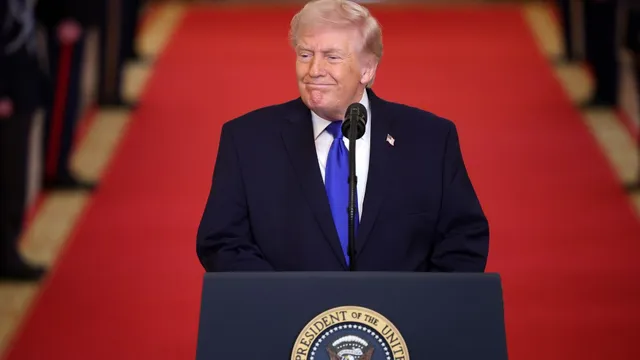
Trump faces impeachment calls after military strikes on Iran
Trump faces impeachment calls after military strikes on Iran
- The U.S. and Israel launched military strikes against Iran, escalating tensions significantly.
- Donald Trump is facing impeachment calls due to the legality of the operations, having taken action without congressional approval.
- The public response is divided, indicating potential repercussions for Trump's presidency and future military actions.
Story
In the early days of March 2026, military operations initiated by the United States and Israel marked a dramatic escalation of tensions with Iran. The operation targeted high-ranking Iranian officials, including Supreme Leader Ayatollah Ali Khamenei, and resulted in significant casualties within Iran, with reports indicating at least 555 fatalities. Critics of President Donald Trump's administration immediately raised concerns regarding the legality of these actions, citing the absence of congressional approval. This situation sparked renewed calls for impeachment among Democratic leaders and commentators who questioned the constitutional implications of unilateral military action undertaken by the president. The strikes have elicited a divided response from both political spheres and the general public. While dissenters are vocal in their objections, (including figures like Minnesota Governor Tim Walz), others have defended Trump's aggressive stance on Iran as a necessary step to protect national security. Trump's remarks claiming to have eliminated an imminent threat from Iran coupled with his encouragement for the Iranian populace to overthrow their government amplified the tensions surrounding the operation. Parallel to the military developments, Nancy Pelosi's criticism of Trump's actions has been viewed in juxtaposition with her previous defense of military interventions during the Obama administration, indicating a complex landscape of political discourse surrounding military engagements. As public opinion appears to lean against the use of military force—where approximately 45% oppose it against Iran—it remains uncertain how these events will shape voter sentiment leading into legislative considerations and potential impeachment. Given the Republican majority in Congress, the chances of impeachment, though heightened, face significant hurdles, and discussions surrounding the implications of Trump's decisions on international stability and domestic politics continue. The situation unfolds as the United States navigates the delicate balance of aggressive foreign policy and adherence to constitutional processes regarding military engagement.
Context
The history of U.S.-Iran relations has been marked by a complex interplay of geopolitical interests, cultural misunderstandings, and pivotal historical events. Initially, in the early 20th century, the U.S. and Iran maintained relatively friendly relations, with American oil companies involved in the development of Iran's oil industry. However, this dynamic changed dramatically after World War II. The 1953 CIA-backed coup that removed Prime Minister Mohammad Mossadegh and reinstated the pro-Western Shah, Mohammad Reza Pahlavi, created long-lasting resentment among many Iranians towards the United States. The coup was aimed at countering perceived Soviet influence in Iran but resulted in the consolidation of authoritarian rule under the Shah, leading to widespread discontent and political repression in the country. Tensions escalated significantly after the 1979 Iranian Revolution, which overthrew the Shah and established an Islamic republic under Ayatollah Khomeini. This event marked a pronounced shift in U.S.-Iran relations, as the new regime viewed the U.S. as a primary adversary, primarily due to its support for the deposed Shah. The seizure of the U.S. embassy in Tehran and the taking of American hostages for 444 days become emblematic of this animosity. In response, the U.S. imposed comprehensive economic sanctions on Iran, which have persisted in various forms over the decades. The late 20th century saw Iran's increasing isolation from the West and the U.S. aligning with regional powers opposed to Iran, further complicating diplomatic efforts. In the 21st century, particularly under the Bush administration, Iran was labeled as part of the "Axis of Evil," further entrenching hostilities. However, efforts towards diplomacy saw some progress under the Obama administration, culminating in the 2015 Joint Comprehensive Plan of Action (JCPOA), which aimed to limit Iran's nuclear program in exchange for sanctions relief. The agreement exemplified a rare moment of potential rapprochement, yet it was undermined when the Trump administration unilaterally withdrew from the JCPOA in 2018, leading to a re-escalation of tensions and renewed economic sanctions. Iran's subsequent advancements in its nuclear program have raised concerns globally, leading to increased military posturing in the region. As of 2026, U.S.-Iran relations remain fraught with tension. The ongoing geopolitical landscape, including Iran's influence in Iraq, Syria, and Lebanon, and its allied military forces, poses major security challenges for Washington and its regional allies. Efforts at negotiation continue sporadically, but deep-seated mistrust and conflicting interests hinder progress. The populace on both sides holds historical grievances and narratives that contribute to the mutual enmity. Future relations will depend heavily on both domestic politics within Iran and the U.S., as well as broader international dynamics, signifying the enduring complexity of this critical bilateral relationship.


