

Thailand escalates tensions with airstrikes against Cambodia
Thailand escalates tensions with airstrikes against Cambodia
- Thailand conducted airstrikes on its border with Cambodia, claiming to target military objectives.
- Cambodian officials accused Thailand of initiating hostilities without provocation.
- The renewed fighting poses a threat to the fragile peace established by previous agreements.
Story
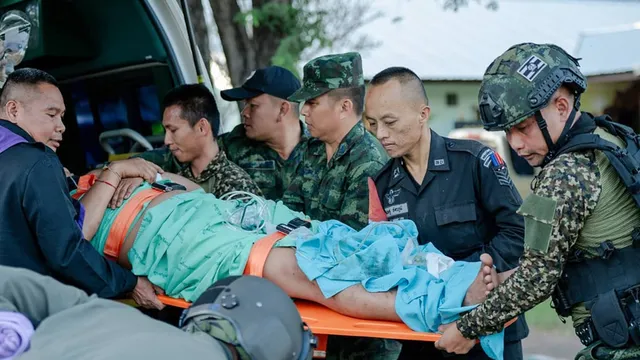
On a recent Monday, Thailand executed airstrikes along its disputed border with Cambodia, reigniting tensions that had been simmering since both nations signed a truce in October 2020, pushed by U.S. President Donald Trump. The historical enmity between Thailand and Cambodia, rooted in centuries of conflict and territorial disputes, re-emerged following accusations from both sides claiming the other had initiated the attacks. The airstrikes were described by the Thai military as necessary to counter Cambodian fire support, leading to calls from Cambodia for Thailand to cease its hostile actions immediately. The incident caused several schools to be closed along the border as local civilians sought safety amidst the escalating conflict. The situation has further complicated the fragile peace established after July's hostilities, during which fighting resulted in significant casualties on both sides. Both countries have continuously exchanged blame for the recent skirmishes, undermining earlier efforts to cooperate in demining operations that were supposed to benefit both nations. Compounded by historical grievances dating back to the 1962 International Court of Justice ruling over territorial sovereignty, the airstrikes signal a troubling prediction for regional stability, as the essential issues over borders remain unresolved, thus perpetuating a cycle of mistrust and aggression.
Context
The historical context of the Thailand-Cambodia border disputes is a complex interplay of historical claims, national identity, colonial legacy, and geopolitical dynamics. The core of the dispute revolves around areas surrounding the ancient Preah Vihear Temple, which has been a focal point for both nations since its construction in the Khmer Empire. The temple's location near the border has led to differing interpretations of the boundaries defined by the Franco-Siamese Treaty of 1907, which sought to formalize borders in the region. This treaty, however, has been contested by both sides, leading to a persistent debate over territorial rights that was exacerbated by adjacent historical grievances and periods of nationalism in the 20th century. Post-colonial legal developments have not alleviated tensions; rather, they have contributed to an atmosphere of conflict. In 1962, the International Court of Justice (ICJ) ruled that Preah Vihear Temple belonged to Cambodia, a decision that was not fully accepted by Thailand, resulting in ongoing disputes regarding the surrounding territories. The fluctuating political landscapes in both nations, alongside the rise of nationalist sentiments, have seen the disputes intensify, including military confrontations in 2008. These clashes have fueled local nationalism and have been utilized by political leaders in both countries to rally domestic support amid economic or social challenges. The broader implications of these disputes extend beyond the specific territories in question, influencing regional stability and relationships among ASEAN countries. The involvement of international legal frameworks showcases the ongoing challenges for effective diplomacy, as both nations have oscillated between cooperation and confrontation based on national interests. Furthermore, the rise of China’s influence in Southeast Asia and its implications for regional geopolitics have added layers of complexity to the disputes. The need for a cohesive approach to conflict resolution is critical, yet it remains hindered by historical animosities and a lack of trust. Ultimately, the historical context of the Thailand-Cambodia border disputes illustrates how colonial legacies, national identities, and regional dynamics are intricately woven together. Moving forward, addressing these disputes will necessitate an engagement rooted in dialogue, mutual respect for historical narratives, and a commitment to peaceful coexistence. Understanding the historical precedents and their manifestations in contemporary politics is essential for academics, policymakers, and stakeholders focused on achieving long-term stability in the region.


