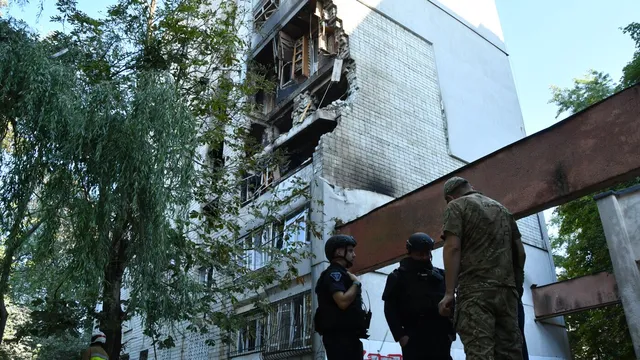
Russian missile strikes kill civilians in Ukraine
military conflicts
tragic
controversial

Russian missile strikes kill civilians in Ukraine

10
(Update: )
sovereign state in Eastern Europe and Northern Asia
country in Eastern Europe
capital and largest city of Ukraine
  • A Russian missile and drone attack in Ukraine resulted in at least eight civilian deaths and numerous injuries.
  • The strikes targeted various regions, including areas far from the front lines, indicating a strategic expansion of the conflict.
  • The situation highlights the urgent need for enhanced air defense systems in Ukraine to protect against ongoing Russian aggression.
Share opinion
1

Story

In Ukraine, a significant escalation in hostilities occurred overnight, resulting in the deaths of at least eight civilians, including children. This attack was part of a broader pattern of Russian bombardments targeting various Ukrainian cities, as Moscow sought to take advantage of Ukraine's dwindling air defense capabilities. The strikes affected multiple regions, including areas near the Polish border, which are typically far from the front lines of the ongoing conflict. Ukrainian officials reported that the barrage involved over 70 missiles and more than 280 drones, with a substantial number of these being intercepted by Ukrainian defenses. Ukrainian President Volodymyr Zelenskyy highlighted the critical situation regarding air defense, noting that the country is facing a severe shortage of Western-supplied anti-ballistic missile systems. This shortage has been exacerbated by the ongoing conflict and the depletion of stockpiles, particularly due to the war in Iran. Zelenskyy praised the professionalism of Ukrainian forces, who have managed to achieve significant defensive successes despite these challenges. The attacks not only resulted in civilian casualties but also caused extensive damage to infrastructure, homes, and businesses across at least ten regions. The Russian military claimed that their strikes were aimed at military targets, including drone production facilities and storage depots. However, the impact on civilian life has been devastating, with reports of families being torn apart by the violence. In one instance, the parents of two children were killed in the same attack, although the children were rescued from the rubble. This incident underscores the tragic human cost of the ongoing conflict and raises urgent questions about the effectiveness of international support for Ukraine's defense. In a related development, a Russian cruise missile reportedly crossed into Polish airspace, prompting concerns about NATO's security and the potential for escalation in the region. Ukrainian officials have called for immediate strengthening of air defenses to prevent further violations and protect European security. The situation remains tense, with ongoing military actions and the potential for further civilian casualties as the conflict continues to unfold.

Context

The conflict between Russia and Ukraine has its roots in a complex interplay of historical, political, and social factors. The tensions escalated significantly in 2014 when Russia annexed Crimea, a move widely condemned by the international community as a violation of international law. This annexation was followed by the outbreak of armed conflict in Eastern Ukraine, particularly in the Donetsk and Luhansk regions, where pro-Russian separatists declared independence. The situation has led to a humanitarian crisis, with thousands of casualties and millions displaced from their homes. The conflict has also strained relations between Russia and Western nations, resulting in economic sanctions against Russia and increased military support for Ukraine from NATO countries. In the years following the annexation, various attempts at peace negotiations have been made, including the Minsk agreements, which aimed to establish a ceasefire and a framework for resolving the conflict. However, these agreements have seen limited success, with frequent violations and ongoing hostilities. The situation has been further complicated by Russia's military involvement, which has included the deployment of troops and military equipment to support separatist forces. This has raised concerns about regional stability and the potential for a broader conflict, as NATO has increased its presence in Eastern Europe in response to perceived threats from Russia. The conflict has also had significant implications for Ukraine's domestic politics and economy. The war has fueled nationalism and a desire for closer ties with the West, leading to a shift in Ukraine's foreign policy. However, the ongoing conflict has also strained Ukraine's economy, which has struggled with the costs of war and the loss of industrial regions in the east. The Ukrainian government has implemented various reforms to strengthen its economy and governance, but progress has been slow, and corruption remains a significant challenge. As of 2026, the conflict remains unresolved, with sporadic fighting continuing in Eastern Ukraine. The international community continues to call for a peaceful resolution, but the prospects for a lasting peace remain uncertain. The geopolitical landscape is further complicated by the broader rivalry between Russia and the West, with both sides entrenched in their positions. The situation in Ukraine serves as a critical flashpoint in international relations, highlighting the challenges of addressing territorial disputes and the importance of diplomatic efforts in resolving conflicts.