

NASA gears up for lunar landing in 2028 with Artemis IV mission
NASA gears up for lunar landing in 2028 with Artemis IV mission
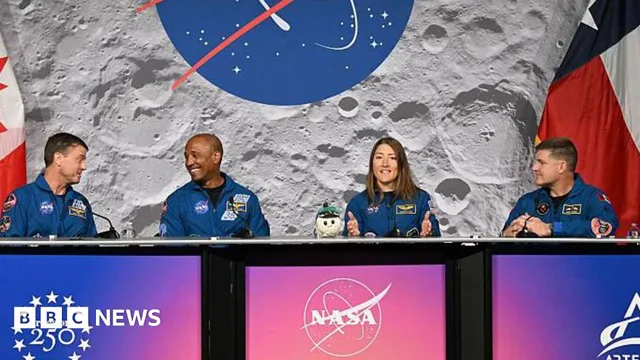
- Artemis II astronauts discussed their mission at NASA's Johnson Space Center in Houston.
- The upcoming Artemis III mission in 2027 aims to prepare for future lunar landings in 2028.
- The astronauts emphasized teamwork and training as crucial factors in mission success.
Story
In a recent debriefing, the Artemis II astronauts engaged with the media at NASA's Johnson Space Center in Houston, Texas, reflecting on the significance of their moon mission. Their experience is part of a broader strategy to prepare for future lunar expeditions, including Artemis III, scheduled for 2027, and Artemis IV, anticipated in 2028. During the press conference, the crew discussed the mission's challenges and triumphs, emphasizing the importance of teamwork and training in carrying out their objectives successfully. The conversation drew parallels to the Apollo missions, highlighting the importance of space exploration in inspiring hope for humanity. The astronauts shared insights about their experiences during the flyby, describing the journey as smooth despite the challenges faced upon entry. The mission was intended to lay the groundwork for subsequent crewed lunar landings and test mission equipment like the new spacesuits. A notable remark comes from astronaut Reid Wiseman, who asserted that based on the observations made during Artemis II, a lunar landing was not far off, suggesting a profound confidence in the preparation leading to future missions. Amid discussions about the technical aspects of the spacecraft, including the functionality of the toilets, the astronauts also encouraged young people aspiring to be astronauts to find their passions and support each other. Christina Koch advised those looking to pursue a career in space exploration to engage with the aspects they love the most and face challenges with determination, advocating unity as a critical element for achieving monumental objectives. This mission symbolizes not just a technical accomplishment but an emotional journey shared by the astronauts and the support team. Their reflections serve to remind us that while the achievements of space travel are monumental, the human element—the teamwork, training, and individual resilience—plays a crucial role in creating meaningful experiences that resonate well beyond the missions themselves.
Context
The Apollo missions, conducted by NASA between 1961 and 1972, marked a significant milestone in human space exploration. These missions were driven by a combination of political ambition, scientific curiosity, and technological innovation, particularly in the context of the Cold War rivalry between the United States and the Soviet Union. The Apollo Program aimed to land humans on the Moon and safely return them to Earth, a goal famously articulated by President John F. Kennedy in 1961. Program milestones included the first manned flight of Apollo 7 in 1968, the historic lunar landing of Apollo 11 in July 1969, and six successful lunar landings by Apollo missions overall. Each mission contributed to expanding our understanding of space travel, demonstrating capabilities that advanced both scientific knowledge and engineering techniques. The successful completion of Apollo 11, with astronauts Neil Armstrong and Buzz Aldrin walking on the Moon, was a monumental event not just for the United States but for humankind. It fostered national pride and established the feasibility of lunar exploration, serving as proof of technology's capabilities. The samples brought back by the Apollo astronauts provided invaluable scientific data, leading to new insights about the Moon's geology and the solar system. This data has had lasting implications for planetary science and has influenced the design and objectives of subsequent space missions, including those of other nations and private enterprises today. Beyond the immediate scientific achievements, the Apollo missions had profound societal and cultural impacts. The images and narratives of the Apollo missions inspired generations to pursue careers in science, technology, engineering, and mathematics (STEM), significantly influencing education and public interest in these fields. The missions were also pivotal in shaping policies regarding space exploration and cooperation among nations, highlighting the potential for humanity to unite in peaceful scientific endeavors. Furthermore, the technology developed during the Apollo era spurred advancements in various fields on Earth, from materials science to computer technology and telecommunications. In summary, the Apollo missions represent a landmark period in space exploration history, with multifaceted impacts that extend beyond the scientific realm. They transformed the perception of space travel, set the stage for future explorations, and fostered global cooperation in advanced technologies. The legacy of the Apollo Program continues to resonate today as missions are planned for returning to the Moon and eventually moving on to Mars, reminding us of the indomitable spirit of exploration that drives human progress.


