

U.S. military destroys Iranian warplanes amid ongoing conflict
U.S. military destroys Iranian warplanes amid ongoing conflict
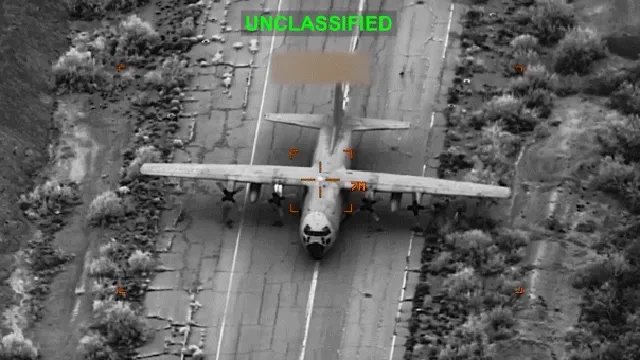
- U.S. Central Command revealed declassified footage of attacks on Iranian warplanes, particularly a C-130 Hercules and P-3F Orion.
- Former President Donald Trump emphasized the need to remain engaged to avoid recurring conflicts in the region.
- The continued military actions signify a methodical dismantling of Iran’s air capabilities by U.S. forces.
Story
The ongoing military operations involving the United States against the Islamic Republic of Iran continue to escalate as U.S. Central Command released newly declassified footage capturing strikes on multiple Iranian warplanes. The footage notably includes attacks on a C-130 Hercules and a P-3F Orion, both of which are aging aircraft purchased by Iran from the U.S. prior to the 1979 Islamic Revolution. In accompanying statements, former President Donald Trump declared that the U.S. had achieved victory in its military objectives but expressed the need to remain engaged to prevent the resurgence of conflict every few years. His remarks underscore a strategic viewpoint aimed at ensuring sustained military pressure on Iran. The ongoing strikes represent a methodical dismantling of Iranian air capabilities, a perspective reiterated by U.S. Central Command in a post shared on X on March 11, 2026. In light of recent military engagements, both U.S. and allied forces, particularly Israel, have been employing advanced aircraft like the F-35 while addressing Iran’s vulnerabilities linked to its older aircraft fleet. CENTCOM also reassured that despite the tumultuous nature of the conflict, no U.S. fighter jets had been downed by Iranian actions. Furthermore, a recent incident involving U.S. F-15E Strike Eagle fighter jets being downed was attributed to friendly fire from Kuwaiti defenses during active combat, illustrating the complexities of operational dynamics in the region. As the conflict moves forward, the capability gaps between the U.S. military and Iranian forces become increasingly pronounced, leading to a heavy reliance by Iran on its ballistic missile program as a counter to sustained U.S. and Israeli military actions.
Context
The tensions between the United States and Iran have remained a critical issue in international relations, particularly since the early 2000s. These tensions began escalating significantly following the U.S. withdrawal from the Joint Comprehensive Plan of Action (JCPOA) in May 2018, which has had profound implications for regional security and diplomatic relations. The U.S. reinstated sanctions that had been lifted under the agreement, targeting Iran's economy and limiting its ability to engage in global trade, particularly in oil. In response, Iran has gradually abandoned its commitments under the nuclear deal, increasing its uranium enrichment activities while maintaining that its nuclear program is for peaceful purposes. This back-and-forth has led to heightened tensions, with both nations engaging in a series of confrontational actions, including military engagements, cyberattacks, and diplomatic maneuvering in the region. The military aspect of these tensions is particularly notable, with both the U.S. and Iran significantly investing in their military capabilities. The U.S. has maintained a large military presence in the Persian Gulf as a deterrent to Iranian aggression, frequently conducting joint exercises with allied nations in the region. The U.S. also supports Israel and Gulf states in bolstering their defensive systems against perceived Iranian threats. Conversely, Iran has expanded its military capabilities and influence through proxy groups such as Hezbollah in Lebanon and various militias in Iraq and Syria. This proxy warfare has enabled Iran to project power across the region, challenging U.S. interests and allies. The risk of a direct military confrontation remains high, particularly in flashpoints like the Strait of Hormuz, critical for global oil transport. Diplomatic efforts to resolve the tensions have been sporadic and often faltering. The Biden administration has expressed a willingness to re-engage diplomatically with Iran, aiming to revive the nuclear deal while addressing a broader range of issues such as missile development and regional activities. However, these efforts face significant hurdles, with domestic political opposition in both countries complicating the process. Iran has insisted on the lifting of sanctions before it fully commits to negotiations, while the U.S. faces pressure from allies to ensure that any agreement curtails Iran's regional influence. The regional dynamics are further complicated by the involvement of other major players, including Russia and China, who have different interests in Iran and the broader Middle East. As of March 2026, the situation remains fluid and possibly volatile. With both nations entrenched in their positions and regional tensions simmering, the prospect for a resolution seems distant. Ongoing conflicts, particularly in Iraq and Syria, continue to be exacerbated by U.S.-Iranian tensions, impacting local populations and fueling instability. The international community watches closely, fearing that miscalculations could lead to a broader conflict. Ultimately, the U.S.-Iranian relationship involves a complex interplay of military posturing, economic sanctions, and geopolitical strategy that will remain crucial to watch in the coming years.


