

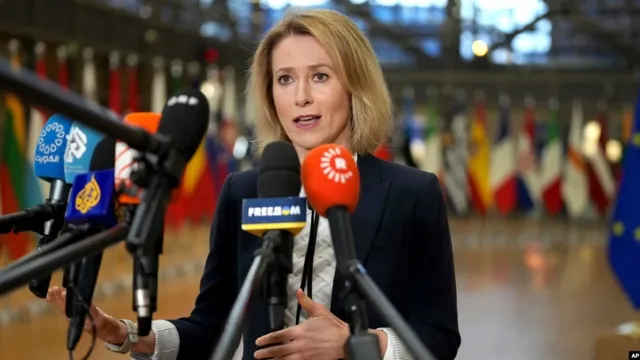
Kaja Kallas insists Europe and Ukraine must join US-Russia peace talks
Kaja Kallas insists Europe and Ukraine must join US-Russia peace talks
- European leaders are alarmed by the lack of Ukrainian involvement in US-Russia peace talks.
- Kaja Kallas emphasizes that any peace plan must include Ukrainians and Europeans to be effective.
- The proposals on the table may require Ukraine to make significant concessions, which are widely opposed.
Story
In recent months, discussions of a peace plan to end the war in Ukraine have emerged, reportedly involving negotiations between the United States and Russia. Various European leaders, including Kaja Kallas, the EU's High Representative for Foreign Affairs, have voiced concerns that Kyiv and European nations are not taking part in the negotiations. Kallas emphasized the necessity of having Ukrainians and Europeans on board for any peace plan to be effective, indicating that excluding these parties risks undermining regional security and Ukraine's sovereignty. According to the reports, the planned negotiations may require Ukraine to make significant concessions, including ceding territory and limiting its military capabilities, which President Volodymyr Zelenskyy has firmly opposed. The lack of input from Ukraine and European officials in the ongoing discussions has raised alarm bells among diplomats across the region, with many fearing a deal negotiated solely between the US and Russia would disregard the interests of those most affected by the conflict. Moreover, Kallas highlighted that ongoing assaults on civilian infrastructure in Ukraine demonstrate Russia's unwillingness to genuinely pursue peace. She marked the continued attacks—targeting schools and hospitals—as evidence that Russia is acting as the aggressor while Ukraine remains the victim in the conflict. Kallas's strong statements reflect the broader sentiment shared among European leaders that any US-Russian agreement must include the perspectives and approval of the EU and Ukraine. While US special envoy Steve Witkoff has been working behind the scenes to draft a peace plan, the details remain unclear. Senior officials from Ukraine and Europe have expressed confusion about the fact that Washington appears to be facilitating discussions without direct Ukrainian involvement. As a result, both Ukraine and European countries have reiterated their stance that they must play a crucial role in formulating a solution to the ongoing war. The heightened tensions arise in light of previous diplomatic efforts including sanctions on Russia and a push for a more unified European approach to support Ukraine against the aggressions from Moscow. As European leaders prepare to meet to discuss the status of negotiations, the call for Ukrainian participation in all discussions resonates strongly within the bloc. The outcomes of these discussions remain critical to the future of not only Ukraine but the broader security architecture of Europe in the context of Russian aggression.
Context
The impact of peace plans on Ukraine's sovereignty is a critical area of discussion as the region seeks to navigate the complexities of conflict resolution and national integrity. Since the onset of the conflict in 2014, various peace initiatives have emerged, each designed to address the ongoing tensions and ultimately restore stability to Ukraine. However, the effectiveness of these plans varies greatly, often influenced by the underlying geopolitical dynamics, the interests of foreign powers, and the resilience of Ukraine's own national identity. Peace plans such as the Minsk Agreements were aimed at establishing a ceasefire and providing a framework for a political resolution; nonetheless, they have struggled to gain full compliance from all parties involved, leading to ongoing clashes and unrest in Eastern Ukraine, particularly in the Donbas region. The question of sovereignty is at the forefront of these discussions, as successful implementation of peace plans may either bolster or undermine Ukraine's territorial integrity. Ukraine's sovereignty, both in terms of its internationally recognized borders and its self-determination, is threatened when external actors exert influence through diplomatic, military, or economic means. This is evidenced by the involvement of Russia, which has not only directly supported separatist movements but also attempted to exert political pressure through various means, often in stark contrast to Ukraine's aspirations for European integration and alignment with Western institutions. As peace dialogues progress, it is imperative that any agreements respect and uphold Ukraine's sovereignty, ensuring that they do not lead to compromises that may legitimize territorial losses or outside interference. Furthermore, the domestic response to these peace initiatives plays a significant role in determining their success and longevity. The perceptions of the Ukrainian populace regarding sovereignty and territorial integrity are deeply rooted, influenced by historical contexts and national sentiment. Public opinion surveys indicate a prevailing skepticism towards concessions that might be viewed as capitulation to external aggression. Thus, any proposal that seeks to establish durable peace must consider the will of the people, integrating their voices into the decision-making process to ensure a sense of ownership and legitimacy. Such inclusivity could foster a more robust peace framework, one that addresses the underlying grievances while preserving the core tenets of Ukrainian sovereignty. Ultimately, the dialogue surrounding peace plans in the context of Ukraine's sovereignty is emblematic of larger global challenges where self-determination, international law, and the rights of nations come into contention. The international community, too, plays a pivotal role, as its support can bolster Ukraine's government and provide assurances that help deter further aggression. However, any intervention must balance respect for Ukraine's sovereignty with strategic interests that could complicate the situation further. As the situation continues to evolve, stakeholders must prioritize the principles of sovereignty and self-determination in peace negotiations, striving for solutions that reinforce Ukraine's national identity and territorial integrity, paving the way for a stable and peaceful future.


