

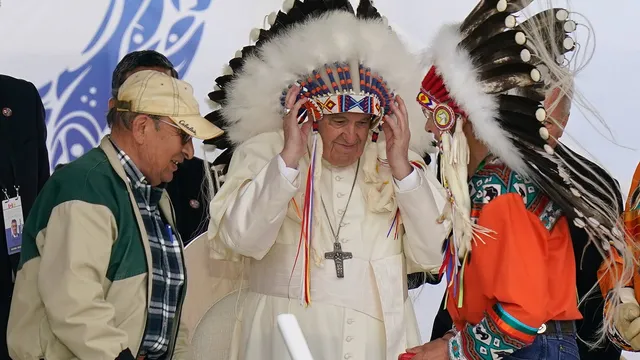
Vatican returns 62 artifacts to Indigenous communities in Canada
Vatican returns 62 artifacts to Indigenous communities in Canada
- The Vatican repatriated 62 artifacts to Indigenous peoples in Canada, responding to historical calls for restitution.
- These items were part of the Vatican Museum's ethnographic collection and were originally sent for a 1925 exhibition.
- This act is seen as a crucial step in the Catholic Church's ongoing efforts to reconcile its colonial past.
Story
In a significant move towards reconciliation, the Vatican repatriated 62 artifacts to Indigenous peoples in Canada, marking a crucial step in acknowledging historical injustices. This handover occurred recently and was emphasized during an audience where Pope Leo XIV addressed a delegation from the Canadian Conference of Catholic Bishops. These artifacts, part of the Vatican Museum's Anima Mundi collection, were originally sent to Rome in 1925 for an exhibition intended to celebrate the church's global missionary efforts. However, there have been longstanding controversies surrounding these items, particularly regarding how they were acquired, which some historians argue were not truly voluntary donations. The return of these artifacts aligns with the Catholic Church's ongoing reckoning with its colonial legacy, especially in relation to Indigenous cultures in the Americas. Following a meeting in 2022, Pope Francis expressed support for returning items from the Vatican collection, focusing on gestures essential to fostering dialogue and respect. The joint statement issued by the Vatican and the Canadian church labeled the returned pieces as a gift, underscoring their significance as symbols of cultural respect and fraternity. The artifacts, which include culturally significant items such as an Inuit kayak, were confiscated during Canada’s government policies aimed at assimilation. This history is fraught with trauma, as the systematic suppression of Indigenous traditions has been described as cultural genocide by Canada’s Truth and Reconciliation Commission. The return process reflects the desire among Indigenous communities for a fair and respectful dialogue surrounding their cultural heritage. The Vatican's decision is part of continuously evolving relations between the Catholic Church and Indigenous peoples, as negotiations around the future of remaining artifacts are anticipated. Although the objects are being handed over to the Canadian bishops’ conference first, they are meant to ultimately belong to Indigenous communities themselves. The initial transfer will mark the beginning of a process aimed at identifying the specific cultural origins of the items, facilitated by experts and Indigenous groups at the Canadian Museum of History in Gatineau. This event is viewed as a consequential step in addressing critical historical narratives and fostering a genuine dialogue about cultural healing and restitution in the face of colonial histories.
Context
The Doctrine of Discovery, a legal and theological concept originating in the 15th century, has profoundly impacted Indigenous peoples across the globe. Rooted in a series of papal bulls, this doctrine asserted that Christian nations had the right to claim lands occupied by non-Christian societies. This notion legitimized the imperial expansion of European powers and facilitated the colonization of vast territories, often disregarding the sovereignty and rights of the Indigenous populations. As a result, numerous Indigenous communities faced displacement, loss of their traditional lands, and obliteration of their cultural identities, which has had lasting effects on their social and economic structures today. The historical consequences of the Doctrine of Discovery continue to resonate, as many Indigenous groups still grapple with the legacies of colonization, including poverty, loss of language, and cultural fragmentation. Understanding the impact of the Doctrine of Discovery involves recognizing its ongoing implications on the rights of Indigenous peoples. Legal frameworks established through this doctrine created a precedent for land dispossession, granting colonial powers authority over territories without regard for Indigenous claims. The resulting treaties, often coerced and unfair, have led to decades—if not centuries—of litigation and struggle for recognition and reparative justice. Indigenous communities have sought to reclaim their rights within the legal landscape shaped by colonialism, asserting their sovereignty and re-establishing their connection to ancestral lands. This struggle is not just a fight for territory but also a quest for cultural survival and self-determination. In recent years, there has been a growing recognition of the adverse effects of the Doctrine of Discovery on Indigenous peoples. Some governments and institutions have begun to confront these historical injustices through policy changes and public acknowledgments. Educational programs highlight the relevance of this doctrine in discussions about colonialism and Indigenous rights, aiming to foster a deeper understanding of these issues among broader populations. Moreover, movements advocating for the return of land to Indigenous peoples—along with the restoration of their rights and cultural heritage—are gaining momentum, reflecting a shift in societal attitudes toward reconciliation. The teachings of the Doctrine of Discovery serve as a cautionary tale about the consequences of viewing land through a lens of ownership rather than stewardship. The path forward requires not only addressing historical wrongs but also fostering relationships built on respect, recognition, and mutual benefit. The resilience of Indigenous peoples in confronting and overcoming the challenges imposed by the Doctrine of Discovery is a testament to their enduring strength and rich cultural heritage. Efforts towards reconciliation must prioritize Indigenous voices, ensuring their perspectives are central to dialogue and policy-making. Only by acknowledging and addressing the impacts of this doctrine can we hope to foster a more equitable future for Indigenous nations and communities.


