

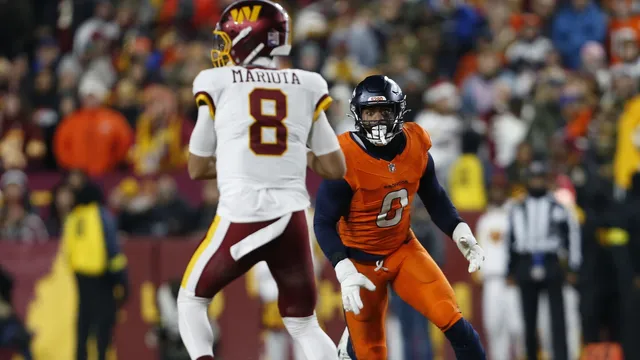
Denver Broncos secure dramatic overtime victory against Washington Commanders
Denver Broncos secure dramatic overtime victory against Washington Commanders
- The Denver Broncos faced the Washington Commanders in Week 13 of the NFL season on November 30, 2025.
- The game ended with the Broncos winning 27-26 in an overtime thriller.
- Denver's strong overall performance secures their position as a top contender in the AFC.
Story
In the United States, on November 30, 2025, the Denver Broncos faced off against the Washington Commanders in an intensely competitive NFL matchup. The game, held at Northwest Stadium, featured both teams battling their current season challenges. The Broncos entered the game with a 9-2 record and an eight-game winning streak, showcasing a powerful defensive line that has dominated the season, leading the league with 49 sacks. Their offense, commanded by quarterback Bo Nix, aimed to maintain momentum against a struggling Washington team, which despite its potential, had lost six consecutive games, coming in with a 3-8 record. Throughout the game, both teams exchanged leads with Denver starting strong. Bo Nix completed 29 of 45 passes, throwing for 321 yards, a touchdown, and an interception. The first half saw key plays from receivers, including a notable touchdown from Courtland Sutton, giving Denver an early edge. The Commanders, however, responded well; Marcus Mariota, the starting quarterback, found success with a mix of short and deep passes, including a touchdown connection with Treylon Burks that momentarily shifted the lead in favor of Washington. The game intensified in the second half, with Denver reclaiming the lead and Washington tying the game late in the fourth quarter with a field goal courtesy of Bobby Wagner’s interception. This set the stage for an intense overtime session where Denver managed to score another touchdown. However, the Commanders were also able to answer back, thanks to a fourth-down touchdown from Mariota to McNichols, preceding a critical two-point conversion attempt. Despite a valiant effort, the pass was broken up by Denver's Nik Bonitto, preserving the Broncos' lead and sealing the victory. With this win, Denver improved to a 10-2 record, achieving the No. 1 seed in the AFC at that moment, while the Commanders continued to struggle, marking their seventh consecutive loss and raising concerns about their overall season performance. The Broncos were set to face the Las Vegas Raiders, while Washington looked to regain some momentum against the Minnesota Vikings in the following weeks. The game underscored the critical moments of strategy and execution that define the high stakes of NFL football, especially as the playoff picture began to take shape, highlighting the importance of strong performances in December as teams strive for post-season success.
Context
In the National Football League (NFL), the overtime rules are designed to determine the outcome of a game that ends in a tie at the end of regulation time. The primary aim of these rules is to ensure a fair and competitive resolution while maintaining the safety of the players. Since their introduction, the overtime rules have undergone several adjustments, notably focusing on the concepts of possession and scoring potential. The current rules, which were implemented in 2012 for regular season games, stipulate that each team has the opportunity to possess the ball at least once unless the first team with the ball scores a touchdown. If a touchdown is scored on the opening drive, the game ends immediately, awarding victory to that team. Conversely, if the first possession results in a field goal, the opposing team will have a chance to possess the ball and can either equalize the score or win outright by scoring a touchdown. The overall structure of overtime consists of one 10-minute period, where the game is played under sudden death conditions after initial possessions. This means that if the score remains tied at the end of the standard overtime period, the outcome is deemed a tie during regular season games. In playoff scenarios, overtime periods are played until a winner is determined, and if the first overtime period ends without a winner, additional 15-minute periods are played until one team emerges victorious. This adjustment emphasizes the importance of player endurance and strategy, as teams must be prepared to play for an extended period if necessary. Since the establishment of the current rules, various factors have influenced public opinion and the effectiveness of the overtime format. Critics have pointed out potential disparities arising from the coin toss, which determines which team will receive the ball first. This element can significantly impact a team's chances of winning, particularly if weather conditions or overall game momentum favor one team over another. In response, the NFL has considered various proposals to modify the rules further, aiming for a balance between fairness and the excitement of sudden death play. Ultimately, the evolution of NFL overtime rules reflects a continuous effort to enhance the game’s integrity, excitement, and fairness. Understanding these rules is crucial for players, coaches, and fans alike, as they can have dramatic implications for playoff positioning, team morale, and overall game dynamics. As the league continues to adapt and evolve, the ongoing discussions and evaluations surrounding overtime rules will likely persist, ensuring the league remains responsive to the needs of the game and its stakeholders.


