

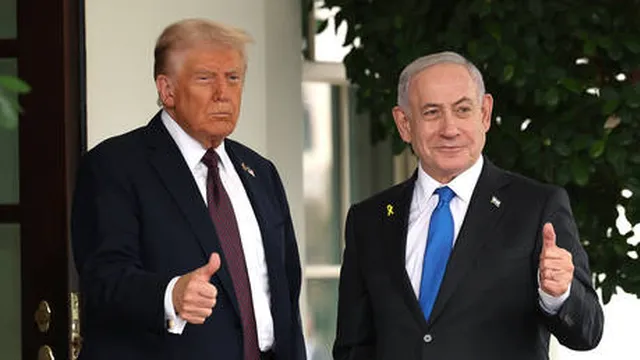
Trump redefines ceasefire amid ongoing Middle East conflicts
Trump redefines ceasefire amid ongoing Middle East conflicts
- U.S. President Donald Trump stated that ceasefire in the Middle East does not mean complete cessation of hostilities.
- Recent military exchanges have resulted in significant casualties, including over 3,400 deaths in Iran and numerous civilian casualties in Lebanon.
- The ongoing violence raises questions about the effectiveness and meaning of ceasefire agreements in the region.
Story
In the context of ongoing military exchanges in the Middle East, U.S. President Donald Trump has redefined the concept of ceasefire, suggesting that it does not necessarily imply a complete halt to hostilities. This statement came after U.S. forces targeted an Iranian tanker, which led to retaliatory missile and drone attacks from Iran on U.S. bases in Kuwait. The situation escalated with U.S. airstrikes on Iran's Qeshm Island, which Trump characterized as self-defense. He emphasized that in this region, a ceasefire could mean engaging in 'moderate' exchanges of fire rather than a total cessation of violence. The conflict has resulted in significant casualties, with reports indicating over 3,400 deaths in Iran due to American and Israeli strikes prior to a truce announced on April 7. The U.S. military reported 13 service members killed and over 300 injured, alongside civilian casualties in Arab states hosting U.S. bases. Despite the extension of a conditional ceasefire framework with Iran and a separate truce in Lebanon, hostilities have persisted, raising questions about the effectiveness and meaning of ceasefire agreements in the region. In Lebanon, Israeli attacks have reportedly killed at least 3,516 civilians since March 2, with over 1,100 deaths occurring since the ceasefire was announced. The Lebanese government has accused Israel of violating ceasefire terms, while Hezbollah, which is not part of the ceasefire negotiations, continues to engage in hostilities against Israel. The situation is further complicated by Israeli Prime Minister Benjamin Netanyahu's desire to increase control over Gaza, despite existing agreements that stipulate military withdrawal. Analysts have pointed out that the term 'ceasefire' has lost its operational meaning in the context of ongoing violence, as both Israel and Hamas accuse each other of breaching agreements. The United Nations has noted the absence of a universally accepted definition of ceasefire, which typically outlines permitted and prohibited military activities. The ongoing conflict and the ambiguous nature of ceasefire agreements highlight the complexities of achieving lasting peace in the Middle East, where military actions continue under the guise of ceasefire agreements.
Context
strategic analysis strategic geopolitical insight shift global global global global shift policy shift market strategic trends geopolitical analysis impact economic geopolitical geopolitical trends economic economic strategic insight insight shift shift insight geopolitical policy shift impact impact policy policy economic shift impact market shift trends global global geopolitical trends insight market policy analysis shift analysis impact economic economic market economic insight policy geopolitical strategic shift market economic global impact economic policy strategic strategic analysis market strategic trends market analysis policy economic...


