

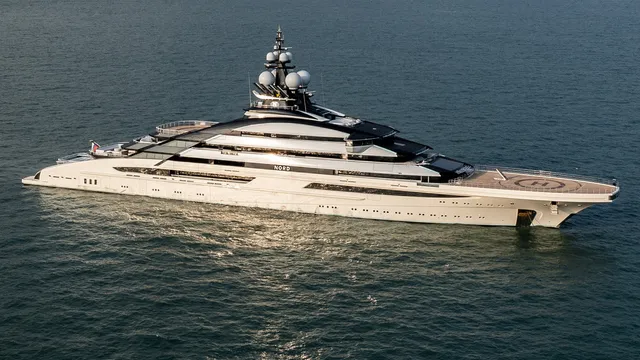
Superyacht sails through tense Strait of Hormuz amid blockade
Superyacht sails through tense Strait of Hormuz amid blockade
- The Nord, a luxury yacht connected to sanctioned billionaire Alexey Mordashov, sailed from Dubai to Muscat, Oman.
- The yacht's passage through the Strait of Hormuz occurred amidst heightened tensions and a blockade imposed by Iran.
- The voyage highlights the ongoing geopolitical complexities and the strategic partnership between Russia and Iran.
Story
In April 2026, the superyacht Nord, linked to Russian billionaire Alexey Mordashov, successfully navigated through the Strait of Hormuz, a critical waterway connecting the Persian Gulf to the Gulf of Oman. The yacht departed from Dubai and reached Muscat, Oman over the weekend, making it one of the few private vessels to traverse this maritime channel since the escalating conflict between the U.S. and its allies against Iran began. The incident occurred amid heightened tensions in the region, owing to Iran's blockade that was enforced against foreign vessels seen as potentially hostile. The Strait of Hormuz is crucial as approximately one-fifth of global crude oil and liquefied natural gas transportation passes through it. Currently, maritime traffic is significantly reduced compared to pre-war levels, impacting global energy markets and leading to fluctuating oil prices. Historically, the Strait has been a hotspot for strategic military interests, and recent incidents report that several ships have come under attack while navigating these waters, further complicating efforts to maintain a safe passage. Mordashov, believed to possess a net worth nearing $37 billion, has faced sanctions over his connections to Russian President Vladimir Putin, particularly following the full-scale invasion of Ukraine in 2022. The Nord yacht is reportedly valued at over $500 million, although Mordashov is not the official owner; prior records indicate it was registered under a company owned by his wife. Nevertheless, the yacht's passage underscores the continuing close ties between Russia and Iran amidst diplomatic standoffs with the United States. As tensions continue to simmer, Iran's diplomatic focus has shifted towards strengthening its strategic partnership with Russia. Recent engagements highlighted a significant meeting between Iranian Foreign Minister Abbas Araghchi and President Putin, where they discussed their mutual cooperation and military ties. Furthermore, the Kremlin indicated that it is willing to facilitate potential negotiations between the U.S. and Iran, given the evolving geopolitical landscape. This backdrop of strategic alliance and looming military threats presents a challenging environment for international shipping and energy supplies in the region.
Context
The impact of the Iran blockade on global oil prices is a multifaceted issue that has reverberated through the international energy markets. The blockade, which has seen various sanctions imposed on Iran due to its nuclear program and other geopolitical tensions, has resulted in significant constraints on the country's ability to produce and export oil. As one of the world's largest oil producers, Iran's reduced oil output not only affects its domestic economy but also has far-reaching implications for global oil prices and supply dynamics. The removal of Iranian oil from the market, which averaged millions of barrels a day pre-sanctions, has contributed to tighter supply conditions, ultimately driving prices upward in times of high global demand, particularly during geopolitical crises or when natural disasters impact production in other key oil-producing regions. In addition to supply constraints, the Iran blockade has led to increased volatility in oil prices due to market speculation and concerns about potential escalations in geopolitical conflicts. Traders closely monitor developments related to the blockade, and any news of negotiations, military actions, or shifts in international relations can lead to dramatic fluctuations in oil prices. This speculative trading, combined with the actual supply limitations caused by the blockade, has created an environment where oil prices can rise sharply on fears of further supply disruptions, or alternatively, fall if diplomatic resolutions appear to be on the horizon. Furthermore, the blockade has prompted countries that traditionally relied on Iranian oil to seek alternative sources, which has altered the flow of global oil trade. Nations such as China and India, who were significant importers of Iranian oil, have turned to other suppliers in the Middle East and beyond. This diversification of oil sources can mitigate risks for importing countries but can also create dependence on less stable regions. Consequently, any changes in the stability or production levels of these alternative sources can also have a cascading effect on global oil prices. The participation of OPEC, especially Saudi Arabia's role in balancing output to stabilize prices, further adds complexity to the situation. In conclusion, the ongoing Iran blockade continues to shape global oil markets significantly. The blockade exemplifies how geopolitical tensions can disrupt not only national economies but also the intricate web of international commerce that governs oil prices. As the situation evolves, it will remain essential for market participants, governments, and consumers to monitor the developments closely, as the implications of the blockade will likely persist. The interconnectedness of global oil markets means that any shifts will be felt well beyond the borders of Iran, influencing pricing and supply chains worldwide.


