

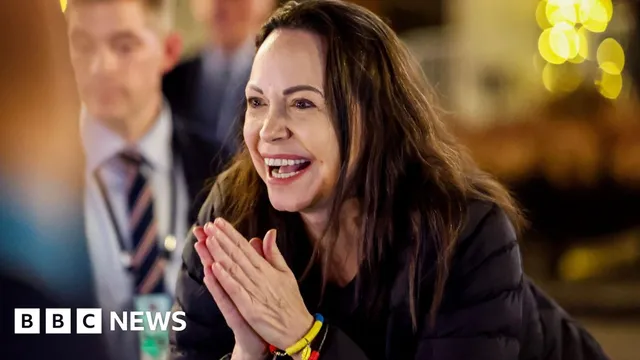
Maria Corina Machado escapes Venezuela with US assistance
Maria Corina Machado escapes Venezuela with US assistance
- Maria Corina Machado successfully escaped from Venezuela, navigating through ten military checkpoints disguised as a precaution against being captured.
- Her journey took her from Caracas to Norway, where she was awarded the Nobel Peace Prize, with significant assistance from the US government.
- Machado's escape underscores the ongoing struggle for democracy in Venezuela and her commitment to returning home when conditions allow.
Story
Maria Corina Machado, a prominent opposition leader in Venezuela, undertook a daring escape from her home country due to persistent threats against her life. Facing political repression after a controversial presidential election that resulted in Nicolas Maduro's victory, she was forced to live in hiding for over a year. Recently, she confirmed that she successfully traversed through ten military checkpoints disguised with a wig during a perilous three-day journey to Norway, where she was set to receive the Nobel Peace Prize. The first leg of her journey commenced from a secret location in Caracas, taking ten arduous hours to a coastal village. It was at this point that she and her two companions made arrangements with the US military for protection during their escape, highlighting the dangerous context surrounding her departure. The situation was exacerbated by recent strikes on what the US labeled as 'narcoterrorists', creating chaos in the region. After reaching the Caribbean, Machado and her team used a wooden fishing boat to travel to Curacao, facing strong currents and high winds. US Navy F-18s provided air support, ensuring their safety until they reached the island. Upon arrival, they were met by a private contractor affiliated with the Trump administration, who facilitated her transport to Norway via executive jet. The journey marked Machado’s first public appearance in years, as she aimed to shed light on the broader struggle for democracy and freedom in Venezuela. In her emotional return to Norway, where she reunited with family members she hadn’t seen for two years, Machado promised to share the stories of those who helped her escape while remaining cautious about exposing their identities. Despite being in a safer environment, Machado's next steps are uncertain, as she expressed a desire to return to Venezuela 'when the time is right', irrespective of Maduro's presence.
Context
The situation in Venezuela under Nicolas Maduro's leadership has been characterized by significant political, economic, and social turmoil. Since Maduro assumed the presidency in 2013, the country has experienced a severe economic crisis, primarily driven by a sharp decline in oil prices, which significantly impacted a nation that is heavily reliant on oil exports. Hyperinflation, which reached staggering levels, has led to a dramatic devaluation of the national currency, resulting in widespread scarcity of basic goods, medicines, and food. This economic collapse has disproportionately affected the Venezuelan population, leading to a humanitarian crisis where millions struggle to meet their daily needs, significantly increasing malnutrition and health issues across the country. In response to these challenges, many Venezuelans have fled the country, seeking refuge in neighboring nations and contributing to a regional migration crisis that still reverberates through Latin America. Politically, the Maduro government has faced immense opposition from both internal and external fronts. Domestically, various factions, including the opposition-controlled National Assembly, have accused Maduro of authoritarian practices, stifling dissent, and undermining democratic institutions through electoral irregularities and repression of political opponents. The government's efforts to consolidate power have led to widespread protests and civil unrest, with security forces often responding with violent crackdowns on demonstrators. Internationally, the Maduro administration has been met with sanctions from the United States, the European Union, and other countries, which aim to pressure the regime to restore democratic processes and respect human rights. However, these sanctions have paradoxically exacerbated the suffering of ordinary Venezuelans, further isolating the nation and complicating the crisis. Amidst these challenging circumstances, the Venezuelan government continues to navigate its relationships with global allies, particularly Russia and China, who have provided financial and political support. This geopolitical context adds complexity to Venezuela's situation, as it remains tied to broader international dynamics and reflects a struggle for influence in the region. Moreover, the government has maintained its narrative of external threats, often attributing the nation's woes to foreign meddling and sanctions, which helps to bolster internal support among its base. Nonetheless, the sustained pressure from both domestic and international actors indicates an ongoing struggle that could lead to changes in governance in the future. Ultimately, the situation in Venezuela under Maduro remains dire, marked by a confluence of economic collapse, political suppression, and humanitarian struggle. The international community continues to watch closely, as solutions or strategies for resolving the crisis remain elusive amidst deep-seated divisions within the country and a fractured opposition. As the crisis unfolds, the health and welfare of the Venezuelan people remain at the forefront, highlighting the urgent need for effective intervention and support to address the significant challenges faced by the nation.


