

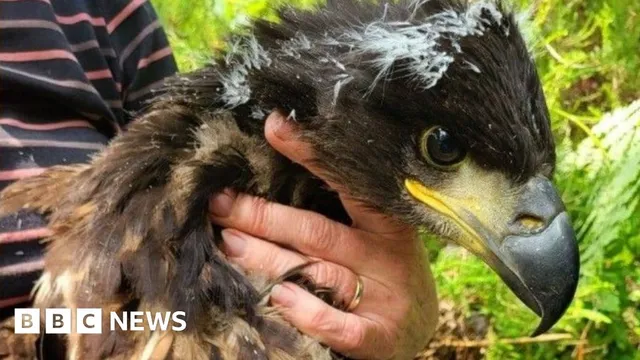
Aspen completes remarkable journey across Ireland
Aspen completes remarkable journey across Ireland
- Aspen, a white-tailed eagle from County Cork, began her journey on March 22, 2026.
- She traveled through various regions of Ireland before returning to Munster, monitored by a satellite tracker.
- Her journey captivates the public and highlights ongoing conservation efforts for the species' reintroduction.
Story
In March 2026, a white-tailed eagle named Aspen, hatched in Glengarriff Nature Reserve in County Cork, began an extraordinary journey across Ireland. Over the following seven weeks, a satellite tracker monitored her movements, revealing an extensive route through Leinster, Ulster, and Connaught before returning to her birthplace in Munster. This remarkable flight pattern captivated the attention of ecologists and the public alike, highlighting her adventurous spirit discovered during her early fledgling days. Aspen's journey has significant implications for the reintroduction efforts of the white-tailed eagle species in Ireland. Since the initiation of the white-tailed eagle reintroduction program in 2007, the National Parks and Wildlife Service (NPWS) has monitored countless eagles, with more than 90 currently under observation by ecologist Clare Heardman. Heardman expressed a unique bond with Aspen, given that she tagged Aspen when she was just eight weeks old. Aspen exhibited an instinct for exploration early on, completing a large loop of Munster on her first solo flight, indicating the adventurous nature typical of her kind. This relationship further deepens due to Aspen's origins, as she is the offspring of a local breeding pair that Heardman has witnessed grow from chicks. Aspen's movements attracted public interest after they were shared on social media, demonstrating how people are engaging with wildlife and conservation efforts. Dr. Eimear Rooney from the Northern Ireland Raptor Study Group noted that while Aspen's movements align with typical behavior observed in white-tailed eagles during this season, the sight of their expansive range remains a remarkable occurrence. These eagles often utilize warm air currents to travel vast distances, feeding on carrion that leads them inland and to higher ground. Observing Aspen's circling around Donegal suggests she was likely scavenging for food during that period. As eagles continue to establish themselves in various locales across Ireland, understanding their migratory and feeding behaviors is key for ongoing conservation efforts. The successful breeding of white-tailed eagles witnessed in various locations, including County Fermanagh, where a pair bred for the first time in Northern Ireland in over 150 years, signifies positive outcomes from the reintroduction initiatives. Nevertheless, alongside the conservation progress come challenges such as illegal poisoning and exposure to bird flu. Such dangers underscore the unpredictability of wildlife management and the responsibility shared among conservationists and the public to protect these majestic birds. As Aspen's engaging journey draws attention to the noble efforts being made to restore white-tailed eagles in Ireland, it serves as an educational opportunity for all, inspiring an appreciation for the intricacies of wildlife reintroduction and the importance of safeguarding vulnerable species. As of now, the situation surrounding Aspen and her fellow eagles remains dynamic and serves as a reminder that ongoing efforts in wildlife preservation must evolve to accommodate changing circumstances while reflecting on the successes achieved thus far.
Context
The history of white-tailed eagles in Ireland presents a remarkable narrative of conservation, decline, and recovery. Once widespread across the island, these majestic birds of prey faced severe declines due to habitat loss, persecution, and the impacts of human activities, leading to their extinction in Ireland by the early 20th century. The last recorded breeding attempt occurred in 1910 in County Kerry, marking the end of an era for a species that had roamed the skies of Ireland for centuries. Historical records indicate that these eagles were revered in folklore and were a vital part of the ecosystem, primarily feeding on fish and carrion. Their absence was a significant loss for biodiversity in Ireland, prompting future conservation efforts that would ultimately seek to reintroduce the species and restore its ecological role in the habitat. The white-tailed eagle reintroduction program in Ireland began in the early 2000s, spearheaded by the Irish National Parks and Wildlife Service, in collaboration with various conservation organizations. In 2007, a small group of eagles was brought over from Norway, successfully marking the start of a long-term effort to re-establish a breeding population in areas where they were historically prevalent. The release of these birds occurred primarily in County Kerry, with additional sites selected in other suitable habitats. The project aimed not only to restore the species but also to raise awareness about wildlife conservation among the local communities. Initial challenges included the necessity of public engagement, ensuring the eagles could adapt to their new surroundings, and mitigating human-wildlife conflict. Over the following years, the white-tailed eagle population in Ireland saw gradual growth, bolstered by the protective measures in place. By 2023, the numbers increased sufficiently for the species to be observed breeding successfully in the wild again. The significant adaptive behaviors demonstrated by these eagles highlighted their resilience and ability to thrive in the reintroduced habitats. Conservationists have actively monitored the eagle population, gathering data on their breeding success, survival rates, and overall health. Education programs worked simultaneously to inform local communities about the importance of protecting these birds, leading to a cultural renaissance where the white-tailed eagle symbolizes both natural heritage and conservation success. Today, white-tailed eagles in Ireland represent a dynamic story of recovery. Awareness of the species has grown, and they are becoming a regular sight in some of Ireland's most picturesque coastal landscapes. Ongoing conservation efforts continue to focus on habitat management, mitigating human disturbances, and fostering a cooperative relationship between the eagles and local communities. The return of the white-tailed eagle not only enhances Ireland’s biodiversity but also serves as a powerful example of how concerted conservation efforts can lead to successful outcomes, offering hope for the restoration of other species that face similar threats.


