

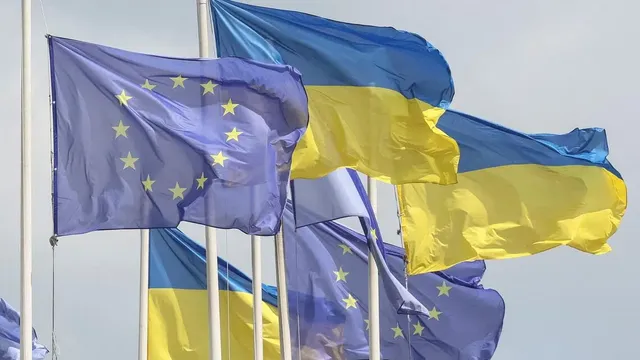
EU commissioner insists Ukraine's membership is inevitable despite Hungarian objections
EU commissioner insists Ukraine's membership is inevitable despite Hungarian objections
- Ukraine applied for EU membership in 2022 amid ongoing conflict with Russia.
- Marta Kos reassures that Hungary's objections will not block Ukraine's accession process.
- The EU is committed to advancing Ukraine's membership, emphasizing necessary reforms and future cooperation.
Story
Ukraine's ambition to join the European Union has intensified, particularly following its application in 2022 amid Russia's ongoing full-scale invasion. EU enlargement chief Marta Kos expressed strong confidence that Hungary would not impede this process, labeling Ukraine's accession as 'inevitable.' Kos emphasized the absence of war within EU territory as a foundational aspect of security guarantees. Discussions around Ukraine's EU membership highlighted the necessity for significant reforms, with the EU providing a comprehensive list to facilitate this process while Hungary remains resistant due to concerns related to its minority population in Ukraine and broader economic implications. Additionally, the EU’s recent efforts in Lviv aimed at bypassing the Hungarian objections showcase a cohesive support among the majority of EU member states for Ukraine's bid. Kos addressed the ongoing war in Ukraine, labeling reforms as pivotal and stating that they could proceed independently of Hungary. Despite Hungarian Prime Minister Viktor Orbán's hesitance to advance talks during wartime, Kos reassured that the necessary reforms could continue. Cyprus, set to assume the rotating EU presidency, also pledged to support Ukraine’s membership goals. Significantly, Ukraine's potential EU membership holds broader geopolitical weight. If admitted, Ukraine would become the largest EU member by land area, surpassing France, while also acting as a bulwark against Russian influence, further underpinning EU values of democracy, human rights, and security. The reform process involves aligning Ukraine's systems with EU standards, necessitating cooperation and consistency from Ukrainian leadership, particularly in light of a recent corruption scandal that has placed rule-of-law reforms at the forefront. As negotiations proceed, calls for solidarity and unity within the EU remain strong, with Kos indicating that the path forward involves both clear guidelines and the unwavering commitment of the Ukrainian populace. By maintaining a steady pace in implementing the listed reforms, Ukraine can strengthen its position in the ongoing discussions related to EU accession, fostering hope for eventual membership and reinforcing the strategic importance of the country in the European landscape.
Context
The timeline of Ukraine's EU membership is a crucial aspect of the country's geopolitical strategy and aspirations for integration into European structures. Following its independence in 1991, Ukraine pursued a variety of foreign policy directions, oscillating between closer ties with European institutions and aligning itself with Russia. The pivotal moment came in 2014, when Russia annexed Crimea and conflict erupted in Eastern Ukraine. This act galvanized Ukraine's commitment to deepening its relationship with the European Union, evidenced by the signing of the Association Agreement in 2014, which aimed to foster economic integration and political association with the EU. In subsequent years, Ukraine took significant steps to align its legislation and reforms with EU standards, focusing on governance, human rights, and anti-corruption measures. The 2019 presidential election, which brought Volodymyr Zelensky to power, underscored the public's desire for a pro-European course, with Zelensky campaigning on a platform that promised further integration with the EU. Ukraine's aspirations were formally recognized with candidate status granted in June 2022, marking a substantial step forward in its EU membership application. As Ukraine progressed toward EU membership, the ongoing conflict with Russia continued to influence its candidacy. The EU provided political support and financial assistance to bolster Ukraine’s economy and defense capabilities. In June 2023, the European Commission assessed Ukraine's reforms and suggested that the country sufficiently met the criteria to begin the accession process. This led to the launch of the negotiations for full EU membership, with Ukraine working to satisfy the comprehensive reforms outlined by the European Council. By late 2025, Ukraine was engaged in intensive negotiations with EU officials, addressing key challenges such as judicial reforms, economic stability, and public administration. The timelines for membership were dynamic, responsive to both advancements in Ukraine’s domestic reforms and external geopolitical developments. Overall, Ukraine's pathway to EU membership exemplifies the interplay of domestic aspirations and regional security dynamics, making it a pivotal aspect of Europe's future and the broader East-West geopolitical landscape.


