

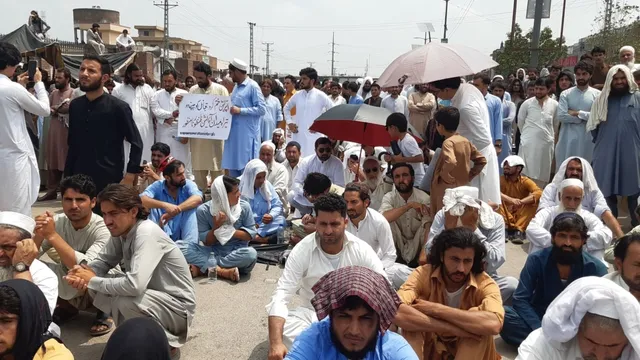
Thousands flee Tirah Valley as Pakistan prepares military operation
Thousands flee Tirah Valley as Pakistan prepares military operation
- More than 80,000 residents of Tirah Valley have evacuated due to fears of a military operation against the Tehrik-e-Taliban Pakistan.
- Harsh weather conditions are also contributing to the mass migration, exacerbating food shortages and uncertainty.
- This situation highlights a long history of forced displacement in the region, raising questions about the effectiveness of military solutions.
Story
In Khyber Pakhtunkhwa Province, Pakistan, over 80,000 residents have evacuated Tirah Valley fearing an impending military operation against the Tehrik-e-Taliban Pakistan. The army has set a January 25 deadline for evacuation, leading to a mass exodus of predominantly women and children, who have traveled in overloaded vehicles to reach safer areas such as Peshawar. Many fleeing families have previously experienced displacement due to ongoing military actions in the region, which has faced numerous operations since the US-led invasion of Afghanistan began in 2001. Residents like Saeed Khan expressed concerns over stating, 'Everything was destroyed,' showcasing the devastating impact of years of military conflict in the area. The harsh winter conditions fell alongside the uncertainty surrounding military actions, further exacerbating their plight. Local officials, including Khyber Pakhtunkhwa Chief Minister Suhail Afridi, criticized the federal government for their handling of the situation, asserting that the military should not pursue a full-scale operation amid such dire circumstances. The Provincial Government has pointed out that the harsh weather, rather than the military actions themselves, caused the mass migrations, although residents have indicated that the fear of violence prompted their departure. This is not the first instance of forced displacement for many families, with significant numbers having been evacuated in the past due to similar operations, leaving them doubting whether the new military campaign will indeed resolve the issues of militancy or if they will find themselves returning to the same conditions after the army’s withdrawal. This situation in Tirah highlights the long-standing conflict in the region that has persisted for two decades. With the Pakistani military citing the need for intelligence-based operations against the militants that have gained strength following the Afghan Taliban's resurgence, local communities remain caught in the crossfire. Moreover, the rise in violence is underscored by reports from the Pakistan Institute for Conflict and Security Studies, which indicated a marked increase in combat-related fatalities, adding a tragic dimension to the ongoing situation in this beleaguered part of Pakistan.
Context
The history of military operations in Khyber Pakhtunkhwa is deeply intertwined with the region's complex socio-political dynamics and geographical significance. Khyber Pakhtunkhwa, situated in northwestern Pakistan, has historically been a frontline territory involving various military campaigns and operations due to its proximity to Afghanistan and its diverse tribal structure. This region played a critical role during the Afghan-Soviet War in the 1980s, where military operations included support for Afghan mujahideen and the establishment of strategic military bases to counter Soviet advances. The inherent tribal customs and the Pashtunwali code have significantly influenced the operations and interactions between state forces and local communities, presenting unique challenges for military strategy and implementation. In the post-9/11 era, Khyber Pakhtunkhwa emerged as a central focus of military operations in Pakistan, particularly in response to rising militancy and the Taliban's influence in the region. Operations such as 'Operation Al-Mizan' in 2002 and subsequent operations like 'Operation Rah-e-Rast' in 2009 aimed to cleanse the region of militant groups that had taken refuge in the border areas. The military faced fierce resistance in these operations, as local levels of loyalty to traditional structures often conflicted with state authority. Notably, the integration of modern military tactics, intelligence operations, and local civilian engagement formed the backbone of efforts to stabilize the region amidst ongoing turbulence. The military's approach in Khyber Pakhtunkhwa evolved over time, especially after the establishment of the National Action Plan in 2014, which sought a comprehensive strategy against terrorism. Operations were not solely focused on military solutions; they also emphasized the importance of governance, developmental projects, and counter-radicalization measures aimed at addressing the root causes of militancy. A combination of strong military action complemented by socio-economic development initiatives became crucial in rebuilding trust between the state and local populations that had suffered from prolonged violence. Despite progress, Khyber Pakhtunkhwa remains a nuanced landscape of security challenges. The recent resurgence of the Tehrik-i-Taliban Pakistan (TTP) underscores the ongoing volatility in the region, necessitating continued military vigilance and adaptation. The lessons learned from past operations underscore a significant understanding that military endeavors in Khyber Pakhtunkhwa require a multidimensional approach, addressing not only immediate security concerns but also long-term stability through engagement with tribal structures and comprehensive regional development initiatives.


