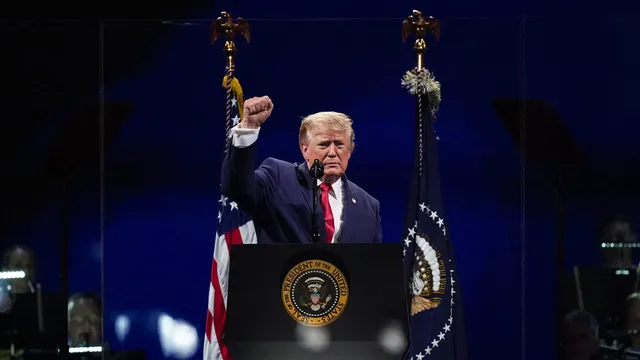
On July 4, 2026, Donald Trump, the 47th president of the United States, addressed Americans from Mount Rushmore, commemorating the 250th anniversary of the Declaration of Independence. This event was part of the Freedom 250 celebrations, which were organized by the White House and aimed to be the largest birthday party in U.S. history. Trump spoke beneath the iconic granite faces of George Washington, Thomas Jefferson, Abraham Lincoln, and Theodore Roosevelt, while military tributes, flyovers, and a fireworks display were also scheduled at the South Dakota landmark. This marked Trump's return to Mount Rushmore six years after his previous appearance in 2020, which had drawn protests from Native American activists and criticism regarding crowding during the COVID-19 pandemic.
The return of fireworks to Mount Rushmore raised environmental and wildfire concerns, especially as much of the U.S. was experiencing a record heat wave that disrupted July Fourth events in various locations. While the weather forecast for Mount Rushmore was cooler, critics warned against holding a large pyrotechnic display in the Black Hills region due to ongoing drought and fire risks. White House press secretary Karoline Leavitt previewed Trump's address as a response to the question of what it means to be an American, framing it as a defense of living in the greatest country in history.
Despite the celebratory atmosphere, a recent Gallup poll indicated that only 58% of U.S. adults felt extremely or very proud to be American, the lowest level recorded since 2001. Other polling suggested that many Americans were not planning to celebrate July 4 this year, and there were concerns about the festivities being too closely associated with Trump personally rather than serving as a bipartisan national commemoration. In Washington, D.C., celebrations continued with a large 'Salute to America' event, military flyovers, and a record-scale fireworks show.
Trump's speech also included honoring veterans, including World War II veterans and one of the first Black officers to lead a Special Forces team in combat in Vietnam. He reiterated his support for the SAVE America Act, an elections bill facing challenges even from fellow Republicans, and emphasized his support for the Second Amendment while denouncing communism, which has become a central theme in his messaging ahead of the upcoming midterm elections. The event was organized by groups aligned with the White House, replacing a bipartisan organization that had been established by Congress a decade earlier.