

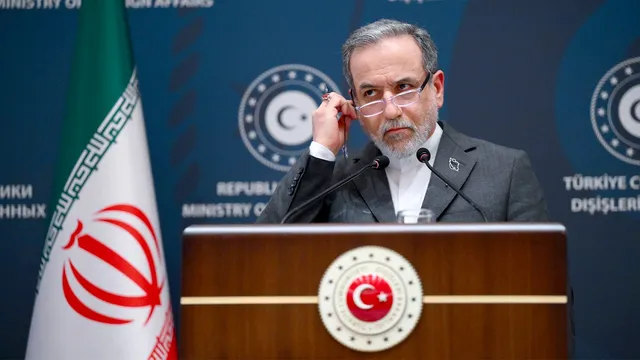
Iran vows to resist pressure from great powers amid nuclear negotiations
Iran vows to resist pressure from great powers amid nuclear negotiations
- Iran's Foreign Minister Abbas Araghchi reaffirmed Tehran's commitment to enriching uranium amidst U.S. pressure.
- During recent talks in Oman, Araghchi articulated that Iran's power lies in resisting external dominance.
- The situation underscores the delicate balance between Iran's pursuit of diplomatic discussions and its readiness to defend against threats.
Story
In Dubai, United Arab Emirates, Iran's Foreign Minister Abbas Araghchi articulated the Islamic Republic's stance during a summit. He emphasized Tehran's resolute position in negotiations with the United States, highlighting that Iran's strength comes from its capacity to say 'no' to what he referred to as 'great powers.' This declaration came in the wake of discussions held recently in Oman regarding Iran's nuclear program, amidst rising tensions. The U.S. has shown its military presence by dispatching significant naval assets to the region, amplifying the pressure on Iran to comply with Western demands concerning its uranium enrichment activities. During his speech, Araghchi underscored that Iran views its nuclear program as a legitimate right and is determined to defend this position against ongoing external pressures. He poignantly declared, 'They fear our atomic bomb, while we are not pursuing an atomic bomb. Our atomic bomb is the power to say no to the great powers.' This rhetoric suggests a commitment to maintain Iran's nuclear capabilities, which have become a focal point in international relations, particularly with the U.S. The Iranian leadership has historically claimed that their nuclear ambitions are peaceful, despite skepticism from the West and various accusations of a military agenda. The backdrop of Araghchi's remarks includes heightened national tensions and recent protests within Iran. Iranian President Masoud Pezeshkian regarded the negotiations with the Americans positively, describing them as a 'step forward' in finding a diplomatic resolution. However, Araghchi's words reveal the complexities of these negotiations, illustrating an intrinsic contradiction of seeking dialogue while simultaneously preparing for conflict should negotiations falter. His assertion reflects a dual approach, acknowledging that while Iran aims for peaceful diplomacy, it remains vigilant and ready to defend its national interests. The geopolitical landscape is influenced further by American military maneuvers. The U.S. has positioned naval assets, including aircraft carriers and destroyers, around key waterways near Iran, which serves to enhance leverage in negotiations but also raises the stakes for potential military engagements. The deployed forces represent a tangible reminder of the pressure Iran faces from the U.S. and its allies. While President Donald Trump has expressed a desire for a deal, the continued military readiness suggests a nuanced strategy, combining diplomatic efforts with a display of force that complicates the dialogue between the two nations.
Context
Negotiations surrounding the Iran nuclear program have been a focal point of international relations for many years, evolving through various phases since the early 2000s. The core aim of these negotiations is to curtail Iran's potential development of nuclear weapons while allowing the nation to pursue peaceful nuclear energy under strict regulations. The Joint Comprehensive Plan of Action (JCPOA), established in 2015, temporarily limited Iran's nuclear activities in exchange for lifting economic sanctions. However, following the U.S. withdrawal from the agreement in 2018, Iran gradually began to breach the terms of the JCPOA, restarting enrichment activities and expanding its nuclear capabilities, which led to heightened tensions in the region and among global powers. Consequently, renewed diplomatic efforts have aimed at reviving the JCPOA or formulating a new agreement that addresses the shortcomings of the original deal while ensuring compliance from Iran regarding its nuclear ambitions. In recent months leading up to February 2026, critical discussions have revolved around reinstating and modifying the JCPOA framework. Key stakeholders including the United States, Iran, and European Union nations have engaged in a series of negotiations, with significant involvement from China and Russia, as both nations have interests in maintaining stability and securing their positions in the region. While there have been intermittent breakthroughs, such as mutual understandings on sanctions relief and additional monitoring of Iran's nuclear site operations, major points of contention remain unresolved. These include the extent of sanctions relief that Iran demands in exchange for compliance and assurances on the long-term viability of its nuclear program for peaceful purposes. Furthermore, geopolitical dynamics have further complicated the negotiations. Ongoing regional rivalries, especially involving Iran's influence in Syria, Iraq, and its support for militant groups like Hezbollah, have led to skepticism from both sides. The U.S. and its allies perceive Iran's regional actions as destabilizing, contributing to the urgency of nuclear negotiations as a means to curb further military ambitions. Conversely, Iran views demands for regional behavior change as a precondition for nuclear discussions as unacceptable, insisting that its right to a peaceful nuclear program is non-negotiable. This standoff requires sensitive diplomacy, with each party needing to balance their strategic objectives with the potential consequences of failure to reach an agreement. As of early 2026, the status of talks remains delicate. The negotiating teams are expected to continue meeting to explore potential middle ground solutions that would balance Iran's nuclear rights with robust mechanisms for oversight, ensuring transparency and preventing military applications. Despite persistent challenges, both Iran and the international community recognize the profound implications that a nuclear-armed Iran could have on regional stability. Therefore, while the situation remains tense and progress is incremental, there is a continuing commitment to dialogue in hopes of reaching a diplomatic resolution that would secure peace and limit proliferation risks.


